He Recorded the Same Tutorial Three Times. Then He Stopped Teaching Catch-Up.
The third time I hit record on the same tutorial, I paused before I said anything. Same scheduling screen. Same software. Same five steps. I had now recorded this exact walkthrough in 2021, in 2023, and again this past spring because the interface had changed just enough to make the old videos useless.
Three videos. Five years. One screen nobody wanted to learn. They just wanted the thing done.
I sat there for a second and thought about every solo operator I know who has spent the last two years doing the same version of what I just did. Learning a workflow in March, watching it go stale by May, loading up a new course, starting over. Not because they're slow. Because the game they were playing was always going to punish them for playing it.
That third recording is what became the spine of The Anticipation Ladder. Not because the tutorial was important. Because it was the clearest possible proof that instructional content doesn't close execution gaps. Only execution closes execution gaps.
The book starts from a simple observation: AI capability has leveled off across every price tier. The eight-dollar model handles most of what most people need. The arms race ended in a tie. So if the engine is no longer the edge, the question becomes: where do you install it, and for whom, and in what order? That is a map problem, not a tool problem.
The Anticipation Ladder is that map. It classifies every AI product on earth into four rungs, shows exactly where consumer expectations are heading on a dated timeline, and turns the gap between where a business sits today and where it needs to be into something you can price and sell. The book has twenty predictions, each with a checkpoint date, and a public scorecard I grade live. I wanted something you could plan against, not just read and feel good about.

The Race Already Ended. Nobody Told the Exhausted People.
Chapter one makes the case plainly: intelligence became a utility bill. The lab with the biggest model no longer wins on model size, because the gap between models is now smaller than the price of lunch. What that means for a solo operator is almost the opposite of scary. The expensive part, knowing which client problem to point the tool at, is a skill that compounds. It does not get obsoleted by the next release. The book calls it the Law of AI: the differentiator is not the engine. It's knowing where to install it.
The differentiator is not the engine. It's knowing where to install it.

Four Rungs. Every AI Product Alive Sits on One of Them.
The Anticipation Ladder framework is the part of the book people dog-ear first. Every AI product on earth is either Reactive (answers when asked), Suggestive (proposes next moves), Anticipatory (prepares before you ask), or Delegated (asks if it can just handle it). The rung a business occupies is a number you can charge money to change. That gap, between where most businesses sit today and where customer expectations are about to land, is not a problem. It is a price list. The book builds that price list out in Part Three for a business of one.
That gap, between where the world's software sits and where the world's expectations are about to be, is not a tragedy. It's a price list.
The Do-It-For-Me Button Is Already Shipping. Someone Needs to Install It.
Chapter seven is the one that ended my tutorial career. The prediction is specific: a Do-It-For-Me button that executes instead of explains. Not a help article. Not a video walkthrough. A button that completes the task. Every piece of instructional content I have ever made was a workaround for that button not existing yet. It exists now. Which means the person who installs it, scopes it, and connects it to the right workflow owns a recurring service line that no amount of free video content can replace.
The Winning Assistant Is Not the Smartest One. It's the One That Knows You.
Chapter eight is the one that changes how you think about retention. Once an AI assistant has standing access to a person's calendar, email, and history, leaving it feels like moving house. The switching cost is made of relationship, not capability. For a service business, this is the most important idea in the book: the operators who build that kind of closeness with their clients first, using the tools on the ladder's upper rungs, create a moat that no cheaper competitor can undercut. Your voice, your opinions, and your relationships are the one input the machines cannot manufacture.
When intelligence is a commodity, the only scarce inputs left are the ones that were always scarce: your voice, your opinions, your relationships.

Twenty Predictions. Specific Dates. He Gets Graded in Public.
Every prediction in the book carries a checkpoint date. March 2027 or March 2028. There is a public scorecard and I update it when the dates arrive. That is the thing that made me want to write this differently than every other AI book I have read. A forecast without a grade is just a feeling. I wanted something you could open today, build an offer around, and check back on when the date lands. The people who read the map earlier win. That is not hype. It is just how timing works.
The people who lose over the next eighteen months won't lose to AI. They'll lose to somebody who read the map earlier.
What readers are saying
"Prediction 12 is the one that got me. Local businesses are bleeding money on missed calls and the $97 phone agent is the cleanest solution I've seen in a long time. Already talking to two clients about it."
— Sarah K."The do-it-for-me button in Prediction 10 is going to reshape software faster than most people realize. By March 2028 a product without that option is going to feel broken. Almost everyone will press it."
— Tyler J."Eighteen months from now the phone agent isn't going to be a nice-to-have. It's going to be the baseline expectation the same way having a website was fifteen years ago. Prediction 12 is going to age well."
— Marcus H.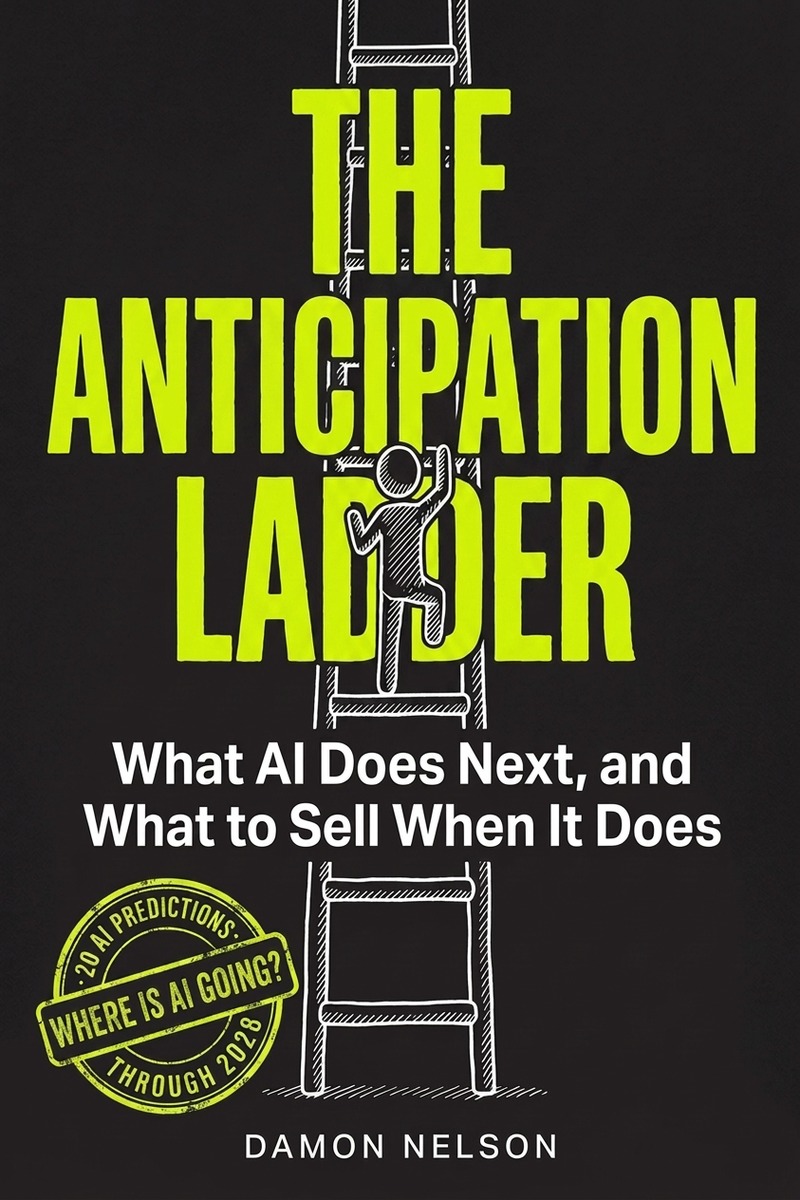
The Anticipation Ladder is one evening, maybe two. The introduction tells you where the map came from and why the predictions have dates on them. Part Three is where most readers go first: priced, sequenced offers for a business of one, built around specific rungs on the ladder. Audits, agent installs, content retrofits, each scoped to a checkpoint date so you can sell the service before the prediction lands, not after.
You do not need to be technical. The book's whole argument is that the technical edge already evened out. The skill it teaches is a marketing skill: which client, which bottleneck, which Tuesday-morning fumble. That is something you already know how to find. The book gives you the framework to price it.
If you have wanted to get ahead of this instead of catching up again, the link below is the place to start.
See It on AmazonQuestions people actually ask
By the time I read this, won't the predictions already be outdated?
Every prediction in the book has a specific checkpoint date: March 2027 or March 2028. There is a public scorecard the author grades live when each date arrives. A dated map you can plan against is the opposite of the 'AI will change everything someday' content that goes stale overnight. The dates are the point.
I've bought AI books before and they're all hype with no real playbook.
Part Three is nothing but priced, sequenced offers sized for a business of one. Audits, agent installs, content retrofits, each matched to a specific prediction. The test is simple: can you open it and build an offer before the first checkpoint date? If you can't, the public scorecard means you will know exactly when the map failed.
I'm not technical enough to sell AI services.
The book's core argument is that the technical edge is gone. Every shop has the same engine for roughly the price of lunch. The scarce skill is knowing which client, which bottleneck, which specific fumble to point the tools at. That is a marketing skill, not an engineering one, and it is what the playbook chapters teach.
My clients aren't asking for AI yet, so there might not be a market for this.
This is the one objection the book concedes in part. If your specific market is genuinely pre-awareness, some offers in Part Three won't land yet. The honest answer: the ladder helps you lead with the outcome your clients already want. A phone answered, a support ticket closed, a morning brief ready. Let the AI stay invisible, the way the book says winning products already work.
I don't have time to read another business book right now.
The introduction says plainly: this costs an evening or two. The predictions stand alone and are built to be dog-eared. You can go straight to Part Three and have a priced offer framework before you have read the whole thing. The ask is one evening, not a semester.
Will this still be relevant if a big new model drops the week after I read it?
That is exactly the trap the book is written to get you out of. The ladder framework is designed to classify any new product in one second, regardless of which lab shipped it. A new model is just a rung. The map does not change because a new traveler showed up.