The AI map with Damon's name on every prediction — and a public scorecard to prove it
You know that feeling in March when you finally got a workflow dialed in, and then by May the tool it ran on was already a footnote? That's not bad luck. That's the specific kind of exhaustion nobody warned you about — the kind that comes from staying curious and keeping up and still ending up behind.
The newsletters don't help. The tool roundups add noise. The keynotes leave you with seventeen tabs and zero invoices. And somewhere under all of it is a quiet question you don't say out loud: is staying current even the right strategy anymore?
I've been in this long enough to know the question is real. And I think the answer is no. Staying current on the tools stopped being a strategy the day the tools tied.
That's what I wrote The Anticipation Ladder to say plainly, and to prove with receipts. The premise is simple: AI capability has leveled across price tiers. 'Intelligence became a utility bill. Nobody sends a press release when something becomes a utility bill. It just quietly stops being the interesting part.' When the engine costs eight dollars a month and every shop on the block has it, the engine is not your edge.
What I built instead is a dated map of the next eighteen months — twenty specific predictions, each with a checkpoint date, graded by me in public on a scorecard I can't quietly delete. Paired with a four-rung framework called the Anticipation Ladder that lets you sort any AI headline in about one second. And a Part Three that's nothing but priced, sequenced offers a one-person shop can build and sell before the first checkpoint date arrives.
I know what you're thinking: another AI book with a framework and a promise. Fair. Here's the difference. Forecasters who won't be graded are just entertainers. My name is on every date.

The arms race already ended — and everybody got the weapons for eight dollars
A few years ago, the edge was access. Big budgets got big models. That's done. The open-weight models keep pushing the floor toward zero, and the eight-dollar tier handles most of what most people need. 'The differentiator is not the engine. It's knowing where to install it.' The Anticipation Ladder starts there — not with which model is best, but with which business problem you're pointing it at and which rung the business currently sits on.
The differentiator is not the engine. It's knowing where to install it.

One-to-many software is ending, and the transition is a paid service
For forty years, software treated every user like a stranger. Same screen, same flow, same answer. AI broke that. The same product now behaves differently for every person — remembering voice, habits, history. 'When intelligence is a commodity, the only scarce inputs left are the ones that were always scarce: your voice, your opinions, your relationships.' That shift from one-to-many to one-to-one is a rung change for every business that hasn't made it yet. Rung changes are billable.
When intelligence is a commodity, the only scarce inputs left are the ones that were always scarce: your voice, your opinions, your relationships.
There are two reputation markets now — you can only see one of them
Google rankings and AI answers overlap less than twenty percent of the time. The citation market (AI quotes you to humans) and the agent-recommendation market (AI recommends you to other AIs) run on different logic. 'Being number one on Google does not guarantee you a place in the AI answers.' Chapters 6 and 7 of the book map both markets and show what structured, useful content looks like to each one. That's a retro-fit service. It's already priced in Part Three.
The Do-It-For-Me button is rung four, and almost everyone presses it
Support agents used to teach users how to do things. The fourth rung skips the lesson entirely. 'Nobody ever wanted the training. They wanted the thing that the training produces.' When you hand someone a trustworthy button that just handles it, almost no one says no. Installing that button for a Main Street business — phone agent, support agent, morning brief — is the computer-guy moment happening again. The book calls it out by name and puts a price structure around it.
Nobody ever wanted the training. They wanted the thing that the training produces.

The people who lose won't lose to AI — they'll lose to someone who read the map earlier
That line is from the introduction, and I mean it exactly as written. The gap between the person who has a dated framework and the person refreshing the newsletter is not technical. It's directional. The Ladder gives you a single scale to place any headline on and a three-part playbook to convert each rung into a service. 'The people who lose over the next eighteen months won't lose to AI. They'll lose to somebody who read the map earlier.'
The people who lose over the next eighteen months won't lose to AI. They'll lose to somebody who read the map earlier.
What readers are saying
"Showed a client the screen of what the AI said about his business versus his competitor. The look on his face was priceless. The audit sells itself. This book is already making me money."
— Brian C."Being number one on Google does not guarantee you a place in the AI answers. That under-20% overlap number should scare every SEO still living in 2019. Prediction 6 is already true for a lot of my clients."
— Samantha K."I keep coming back to the law about the differentiator not being the engine. It's knowing where to install it. That's the whole game now. Most people are still arguing about models."
— Derek L.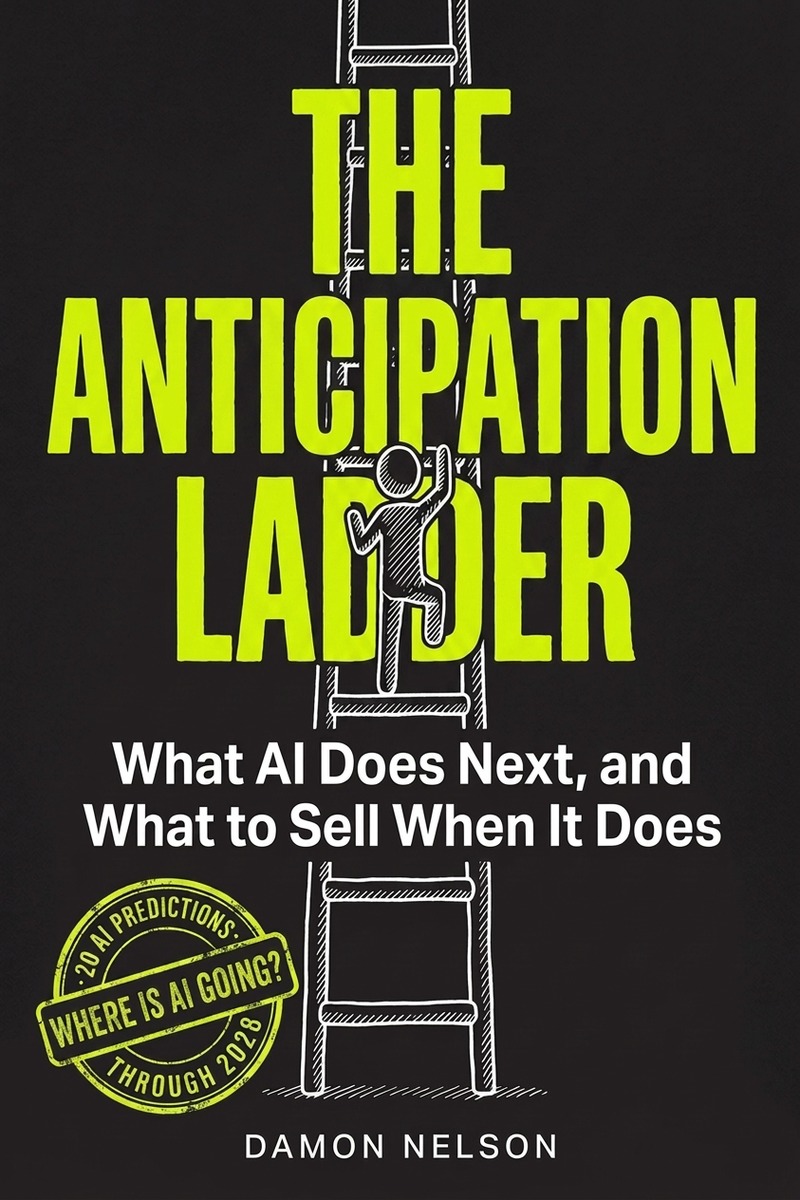
Here's what The Anticipation Ladder actually is: a book you can read in an evening or two. The introduction and Part Three stand alone — you can go straight to the priced offer frameworks before you've finished the whole thing. The twenty predictions each carry a specific checkpoint date, March 2027 and March 2028, and I grade them publicly. If the map fails, you'll know exactly when and exactly how.
This isn't a semester. It's one evening and a decision about whether you want to be the person who had the map or the person who found out about it later. The AI headlines will keep arriving either way. The question is whether you spend three seconds placing each one on the Ladder and deciding, or another forty-five minutes in a newsletter rabbit hole that ends at a tab you'll never reopen.
If you've been wanting to get ahead of this instead of catching up again, this is the specific, concrete thing to do about that.
See It on AmazonQuestions people actually ask
By the time I read this, won't the predictions already be outdated?
The predictions are built for this exact worry. Every one carries a hard checkpoint date — March 2027 or March 2028 — and a public scorecard the author grades live. A dated map you can plan against is the opposite of vague 'AI will change everything' content. The dates are the whole point.
I've bought AI books before. They're all framework and no actual playbook.
Part Three is nothing but priced, sequenced offers sized for a business of one — audits, agent installs, content retrofits — matched to specific predictions. The test is simple: can you open it and have a scoped service built before the first checkpoint date? If you can't, the public scorecard will tell you exactly when the map failed.
I'm not technical enough to sell AI services. Is this book actually for me?
The book's core argument is that the technical edge is gone. Every shop has the same engine for eight dollars. The scarce skill is knowing which client, which bottleneck, which specific Tuesday-morning fumble to point it at. That's a marketing skill. It's what the playbook chapters teach. No, you do not need to be an engineer — and the book is direct about that.
My clients aren't asking for AI yet. Is there even a market for this?
This is the one objection the book partly concedes. If your market is genuinely pre-awareness, some offers in Part Three won't land yet. What the Ladder helps you do is lead with the outcome your clients already want — a phone answered, a support ticket closed, a brief ready by morning — and let the AI be invisible. That's not a dodge; it's the strategy the book calls winning.
I don't have time to read another business book right now.
The introduction is explicit: this costs an evening or two. The predictions are built to be dog-eared. Part Three works before you've finished everything else. The ask is one evening and a decision. Not a semester.