He built the thing, pre-sold it, and the market still said no. Here's what that taught him about getting ahead of AI instead of chasing it.
The launch went fine. The pre-sales came in. The tool was real, it was built, and it had everything we knew how to put into it. Then the market just... didn't show up. Not in the numbers our other products had seen. Not even close.
I spent longer than I'd like to admit not listening to what that meant. Because we'd done the work. We'd built the right thing. Except we'd built it for where the market was, not for where it was going. By the time it shipped, the gap we'd built into it had mostly closed.
Every lifetime buyer got the next product free. I still support them. I'm not telling you this because it makes me look good. I'm telling you because it's where the two rules at the center of this book came from, and they cost enough that I'd rather you have them cheap.
That failure sat with me for a while. Not the money part, though that stings. The part that stayed was the question I hadn't asked before I started: what will be free by the time I ship this? I'd been building on a model gap, and model gaps close. That's just what they do.
Trying to answer that question honestly is what eventually became The Anticipation Ladder. It's a book about a four-rung framework for reading where AI is going, and a set of priced, sequenced offers a small operator can be selling before the next checkpoint date lands. It also comes with twenty dated predictions and a public scorecard I grade myself on. Publicly. With dates.
I wrote it because I kept watching sharp, experienced people get perpetually lapped by a race they'd been running hard. Not because they weren't paying attention. Because the thing they were watching, the tools, the model releases, the weekly breathless newsletters, was the wrong scoreboard.

The arms race already ended. Nobody won.
Here's the thing about the AI horsepower competition: it resolved. The eight-dollar model handles most of what most people actually need. Big labs spent years and billions narrowing that gap, and now every small operator has the same engine as the Fortune 500, for the price of lunch. As the book puts it: "Intelligence became a utility bill. Nobody sends a press release when something becomes a utility bill. It just quietly stops being the interesting part." The differentiator stopped being the engine the day everyone got one. It became knowing where to install it.
The differentiator is not the engine. It's knowing where to install it.

Every AI product on earth sits on one of four rungs. The rung is a number you can charge to change.
The Anticipation Ladder sorts everything: Reactive (answers when asked), Suggestive (proposes next moves), Anticipatory (prepares before you ask), Delegated (asks if it can just handle it). Most business software is sitting on rung one or two. Consumer expectations are climbing toward three and four, and climbing fast. That gap is not a crisis for a small operator who can see it. "That gap, between where the world's software sits and where the world's expectations are about to be, is not a tragedy. It's a price list." You can glance at any AI headline and place it on the ladder in about one second. Then decide, in the same breath, whether it's worth your morning.
The rung a business sits on is a number you can charge money to change.
The thing that cannot be photocopied is already yours.
AI trained on AI output produces diminishing returns. The machines run on fresh, dated, verified human experience, and they cannot manufacture it. For forty years, software treated every user identically, a photocopy handed to everyone in the room. AI-powered tools now behave differently for every person who uses them, built around voice, habits, history. The inputs that are genuinely scarce are the ones that were always scarce. Your opinions, your client relationships, the scar tissue from a pre-sale that didn't land. "AI writes the skeleton. You supply the heartbeat." That is not a comfort. It is a competitive position.
AI writes the skeleton. You supply the heartbeat.
Build for where it will be when you ship, not where it is when you start.
A build takes six to eighteen months. Models improve every month. The question I didn't ask myself before that tool: what will be free by my ship date? Any offer built on a gap that closes dies when the gap closes. The book has one test for every product idea: does it compound when models improve, or does it get gutted? Build on your data, your relationships, your distribution, and your judgment, and every model improvement lifts your product instead of eating it. That's the rule the tuition bought. "Tools built on a model gap die when the gap closes."

The people who lose won't lose to AI.
They'll lose to someone who read the map earlier. That line is in the introduction and it's not a scare tactic. It's a description of a very specific Tuesday morning: the one where a competitor sends a client a scoped, priced anticipation-ladder audit and your client thinks it sounds exactly like something they needed. The twenty dated predictions in the book exist so you have a map with actual coordinates, not a vague direction. And the public scorecard exists so you know when the map is wrong. "Forecasters who won't be graded are just entertainers. Hold me to the difference."
The people who lose over the next eighteen months won't lose to AI. They'll lose to somebody who read the map earlier.
What readers are saying
"Showed a client the screen of what the AI said about his business versus his competitor. The look on his face was priceless. The audit sells itself. This book is already making me money."
— Brian C."The whole 'intelligence became a utility bill' idea reframes everything. Once the engines are equal, the only things left that matter are your voice, your judgment, and your relationships. That feels true."
— Claire E."You become the asset. That's Prediction 20, and it's the longest-range idea in the book. Fresh human experience is the one ingredient the machines still can't manufacture. The people filing their knowledge banks and journals now are going to be the ones holding inventory when the royalties start."
— Rachel V.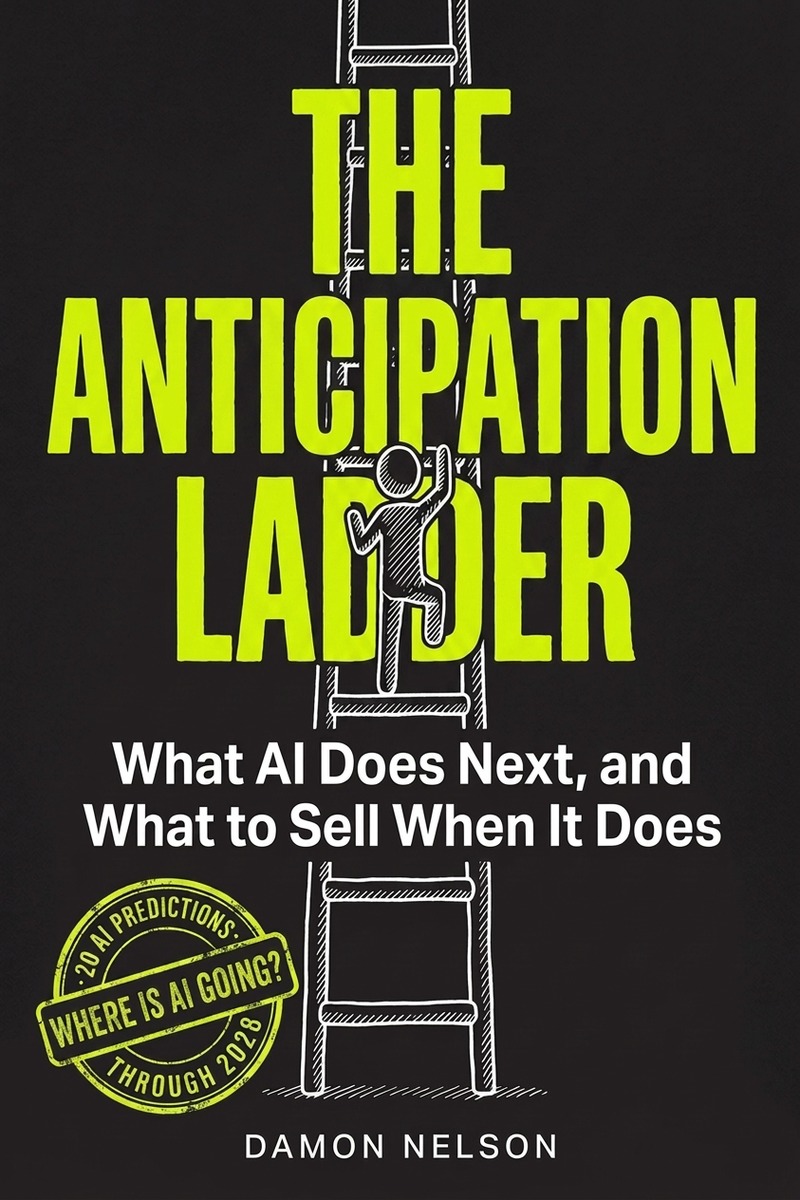
The Anticipation Ladder is where all of this lives in one place. The four-rung framework. Twenty dated predictions with checkpoint dates in March 2027 and March 2028. A graded public scorecard I update myself. And Part Three, which is nothing but priced, sequenced offers sized for a solo operator or small team: audits, agent installs, content retrofits, matched to specific predictions.
You can go straight to Part Three and have an offer framework before you've finished the book. The introduction is honest about the ask: an evening or two, not a semester. If the map is wrong, the scorecard will tell you exactly when and how. That is the whole deal.
If you've followed the newsletter, you already know the voice. This is just the version with dates attached and skin in the game. Head to the link below to get it.
See It on AmazonQuestions people actually ask
By the time I read this, won't the predictions already be outdated?
Every prediction has a specific checkpoint date, March 2027 or March 2028, and a public scorecard the author grades live. A dated map you can plan against is the opposite of the vague 'AI will change everything someday' content that goes stale overnight. The dates are the entire point.
I've bought AI books before. They're all ideas with no real playbook.
Part Three is nothing but priced, sequenced offers sized for a business of one. Audits, agent installs, content retrofits, matched to specific predictions. The test is simple: open the book and try to build an offer before the first checkpoint date. If you can't, the public scorecard means you'll know exactly when the map failed.
I'm not technical enough to sell AI services.
That's the book's core argument: the technical edge is gone. Every shop has the same engine for roughly the cost of lunch. The scarce skill now is knowing which client, which bottleneck, which specific fumble to point it at. That's a marketing skill. It's what the playbook chapters are built to teach.
My clients aren't asking for AI yet, so there's no market for this right now.
This is the one objection the book concedes, partly. If your specific market is genuinely pre-awareness, some offers in Part Three won't land yet. The honest answer: the ladder helps you lead with the outcome your client already wants, a call answered, a ticket closed, a brief ready, and let the AI stay invisible. That's how the winning products already work.
I don't have time for another business book right now.
The introduction is upfront about this. It costs an evening or two. The predictions stand alone and are built to be dog-eared. You can go straight to Part Three before you've read the whole thing. The ask is one evening, not a semester.