I predicted the sale. Nobody predicts the un-sale. Here is what that got me.
It was a January voice memo, the kind you record in your car because the thought won't wait. I said the big AI players were going to start buying up the hottest agent companies. Acquisitions, consolidations, the whole playbook. I felt good about it.
Meta went out and bought Manus for two billion dollars. I was right. Then Beijing stepped in, and by June the deal was unwinding in real time. I did not see that coming. Nobody did.
I wrote about it anyway, in full, with the original prediction sitting right next to the outcome. Because a forecaster who only shows you the wins is an entertainer. And I had spent too long reading entertainer forecasts to want to write another one.
That memo became the spine of a book called The Anticipation Ladder: What AI Does Next, and What to Sell When It Does. Not a tool tutorial. Not a hype piece about whatever shipped last Tuesday. A dated map of the next eighteen months, with twenty specific predictions, checkpoint dates, and a public scorecard I grade myself.
The premise is simple, even if the arms race made it feel complicated. AI capability has leveled across price tiers. The eight-dollar model handles most of what most people need. The differentiator is not the engine anymore. It is knowing where to install it. And the people who figure that out first are already invoicing clients while everyone else is still watching keynotes.
The book exists because I kept meeting smart, experienced operators, people who had survived every previous 'this changes everything' cycle, who were still stuck in the same loop: subscribe to the newsletter, buy the course, feel behind by Friday. The loop is not a you problem. It is a map problem. Most of what gets published is vague enough that nobody can ever check whether it was right. This book is not that.

The arms race ended in a tie. Act accordingly.
For the last few years, staying current on tools felt like the strategy. Learn the new model, watch the new demo, open a new tab. What the book's first chapter lays out is that this was always a losing game for small operators, because the advantage lived with the labs, not with you. Now that intelligence is a utility bill, the edge moved entirely to application. Knowing which client, which bottleneck, which Tuesday-morning fumble to point it at. That is a marketing skill. You already have most of it.
The differentiator is not the engine. It's knowing where to install it.

Every AI product on earth sits on one of four rungs. One second to place it.
Reactive, Suggestive, Anticipatory, Delegated. Those four rungs are the whole ladder. A reactive tool answers when you ask. A suggestive one proposes the next move. An anticipatory one prepares before you ask. A delegated one just handles it and checks in after. Once you have the ladder in your head, every AI headline sorts itself. You read the announcement, you place it on a rung, you decide in the same breath whether it matters to your clients. The scanning exhaustion goes quiet.
That gap, between where the world's software sits and where the world's expectations are about to be, is not a tragedy. It's a price list.
The gap between rungs is not a problem. It is a price list.
Here is the move the book is built around. Most businesses are sitting on rung one or two. Their customers' expectations, shaped by whatever the consumer apps are doing, are already pointing at rung three. That gap is not a tragedy. It is a scoped, priced service. The book's third section maps specific offers, from a one-session audit to a full agent install, sized for a solo shop and matched to specific predictions so you know which offer to lead with before each checkpoint date arrives.
Dated predictions with a public scorecard. The accountability is the point.
Every prediction in the book carries a checkpoint: March 2027 or March 2028. Not 'someday soon.' Not 'the next few years.' A date. And when the date arrives, I grade it publicly, including the ones I get wrong, the same way I wrote about the Meta and Manus un-sale. The dates are not a gimmick. A dated map you can plan against is the opposite of the vague content that goes stale overnight. The map has dates, and a public scorecard.
Forecasters who won't be graded are just entertainers. Hold me to the difference.

Your voice, your clients, your scar tissue. The one thing that cannot be copied.
The book spends a chapter on what the model era actually makes scarce. It is not the engine. It is not the interface. It is fresh, specific, human experience: the client call you sat through in 2019 where you learned something nobody else in that room knew. The failed campaign that taught you which levers are painted on. AI writes the skeleton. You supply the heartbeat. The operators who understand this first are the ones building the moat right now.
AI writes the skeleton. You supply the heartbeat.
What readers are saying
"Being number one on Google does not guarantee you a place in the AI answers. That under-20% overlap number should scare every SEO still living in 2019. Prediction 6 is already true for a lot of my clients."
— Samantha K."Read it. Liked it. Already using the ladder with clients. Get the book."
— Nicole B."The Dunkin' drive-thru example is stuck in my head. The difference between fumbling with the app and the phone already knowing your order is exactly what anticipation looks like. Can't stop seeing it everywhere now."
— Dan S.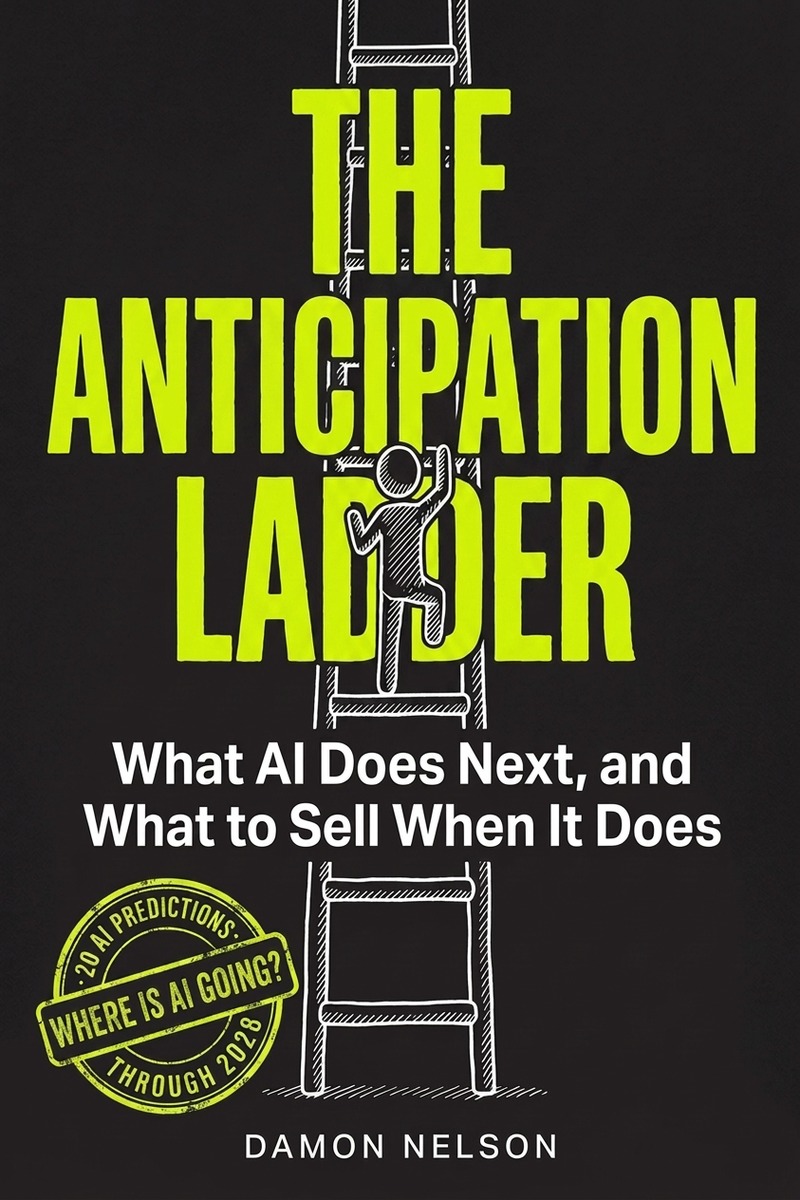
The book costs an evening, maybe two. The introduction gives you the lay of the land. Part Three gives you priced, sequenced offers you can start scoping for real clients before the first checkpoint date arrives. If you want to go straight to the playbook chapters, they stand alone. You do not have to read cover to cover to leave with something you can sell.
The twenty predictions are built to be dog-eared. Each one names the rung, the gap, the offer, and the date you can check it against. The public scorecard travels with the book. When I am wrong, you will know exactly when, and exactly how to adjust.
If you have been waiting for a map that is honest about what it does not know and specific about what it does, this is the one. Get it through the link below.
See It on AmazonQuestions people actually ask
By the time I read this, won't the predictions already be outdated?
Every prediction has a specific checkpoint date, March 2027 or March 2028, and a public scorecard that gets graded live. That is the whole point. A dated map you can plan against is the opposite of the vague 'AI will change everything someday' content that goes stale the moment you close the tab. The dates are not decoration. They are the product.
I've bought AI books before and they're all hype with no real playbook.
Part Three is nothing but priced, sequenced offers sized for a solo shop: audits, agent installs, content retrofits, all matched to specific predictions. The test the book sets for itself is whether you can open it and build an offer before the first checkpoint date. If you cannot, the public scorecard exists so you know exactly when the map failed.
I'm not technical enough to sell AI services.
The book's core argument is that the technical edge is already gone. Every shop has the same engine for roughly the price of lunch. The scarce skill is knowing which client, which bottleneck, which fumble to point it at. That is a marketing skill, not an engineering one, and it is what the playbook chapters actually teach.
My clients aren't asking for AI yet, so there's no market for this.
This is the one objection the book concedes in part. If your market is genuinely pre-awareness, some offers in Part Three won't land yet. The honest answer is that the ladder helps you identify which rung your clients are already on so you lead with the outcome they already want: a phone answered, a support ticket closed, a morning brief ready. The AI stays invisible, the way the book says winning products already work.
I don't have time to read another business book right now.
The introduction is explicit about this: it costs an evening or two. The predictions are built to be dog-eared, and Part Three stands alone. You can have a priced offer framework before you have finished the whole book. The ask is one evening, not a semester.
Will this still be relevant if a major AI announcement drops next month?
That is exactly what the ladder is for. Every new announcement sits on one of the four rungs. Once you have the framework, a new product launch takes about one second to classify and about ten seconds to decide whether it changes your offer or not. The map does not go stale with headlines. The headlines plug into the map.