He Built His Son a Website Over Lunch. That Afternoon Changed How He Sees the Next Eighteen Months.
It was a Friday in January. Damon sat down with his son over lunch, asked him about his goals, the sites he liked, who his competitors were. Standard questions. He recorded the conversation on his phone.
After the plates were cleared, he fed the recording into an AI design tool. An hour later, his son had a one-page website, a logo, and a business card. His son went to tell his friends.
Damon used to build websites for a living — the old way. Weeks of emails. Texts back and forth. Rounds of mockups. Three months to get five pages out the door. They did it over lunch. That mild vertigo he felt sitting there, watching it all come together? That was the moment he understood something had actually shifted. Not someday. Already.
Most of the AI conversation happening right now is about the tools. Which model is smartest. Which one is cheaper. Which one just launched. It's an arms race with a newsletter for every skirmish, and if you've been following it, you already know how that feels: more tabs open, less clarity, zero invoices.
The Anticipation Ladder, by Damon Nelson, is not a tool guide. It's a map of where the whole thing is going over the next eighteen months — four distinct rungs from reactive to fully delegated — with twenty dated public predictions the author grades live. The book's argument is quieter and more useful than most: the tools are already tied. The edge now belongs to whoever knows which specific problem to point them at, and can package that knowledge as a service before the wave breaks.
The lunch story is in the introduction. It's not there to impress you. It's there because it's the fastest way to feel what 'the ground is already moving' actually means.

The arms race ended. Everyone got the weapons for eight dollars.
AI capability has leveled across every price tier. The model you're paying a premium for and the one your competitor signed up for this morning are, for most real-world tasks, functionally identical. Nelson's call in Chapter 1 is blunt: 'Intelligence became a utility bill. Nobody sends a press release when something becomes a utility bill. It just quietly stops being the interesting part.' Chasing model upgrades is the wrong game now. The right game is knowing which bottleneck in which specific business to point the thing at. That is a marketing skill. It always was.
The differentiator is not the engine. It's knowing where to install it.

One-to-many software just ended. Forty years of it, gone.
For four decades, software treated every user identically. The same menus, the same prompts, the same output whether you were a dentist in Denver or a florist in Dublin. That model is breaking. The same product now remembers your voice, your habits, your history, and behaves differently every time. 'When intelligence is a commodity, the only scarce inputs left are the ones that were always scarce: your voice, your opinions, your relationships.' The book names this the end of one-to-many — and the business sitting on top of that shift is whoever helps local businesses make the transition.
The ladder tells you exactly which rung a client is on — and what to charge to move them up.
Every AI product on earth sits on one of four rungs: Reactive (you ask, it answers), Suggestive (it answers then proposes your next move), Anticipatory (it prepares before you ask), Delegated (it asks if it should just handle it). Most small businesses are still on rung one. Nelson's line does the work: 'The rung a business sits on is a number you can charge money to change.' An audit that places a client on the ladder, a project scoped to move them one rung, a recurring retainer to maintain it. That's a service. It's in the book.
The rung a business sits on is a number you can charge money to change.
Two reputation markets exist now. You can only see one of them.
There is the world where Google ranks you for humans. And there is a second, less visible world where AI recommends you to other AIs — agents doing research, comparing vendors, building shortlists without a human in the loop. The two lists overlap less than 20% of the time. 'Being number one on Google does not guarantee you a place in the AI answers.' Chapter 6 maps both markets and explains what structured, useful, human-sourced content does for you in each. It's not SEO. It's something newer that pays the same way SEO used to.
There are now two reputation markets: one where AI quotes you to humans, and one where AI recommends you to other AIs. You can only see the first one.

The people who built on the gap are already in trouble. Build on what never levels.
Any product whose core value is a capability the base models are visibly closing is in trouble. Nelson names this plainly: 'Tools built on a model gap die when the gap closes.' What doesn't close is judgment about a specific market, relationships in a specific community, distribution you built before the models arrived. Every model upgrade becomes a rising tide under a boat built on those inputs. The final chapters of the book are about building that way — not as a hedge, but as the actual strategy.
Tools built on a model gap die when the gap closes.
What readers are saying
"Short and sweet: the book makes sense of the chaos. Worth reading if you're actually trying to sell into this shift instead of just watching it."
— Olivia F."The part that stuck with me longest is how the winners go quiet. The higher something climbs the Anticipation Ladder, the less you hear the word AI at all. That invisibility is the real endgame."
— Justin M."Three moves at the end are simple and sharp. Picked my stack, started the vault, and pitched the first phone agent today. The reader who invoices once keeps going. That line got me moving."
— Steve A.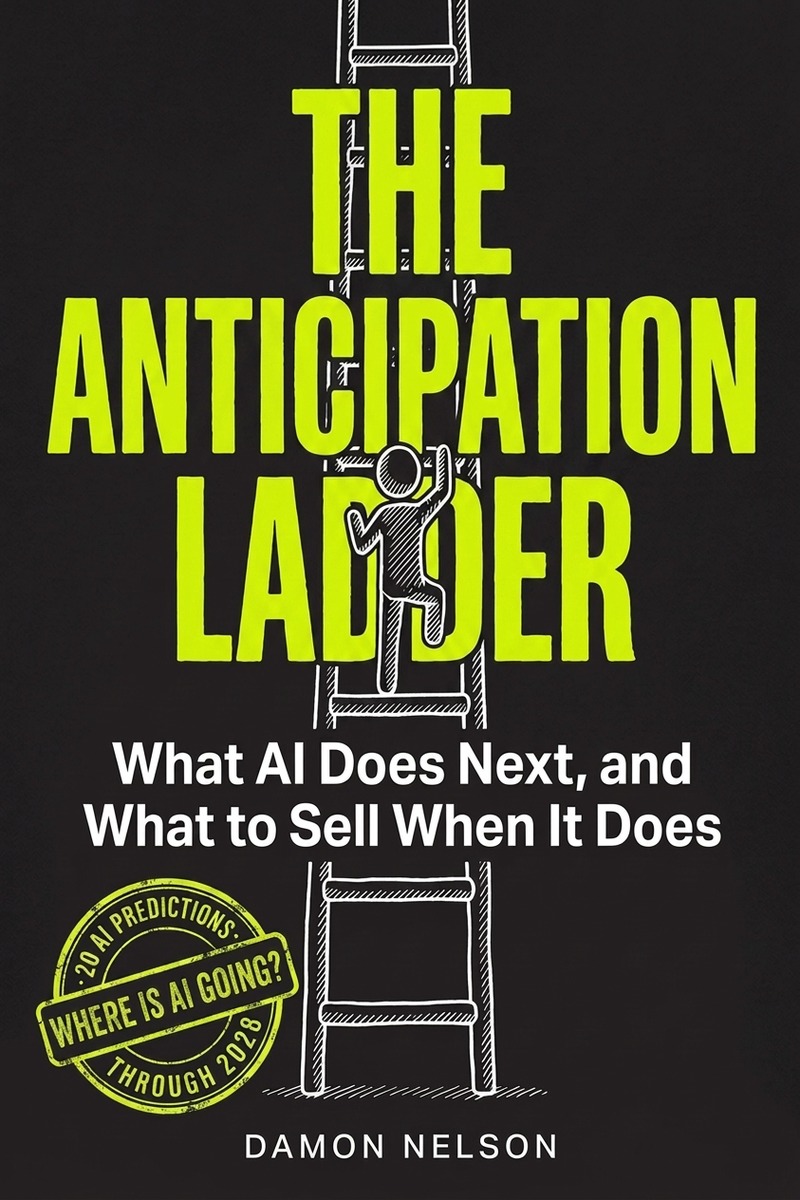
The Anticipation Ladder costs you an evening. Maybe two if you linger on the playbook chapters, which is the right place to linger. The introduction and the scorecard stand alone — read the predictions, note the dates, decide what you believe. Then go to Part Three and scope your first offer before the first checkpoint arrives.
You are not buying a forecast. You are buying a map with dates on it, a framework that sorts every AI headline in about one second, and a set of priced, sequenced services sized for a business of one. The scorecard is public. Nelson grades it live. 'Forecasters who won't be graded are just entertainers.' He put his name on the dates.
If you wanted to get ahead of this — not just catch up again — this is the right afternoon to start.
See It on AmazonQuestions people actually ask
By the time I read this, won't the predictions already be outdated?
Every prediction in the book carries a specific checkpoint date — March 2027 and March 2028 — and a public scorecard Nelson grades live. A dated map you can plan against is the opposite of the vague 'AI will change everything someday' content that goes stale overnight. The dates are the point.
I've bought AI books before. They're all hype with no real playbook.
Part Three is nothing but priced, sequenced offers sized for a business of one — audits, agent installs, content retrofits — matched to specific predictions. The test Nelson offers is simple: if you can't open the book and build a scoped offer before the first checkpoint date, the public scorecard means you'll know exactly when the map failed. That accountability is either a reason to trust it or a reason to wait and watch. Either way, you're not flying blind.
I'm not technical. Can I actually sell AI services?
The book's core argument is that the technical edge is gone. Every shop has the same engine for eight dollars. The scarce skill is knowing which client, which bottleneck, which Tuesday-morning fumble to point it at. That's a marketing skill, not an engineering one, and it's what the playbook chapters teach. If you can scope a project and write a proposal, you have the prerequisite.
My clients aren't asking for AI yet. Is there even a market?
This is the one objection the book answers honestly in part: if your market is genuinely pre-awareness, some offers in Part Three won't land yet. What the ladder framework helps you do is lead with the outcome your client already wants — a phone answered, a support ticket closed, a morning brief ready — and let the AI stay invisible. That's how the winning products already work. The client doesn't need to ask for AI; they need to ask for the result.
I don't have time for another business book right now.
The introduction is explicit: this is an evening or two, not a semester. The predictions are built to be dog-eared and stood alone. You can go straight to Part Three and have a priced offer framework before you've finished the whole thing. The ask is one evening. What you're deciding is whether that evening has a better use.
How do I know the eighteen-month window is real and not just a marketing hook?
You don't, yet. The scorecard is the answer. Nelson published the predictions with checkpoint dates and grades them publicly. 'Forecasters who won't be graded are just entertainers.' If the window is wrong, the scorecard will say so on the date it promised to.