The AI Race Already Ended in a Tie. Here Is Who Wins What Comes Next.
On a Friday in January, I sat down to lunch with my son. He needed a website. So I interviewed him for about an hour, asked about his goals, the sites he liked, his competitors. Then I fed the recording into an AI design tool.
An hour after we finished eating, he had a one-page site. Business card. Logo. Done.
I used to build websites for a living. The old way. Weeks of emails, rounds of mockups, three months to get five pages out the door. Watching that entire workflow collapse into a lunch did something to me. I didn't feel triumphant. I felt vertigo.
That afternoon I started writing what became The Anticipation Ladder: What AI Does Next, and What to Sell When It Does.
Not because I had the answers. Because I was tired of the same loop every solo operator I know is stuck in: learn the tool, build the workflow, watch it get obsoleted, repeat. And I wanted to know if there was a way to get ahead of that loop instead of just running it faster.
The book is built around one framework and twenty dated predictions with a public scorecard I grade live. If the predictions miss, you'll know exactly when and why. I wanted to write something I'd actually be held to. As I put it in the conclusion: "Forecasters who won't be graded are just entertainers. Hold me to the difference."

The arms race ended. Nobody told the newsletters.
The eight-dollar model handles most of what most people need. The gap between what the Fortune 500 runs on and what you can buy before your morning coffee is essentially closed. I wrote it as a law in Chapter One: "The differentiator is not the engine. It's knowing where to install it." That shift is the whole book. The edge stopped belonging to whoever has the smartest model. It belongs to whoever knows which specific business problem to point it at.
The differentiator is not the engine. It's knowing where to install it.

Every AI product on earth sits on one of four rungs. The gap between rungs is a price list.
Reactive software answers when you ask. Suggestive software proposes next moves. Anticipatory software prepares before you ask. Delegated software asks if it can just handle it. That four-rung ladder classifies every AI headline you will ever read. More useful: the rung a client's business sits on today versus where their customers' expectations are heading is a scoped, priced service. "That gap, between where the world's software sits and where the world's expectations are about to be, is not a tragedy. It's a price list."
That gap, between where the world's software sits and where the world's expectations are about to be, is not a tragedy. It's a price list.
The clients who aren't asking for AI yet are already using it. They just can't see it.
A technology hasn't fully won until it vanishes from the label. The businesses winning right now barely say the word AI out loud. What they have is a phone that answers every call, a support queue that clears itself, a morning brief that's ready before the owner sits down. Each of those invisible layers needs someone to install it, document it, and keep it fed with structured inputs. That's a recurring service, not a one-time project, and it doesn't require an engineering degree.
There are two reputation markets now. Most people can only see one of them.
There is a market where AI quotes you to humans: citations, summaries, answer boxes. And there is a market where AI recommends you to other AIs, agent to agent, no human in the loop. The top Google result and the top AI citation overlap less than twenty percent of the time. Both boards reward the most specific, most structured, most useful source. That is a content audit, a retrofit, and a recurring retainer. It is also a service most clients don't know they need yet, which is exactly when to offer it.
There are now two reputation markets: one where AI quotes you to humans, and one where AI recommends you to other AIs. You can only see the first one.

Your voice is the one thing the machine can't manufacture.
AI trained on AI output produces the photocopy-of-a-photocopy problem. Fresh, dated, verified human experience is the scarce raw material the models run on and cannot make themselves. Small operators who spent years building a voice, a client relationship, a read on a specific market have been sitting on the only asset that actually compounds in this environment. The book makes that concrete: "When intelligence is a commodity, the only scarce inputs left are the ones that were always scarce: your voice, your opinions, your relationships."
AI writes the skeleton. You supply the heartbeat.
What readers are saying
"Being number one on Google does not guarantee you a place in the AI answers. That under-20% overlap number should scare every SEO still living in 2019. Prediction 6 is already true for a lot of my clients."
— Samantha K."The Dunkin' drive-thru example is stuck in my head. The difference between fumbling with the app and the phone already knowing your order is exactly what anticipation looks like. Can't stop seeing it everywhere now."
— Dan S."I keep coming back to the law about the differentiator not being the engine. It's knowing where to install it. That's the whole game now. Most people are still arguing about models."
— Derek L.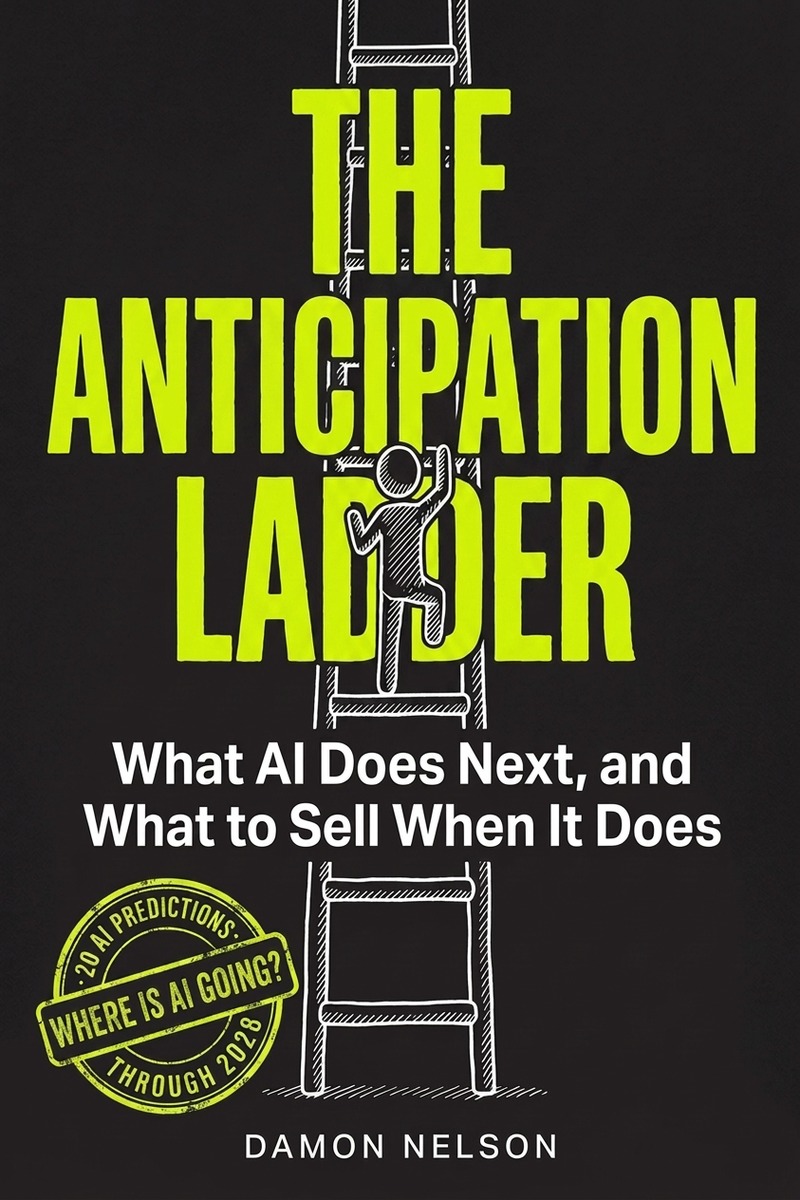
The Anticipation Ladder is built to cost you one evening, maybe two. The introduction and the ladder framework stand alone if that's all you have time for right now. Part Three is nothing but priced, sequenced offers sized for a business of one: audits, agent installs, content retrofits, matched to specific predictions with specific checkpoint dates.
The twenty predictions run to March 2027 and March 2028. They are public. I grade them live. You will know exactly when the map is working and exactly when it isn't.
"The people who lose over the next eighteen months won't lose to AI. They'll lose to somebody who read the map earlier."
If you want the map, it's on the page below.
See It on AmazonQuestions people actually ask
By the time I read this, won't the predictions already be outdated?
This is the exact objection the book was built to answer. Every prediction carries a specific checkpoint date, March 2027 or March 2028, and a public scorecard I grade live. A dated map you can plan against is the opposite of vague 'AI will change everything someday' content. The dates are the point, not the fine print.
I've bought AI books before. They're all hype with no real playbook.
Fair. Part Three exists because of that objection. It is nothing but priced, sequenced offers: audits, agent installs, GEO retrofits, workflow documentation. Each one is matched to a specific prediction. The test is whether you can open it and have a scoped offer built before the first checkpoint date. If you can't, the scorecard means you'll know exactly when the map failed.
I'm not technical enough to sell AI services.
The book's core argument is that the technical edge is gone. Every shop has the same engine for the price of lunch. The scarce skill now is knowing which client, which bottleneck, which Tuesday-morning fumble to point it at. That is a marketing and judgment skill. It's what the playbook chapters teach, and it's probably what you've been building for years without a name for it.
My clients aren't asking for AI yet, so is there actually a market here?
Honest answer: if your market is genuinely pre-awareness, some offers in Part Three won't land yet. The book helps you figure out which rung your clients are on, so you lead with the outcome they already want: a phone answered, a support queue cleared, a brief ready at eight. The AI stays invisible. That's actually how the winning products already work.
I don't have time to read another business book right now.
The introduction says it plainly: this costs an evening or two. The predictions are built to be dog-eared and used standalone. You can go straight to Part Three and have a priced offer framework before you've read the whole thing. The ask is one evening, not a semester.
Is this book for someone already selling AI services, or someone just starting to think about it?
Both, but the fit is better if you've already tried something and found it didn't stick. The framework is most useful when you have a client base to apply it to. If you've never sold a service in your life, the ladder gives you the map but you'd still need to build the sales muscle separately. That part the book doesn't pretend to cover.