The map has dates, and the author grades himself on every one of them
He keeps a plain notepad on his desk. Nothing special about it. He talks into a dictation tool, no keyboard, no AI in the room, and whatever comes out goes into the notepad. His mornings, his half-formed opinions, the specific ways certain clients fumble the same Tuesday problem every week. Nobody else's voice. Just his.
His emails are blended now. His video scripts are machine-drafted. But the notepad is where the unfakeable stuff comes from. Some of what you are about to read arrived exactly that way: talked into a plain file, shaped later, no committee.
He started doing it because he noticed something. The stuff people actually forwarded, the lines that landed, the ideas that got quoted back to him three months later, they never came from the polished drafts. They came from the unrepeatable corner. The part no model could have been in the room for.
That observation sits at the core of The Anticipation Ladder, his new book on what AI does next and, more usefully, what to sell when it does. The journal habit is not a productivity tip. It is a business argument. The book makes it plainly: AI trained on AI output produces the photocopy-of-a-photocopy problem. Fresh, dated, verified human experience is the scarce raw material the machines run on and cannot make.
The book is not a trends roundup. It is a dated map. Twenty predictions, each carrying a specific checkpoint date, each graded publicly by the author. He puts it plainly in the conclusion: 'Forecasters who won't be graded are just entertainers. Hold me to the difference.'
That line is either the most confident thing an author has ever written or the most honest. Probably both.

The arms race already ended, and everybody tied
The eight-dollar model handles most of what most people need. That is not an opinion in the book; it is the opening argument. 'Intelligence became a utility bill. Nobody sends a press release when something becomes a utility bill. It just quietly stops being the interesting part.' The edge moved. It moved entirely to knowing which specific business, which specific bottleneck, which Tuesday-morning fumble to point the thing at. That is a marketing skill, not an engineering one.
The differentiator is not the engine. It's knowing where to install it.

Every AI product on earth sits on one of four rungs
Reactive answers when you ask. Suggestive proposes next moves. Anticipatory prepares before you ask. Delegated asks if it can just handle it. That is the Anticipation Ladder, and it is a sorting tool that takes about one second per headline. More useful: 'The rung a business sits on is a number you can charge money to change.' The gap between where software sits today and where client expectations are heading is not a mystery. It is, as the book says, a price list.
That gap, between where the world's software sits and where the world's expectations are about to be, is not a tragedy. It's a price list.
The winners go invisible, but the loading-dock work stays visible
A technology hasn't fully won until it vanishes from the label. AI is mid-disappearance. The companies winning at CES 2026 barely said the word. But every invisible AI layer runs on visible, structured inputs that somebody has to supply. That work is skilled, recurring, and paid. The installer who shows up before the label disappears is the one who sets the price. The one who shows up after is competing on rate.
There are two reputation markets now, and you can only see one of them
There is a market where AI quotes you to humans, citations, GEO, and a market where AI recommends you to other AIs. The citation has replaced the click as the front page of the internet. The top Google rank and the top AI citation overlap less than twenty percent of the time. Both boards reward the most useful, most specific, most structured source. Your journal, your opinions, your dated experience. The book makes the point quietly: 'Word of mouth didn't die. It just stopped needing mouths.'
Word of mouth didn't die. It just stopped needing mouths.

Your voice is the one input the model cannot manufacture
For forty years, software treated every user identically. One to many. The same photocopy, handed to everyone. AI-powered software now remembers your voice, habits, and history. One to one is replacing one to many, and the only inputs it cannot replicate are the ones that were always scarce. The book puts it directly: 'When intelligence is a commodity, the only scarce inputs left are the ones that were always scarce: your voice, your opinions, your relationships.' That is not consolation. That is the business model.
AI writes the skeleton. You supply the heartbeat.
What readers are saying
"Three moves at the end are simple and sharp. Picked my stack, started the vault, and pitched the first phone agent today. The reader who invoices once keeps going. That line got me moving."
— Steve A."Prediction 1 says by March 2028 picking an AI model will feel like picking a cell carrier. Looking at how close the mid-tier models already are, that doesn't feel far-fetched at all."
— Jordan P."Prediction 6 finally explained why my rankings look fine but traffic keeps falling. Being number one on Google doesn't mean the AI will cite you. That under-20% overlap number was a wake-up call."
— Kevin J.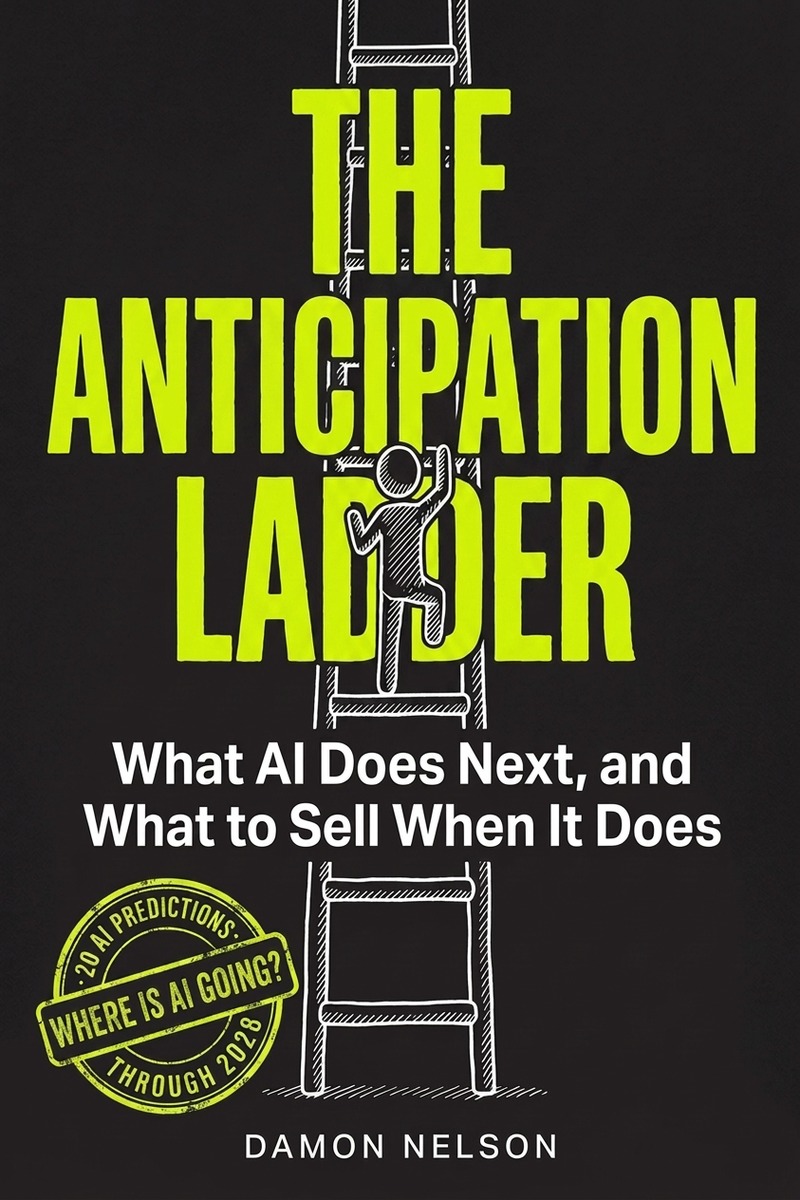
Here is what you get from the link below. A dated map of the next eighteen months of AI development. A sorting framework that classifies any AI headline in about one second. A set of priced, sequenced offers sized for a business of one: audits, agent installs, content retrofits, matched to specific predictions you can act on before the first checkpoint date arrives.
The introduction is explicit about the time ask: an evening, maybe two. Part Three stands alone if that is where you need to go first. The scorecard is live and public, because a map nobody grades is just decoration.
The people who come out ahead over the next eighteen months will not have the fastest model. They will have read the map earlier. The link is below.
See It on AmazonQuestions people actually ask
By the time I read this, won't the predictions already be outdated?
Every prediction in the book carries a specific checkpoint date: March 2027 and March 2028. The author grades each one publicly when the date arrives. A dated map you can plan against is the opposite of vague 'AI will change everything someday' content. Stale is when there are no dates. This has twenty of them.
I've bought AI books before. They're all the same hype with no real playbook.
Part Three is nothing but priced, sequenced offers sized for a business of one. Audits, agent installs, content retrofits, each matched to a specific prediction. The honest test: open it and try to build an offer before the first checkpoint date. If you can't, the public scorecard means you'll know exactly when the map failed. The author signed his name to that.
I'm not technical enough to sell AI services.
The book's central argument is that the technical edge is gone. Every shop has the same engine for eight dollars. The scarce skill is knowing which client, which bottleneck, which specific Tuesday-morning fumble to point it at. That is a marketing skill. The playbook chapters teach that, not engineering.
My clients aren't asking for AI yet. Is there even a market for this?
This is the one objection the book concedes in part. If your market is genuinely pre-awareness, some offers in Part Three won't land yet. The honest answer: the ladder helps you identify which rung your clients are on so you lead with the outcome they already want. A phone answered. A support ticket closed. A morning brief ready. The AI stays invisible, the way the book says winning products already work.
I don't have time to read another business book right now.
The introduction names the ask plainly: an evening or two. The predictions are built to be dog-eared and stand alone. You can go straight to Part Three and have a priced offer framework before you've read the whole thing. It is one evening, not a semester.
Will this still be relevant a year from now?
The framework is built for exactly that question. Tools built on a specific model gap die when the gap closes. The ladder is built on the gap between where client expectations are heading and where most software sits today. That gap does not close in a year. It widens. The dated predictions let you track whether the map is holding, in real time.