He Made Twenty Predictions and Graded His Own Work Six Months Later
You learned the workflow in March. It was obsolete by May. That's not a learning problem. That's a map problem.
Most of what gets written about AI is a snapshot with no date stamp. It describes where things are right now, which means by the time you read it, it's already a little wrong. You end up with a bigger stack of screenshots and a worse sense of direction.
The thing nobody tells you: staying current on the tools stopped being the strategy the day every shop got access to the same engine for eight dollars. The edge moved. And the people who found it aren't the ones who took the most notes.
Back in January, Damon Nelson sat down and recorded a voice memo about where AI was going. Then he did something most forecasters avoid completely: he waited six months and checked his own work.
Some calls landed early. The anticipatory-assistant prediction appeared nearly word-for-word in an AI lab's official roadmap by spring. One got weirder than he'd have said out loud: he predicted Meta would acquire a hot agent company. They did. Then the government made them give it back. He predicted the sale. Nobody predicts the un-sale.
That voice memo became The Anticipation Ladder, a book built around twenty dated public predictions, a four-rung framework for sorting any AI headline in about one second, and a concrete set of priced offers a one-person shop can be running before the first checkpoint date arrives. The scorecard is public. His grades are attached. As he puts it in the introduction: Forecasters who won't be graded are just entertainers.

The Old Way: Staying Current. The New Way: Knowing Which Rung Pays.
The old assumption was that the person who knew the most tools would win. That made sense when the tools were unequal. They're not anymore. As the book puts it: Intelligence became a utility bill. Nobody sends a press release when something becomes a utility bill. It just quietly stops being the interesting part. The Anticipation Ladder gives every AI product a rung — Reactive, Suggestive, Anticipatory, Delegated — and the rung a business sits on is a number you can charge money to change. Knowing which number to quote is a marketing skill, not an engineering one.
The differentiator is not the engine. It's knowing where to install it.

The Old Way: Ranking on Google. The New Way: Two Reputation Markets.
SEO still works. That's the honest concession. But a second market opened quietly beside it, and most people can't see it yet. There is now a citation market, where AI quotes you to humans, and a recommendation market, where AI recommends you to other AIs. The two lists overlap less than 20% of the time. Being number one on Google does not guarantee you a place in the AI answers. The book maps what feeds both markets — and what you can sell to clients who don't know the second one exists yet.
There are now two reputation markets: one where AI quotes you to humans, and one where AI recommends you to other AIs. You can only see the first one.
The Old Way: Training People. The New Way: The Do-It-For-Me Button.
Support has been sold as training for forty years. Here's the uncomfortable part: nobody ever wanted the training. They wanted the thing the training produces. When a support agent stops teaching and starts doing, the entire pricing model for that service changes. The book calls this rung four and walks through exactly how to build, scope, and price it as a productized offer before most of your competitors have read the chapter.
Nobody ever wanted the training. They wanted the thing that the training produces.
The Old Way: Waiting for Clients to Ask. The New Way: Installing the Invisible Layer.
A technology hasn't fully won until it vanishes from the label. Nobody shops for a motorized thermostat. AI is mid-disappearance right now. The highest-rung products already stop saying 'AI' and just deliver a morning that worked. The book's gold rush chapter makes a specific argument: thousands of hardware and local-service businesses built for the anticipated world have spec-sheet websites and no path for machine buyers. The person who can write the human story and build the second front door names their price. That is a gap you can walk into before March 2027.

The Old Way: Your Content Feeds the Algorithm. The New Way: Fresh Human Experience Is the Scarce Input.
The machines learned from what humans made. Now the web fills with machine-made content — copies of copies, each one a little blurrier. Fresh, dated, verified human experience is the one ingredient the AI companies need and cannot manufacture themselves. When intelligence is a commodity, the only scarce inputs left are the ones that were always scarce: your voice, your opinions, your relationships. The book's content chapter shows what that's worth and how to structure it so both reputation markets can find it.
When intelligence is a commodity, the only scarce inputs left are the ones that were always scarce: your voice, your opinions, your relationships.
What readers are saying
"You become the asset. That's Prediction 20, and it's the longest-range idea in the book. Fresh human experience is the one ingredient the machines still can't manufacture. The people filing their knowledge banks and journals now are going to be the ones holding inventory when the royalties start."
— Rachel V."Just finished The Anticipation Ladder. The four rungs finally made the whole AI mess click for me. I graded every tool I use this morning and most of them are still stuck on rung one. That alone was worth the read."
— Mike R."Prediction 10 hit me the hardest. That 'want me to just do it for you' button is coming and most people will press it without thinking twice. I've already started writing those sentences under every tutorial I create."
— Rachel M.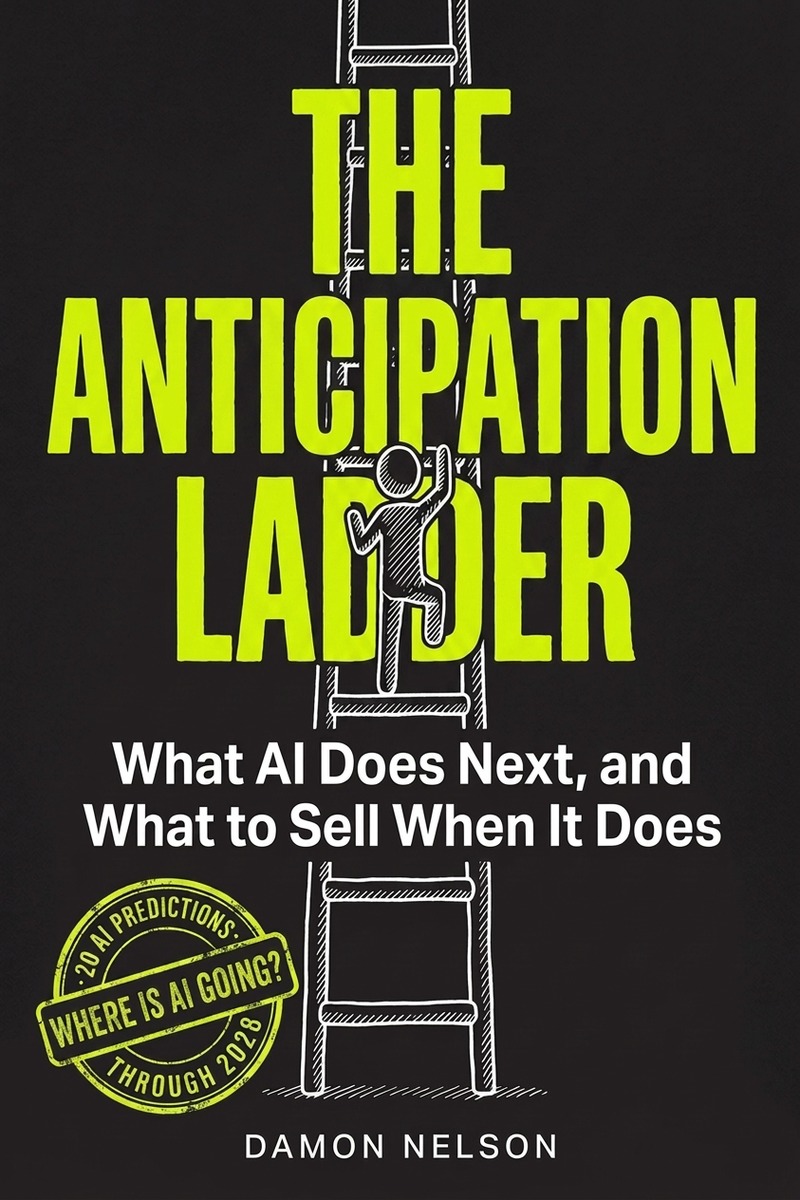
The Anticipation Ladder is a two-evening read, built to be dog-eared. The predictions stand on their own — they have checkpoint dates and a live public scorecard, so you'll know exactly when the map is right and when it isn't. That's not a promise most business books are willing to make.
Part Three is nothing but priced, sequenced offers sized for a business of one: anticipation-ladder audits, agent installs, content retrofits, machine-path builds. You can go straight there before you've finished the introduction and have a scoped service ready to quote before the week is out.
The people who lose over the next eighteen months won't lose to AI. They'll lose to somebody who read the map earlier. Find it on Amazon.
See It on AmazonQuestions people actually ask
By the time I read this, won't the predictions already be wrong?
That's the exact problem the book was built to solve. Every prediction carries a specific checkpoint date — March 2027 and March 2028 — and a public scorecard the author grades live. A dated map you can plan against is the opposite of 'AI will change everything someday' content that ages out overnight. The dates are the point.
I've bought AI books before. They're all hype and no playbook.
Fair. Part Three is the test. It's nothing but priced, sequenced offers — audits, agent installs, content retrofits — matched to specific predictions. Open it and see if you can build an offer before the first checkpoint date. If you can't, the public scorecard means you'll know exactly when the map failed. That accountability is either reassuring or disqualifying, depending on what you've been sold before.
I'm not technical. Can I actually sell AI services?
The book's core argument is that the technical edge is already gone. Every shop has the same engine for roughly eight dollars. The scarce skill is knowing which client, which bottleneck, which specific Tuesday-morning fumble to point it at. That is a marketing skill, and it's what the playbook chapters teach. No engineering required.
My clients aren't asking for AI yet. Is there even a market here for me?
This is the one objection the book concedes in part. If your market is genuinely pre-awareness, some offers in Part Three won't land yet. The honest answer is that the book helps you identify which rung your clients are already on — so you lead with the outcome they already want, a phone answered, a support ticket closed, a morning brief ready, and let the AI stay invisible. That's how the highest-rung products already work.
I don't have time for another business book right now.
The introduction is explicit: this costs an evening or two. The predictions are built to be read standalone and dog-eared. You can go straight to Part Three and have a priced offer framework before you've finished the whole thing. The ask is one evening, not a semester.
What if the predictions are just guesses dressed up with dates?
Some will be wrong. Nelson says so. The public scorecard exists precisely because, as the book puts it, forecasters who won't be graded are just entertainers. The January voice memo and the six-month check are in the introduction for a reason — to show you what it looks like when someone actually grades their own work, even when the grade is uncomfortable.