The AI race already ended in a tie. Here's what gets sold to the people who know that.
Picture a family doctor. She sees thirty patients a day, fifteen minutes each. She is good, she is present, and she is working with a slice of information that would embarrass a spreadsheet. Every visit is its own island.
Now picture something watching across all three hundred patients at once, in the same town, in the same month. Not diagnosing. Just noticing. Three hundred people, one odd cluster of symptoms, and a pattern no individual appointment could ever surface.
That thought sat with me for a long time after I wrote it down. Not because of the medicine. Because of what it said about where the value actually lives when intelligence stops being the expensive part.
I sketched out that scenario in January, over lunch, as a what-if. It's in Chapter 14 of The Anticipation Ladder: What AI Does Next, and What to Sell When It Does.
The book isn't about healthcare. That scenario is just the clearest illustration I could find of something that's already happening across every industry: the engine got cheap, the capability leveled out, and the interesting question shifted. It stopped being 'which AI is smarter?' and started being 'who knows where to point it?'
If you've been in marketing or digital services for more than a few years, you already felt that shift. You just might not have a name for it yet. The Anticipation Ladder gives it one, and then tells you what to charge for the gap.

The arms race ended. Nobody sent a memo.
The eight-dollar model handles most of what most people need. The book calls it the Great Leveling, and the implication runs through everything that follows. As Damon writes: "Intelligence became a utility bill. Nobody sends a press release when something becomes a utility bill. It just quietly stops being the interesting part." When the engine is a commodity, the person who wins is not the one with the best engine. It's the one who knows which door to walk it through.
The differentiator is not the engine. It's knowing where to install it.

Four rungs. Every AI product on earth fits on one of them.
The Anticipation Ladder classifies AI products into four stages: Reactive (answers when asked), Suggestive (proposes next moves), Anticipatory (prepares before you ask), Delegated (asks if it can just handle it). Most small businesses are sitting on rung one or two. Consumer expectations are already moving toward rung three. That gap is not a problem. The book is clear on this: "That gap, between where the world's software sits and where the world's expectations are about to be, is not a tragedy. It's a price list." The rung a business occupies is something you can charge money to change.
The rung a business sits on is a number you can charge money to change.
Your voice is the one input the model cannot manufacture.
For forty years, software treated every user the same. One template, copied to everyone. AI-powered software now remembers your history, your tone, your habits, and behaves differently for every person who runs it. One-to-many is ending. The scarce inputs are the ones that were always scarce: your voice, your opinions, your relationships. The book puts it plainly: "AI writes the skeleton. You supply the heartbeat." That is not a comfort. It is a positioning statement.
There are two reputation markets now. You can only see one.
The top Google rank and the top AI citation overlap less than 20% of the time. There is a market where AI quotes you to humans, and a separate one where AI recommends you to other AIs. Most small operators are optimizing for a front page that is no longer the front page. The book's call: "Being number one on Google does not guarantee you a place in the AI answers." The businesses that figure this out first get the second slot for free. The ones who figure it out last pay someone to retrofit it.
Word of mouth didn't die. It just stopped needing mouths.

Twenty predictions. All of them graded in public.
Every prediction in the book carries a checkpoint date, March 2027 or March 2028, and a public scorecard the author grades himself. That is not a feature. It is the whole posture of the book. Damon writes: "Forecasters who won't be graded are just entertainers. Hold me to the difference." A dated map you can plan against is the opposite of the vague 'AI will change everything someday' content that goes soft the week after you read it. The dates are the point. They are what let you build a service before the prediction lands.
The people who lose over the next eighteen months won't lose to AI. They'll lose to somebody who read the map earlier.
What readers are saying
"When intelligence becomes a commodity, the only scarce things left are your voice, your opinions, and your relationships. That single sentence reordered how I look at every offer I'm building."
— Jessica M."Proper useful book. Clear thinking, no fluff, and the playbook sections are ready to use the same day. The ladder alone is worth the price of admission."
— Sophie R."Three moves at the end are simple and sharp. Picked my stack, started the vault, and pitched the first phone agent today. The reader who invoices once keeps going. That line got me moving."
— Steve A.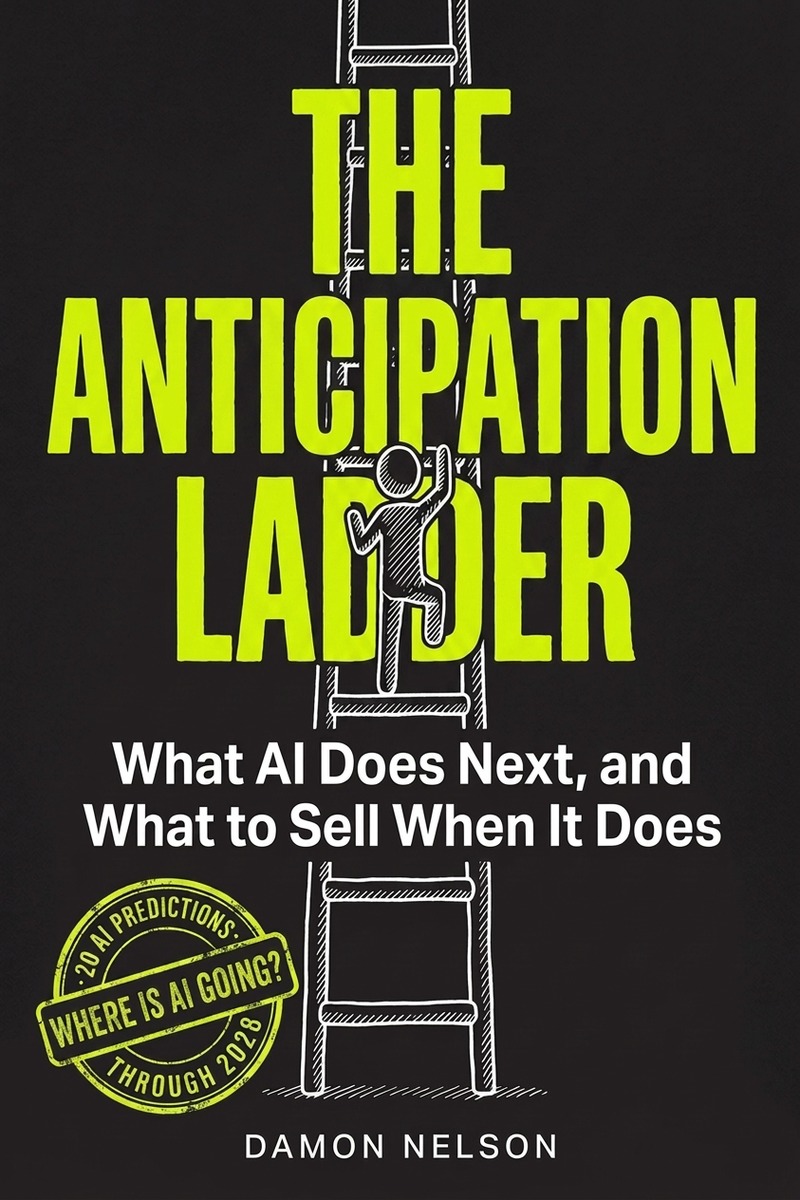
The Anticipation Ladder is built to be read in an evening or two. The introduction and the predictions stand alone and are built to be dog-eared. Part Three is nothing but priced, sequenced offer frameworks: audits, agent installs, content retrofits, sized for a business of one.
You can go straight to Part Three and have a scoped, priced service sketched out before you've finished the whole book. The ask is one evening, not a semester.
The scorecard is live. The checkpoint dates are already set. If the map is wrong, you'll know exactly when it failed, and so will everyone else reading it.
If you've been waiting for an AI book that signs its name to a deadline, this is the one. Hit the link below and grab your copy.
See It on AmazonQuestions people actually ask
By the time I read this, won't the predictions already be outdated?
Every prediction carries a specific checkpoint date, March 2027 or March 2028, and a public scorecard the author grades live. A dated map you can plan against is the opposite of the vague 'AI will change everything someday' content that goes stale overnight. The dates are the point.
I've bought AI books before and they're all ideas with no real playbook. Is this the same?
Part Three is nothing but priced, sequenced offers sized for a business of one: audits, agent installs, content retrofits, matched to specific predictions. The test is whether you can open it and build an offer before the first checkpoint date. If you can't, the public scorecard means you'll know exactly when the map failed.
I'm not technical. Can I actually sell AI services?
The book's core argument is that the technical edge is gone. Every shop has the same engine for the price of lunch. The scarce skill is knowing which client, which bottleneck, which Tuesday-morning fumble to point it at. That is a marketing skill, not an engineering one, and it's what the playbook chapters teach.
My clients aren't asking for AI yet. Is there even a market for this?
This is the one objection the book concedes in part. If your market is genuinely pre-awareness, some offers won't land yet. The honest answer: the ladder helps you identify which rung your clients are on so you lead with the outcome they already want, a phone answered, a support ticket closed, a morning brief ready, and let the AI stay invisible.
I don't have time for another business book right now.
The introduction is explicit: this costs an evening or two. The predictions stand alone and are built to be dog-eared. You can go straight to Part Three and have a priced offer framework before you've read the whole thing. The ask is one evening, not a semester.