You don't need to catch up. You need a dated map of where this is already going.
March, you nailed a new workflow. May, it was obsolete. July, you bought a course on the thing that replaced it. Now it's August and there's already another thing.
That's not bad luck. That's the game as it was designed: stay on the treadmill, keep spending, never quite arrive. And the worst part? You're not even behind because you stopped paying attention. You're behind because you kept paying attention, and it still wasn't enough.
If that sentence just landed somewhere specific in your chest, stay with me for a few minutes.
So I'm at the Dunkin' drive-thru. Same store, same two-car wait, same fumble I run every single week. I'm trying to pull up the app before the scanner guy leans out the window. The app is slow. I'm thumbing through screens. He's watching me. Thirty seconds go by. Maybe a minute. I finally find the QR code and we both pretend that wasn't embarrassing.
Same store. Same order. Every week. And I still do it manually every time.
That's rung one of the Anticipation Ladder. All the intelligence is right there in my pocket, fully paid for, already running. But the labor of asking is entirely mine. The app answers when I ask. It does not know I'm two cars back. It does not have my order ready. It is reactive, and I am the friction it runs on.
That small, dumb, recurring fumble is the concrete version of what I wrote about in The Anticipation Ladder. Every AI product on earth sits somewhere on a four-rung ladder: Reactive, Suggestive, Anticipatory, Delegated. The rung it sits on tells you exactly what the product is worth today, and exactly what it will need to be worth more tomorrow. The gap between those two things is, as I put it in the book, not a tragedy. It's a price list.
The book lays out twenty dated predictions, each one tied to a specific checkpoint so you can plan against them rather than just nod at them. It includes a public scorecard I grade live, because, as I wrote: forecasters who won't be graded are just entertainers. And it closes with a set of priced, sequenced offers built for a business of one, so you have something to invoice before the first checkpoint arrives.

The arms race already ended. Nobody won.
The eight-dollar model handles most of what most people need. The gap between the cheap tool and the expensive one closed faster than anyone predicted, and it closed for everyone at the same time. Small operators, Fortune 500 companies, your most annoying competitor: same engine, same price. The differentiator is gone. What's left is knowing which specific Tuesday-morning fumble in which specific business to point the thing at. That is a marketing skill. It always was.
The differentiator is not the engine. It's knowing where to install it.

The ladder sorts every headline in about one second.
Reactive answers when you ask. Suggestive proposes what comes next. Anticipatory prepares before you ask. Delegated asks if it can just handle the whole thing. Every AI product announcement, every keynote, every 'this changes everything' thread fits on one of those four rungs. Once you have the ladder, you stop doom-scrolling the news and start reading it as a price list. The rung a business sits on is a number you can charge money to change.
That gap, between where the world's software sits and where the world's expectations are about to be, is not a tragedy. It's a price list.
Your voice is the one input that can't be photocopied.
For forty years, software treated every user identically. One product, millions of identical copies. AI killed that model. The tool that wins now is the one that knows you specifically: your habits, your history, your way of saying things. That means the only inputs left with real scarcity are the ones that were always scarce. Your relationships. Your opinions. Your specific, field-tested, scar-tissue-backed experience. AI writes the skeleton. You supply the heartbeat.
AI writes the skeleton. You supply the heartbeat.
Dated predictions beat vague forecasts every time.
Every prediction in the book carries a checkpoint: March 2027 or March 2028. Not 'soon.' Not 'in the coming years.' A date you can put in your calendar and plan a service offer around. The public scorecard means you will know exactly when the map was right and exactly when it wasn't. That accountability is the whole point. A map you can grade is the opposite of the newsletter noise that goes stale by Thursday.
The people who lose over the next eighteen months won't lose to AI. They'll lose to somebody who read the map earlier.

The installer is a real trade with a real pricing ladder.
The same moment that created 'the computer guy' in 1998 is repeating right now. Phone agents, support agents, workflow documentation, content retrofits for the new search. These bundle into a recognized local profession with a pricing ladder a solo operator can actually run. The skills that sell that work to a small business sell the same work to a funded hardware company at ten times the invoice. Trust is the expensive part, and if you have been in this long enough to be tired, you already own some.
What readers are saying
"Proper useful book. Clear thinking, no fluff, and the playbook sections are ready to use the same day. The ladder alone is worth the price of admission."
— Sophie R."Started documenting my own workflows the way Prediction 4 says. Agents can't run what isn't written down. Simple advice that most people will ignore until it's too late."
— Mark D."Prediction 6 finally explained why my rankings look fine but traffic keeps falling. Being number one on Google doesn't mean the AI will cite you. That under-20% overlap number was a wake-up call."
— Kevin J.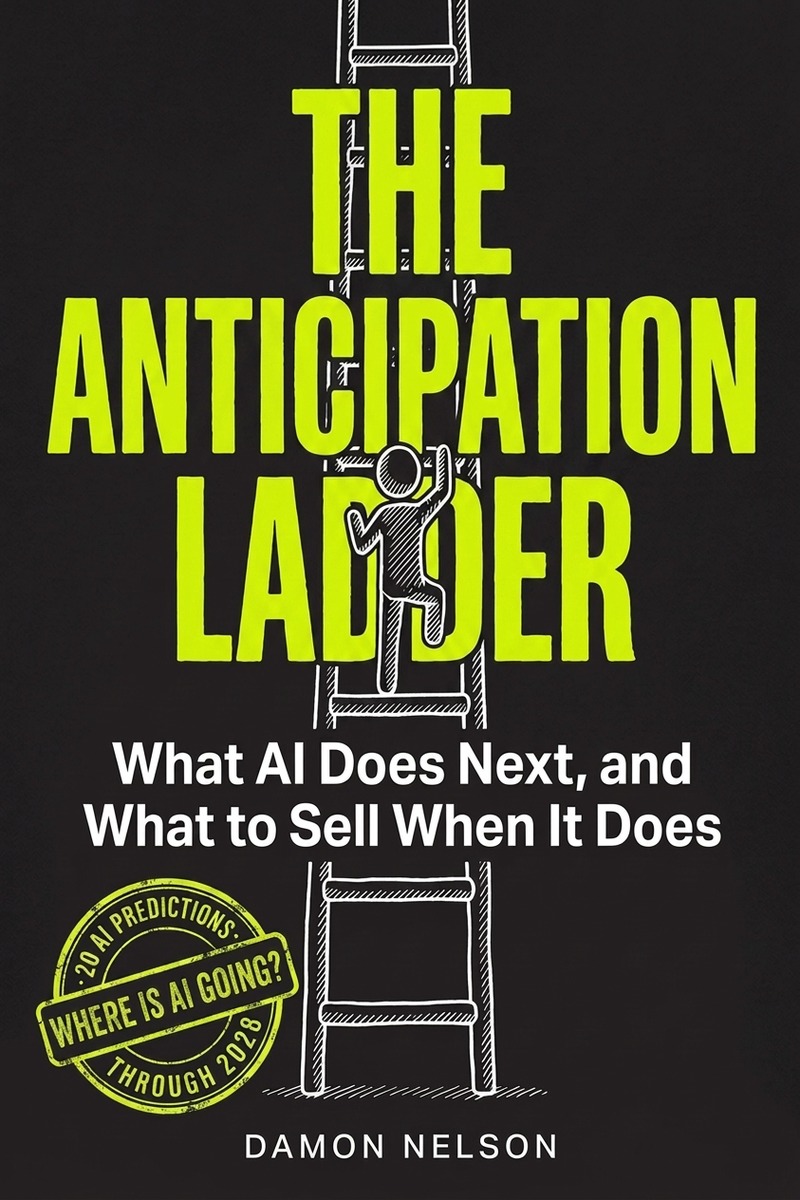
The Anticipation Ladder is one evening, maybe two. The introduction is a plain-language state of the union that takes about thirty minutes. The predictions stand alone and are built to be dog-eared. You can go straight to Part Three and have a priced offer framework before you've finished the whole book.
What you walk away with: a four-rung lens that sorts every AI headline in one second, twenty dated predictions you can plan offers around, and a public scorecard that holds the map accountable so you don't have to take it on faith.
The people who will be ahead in eighteen months are not the ones who found the smartest engine. They're the ones who read the map earlier. The link below is the map.
See It on AmazonQuestions people actually ask
By the time I read this, won't the predictions already be outdated?
Every prediction carries a specific checkpoint date, March 2027 or March 2028, and a public scorecard the author grades live. A dated map you can plan against is the opposite of the vague 'AI will change everything someday' content that goes stale overnight. The dates are the point.
I've bought AI books before and they're all hype with no real playbook. Why is this different?
Part Three is nothing but priced, sequenced offers sized for a business of one: audits, agent installs, content retrofits, matched to specific predictions. The test is simple. Open it, and see if you can build an offer before the first checkpoint date. If you can't, the public scorecard will tell you exactly when the map failed.
I'm not technical enough to sell AI services.
The book's core argument is that the technical edge is already gone. Every shop has the same engine for the price of lunch. The scarce skill is knowing which client, which bottleneck, which Tuesday-morning fumble to point it at. That is a marketing skill, not an engineering one, and it's what the playbook chapters teach.
My clients aren't asking for AI yet. Is there even a market for this?
This is the one objection the book concedes in part. If your specific market is genuinely pre-awareness, some offers won't land yet. The honest answer is that the ladder helps you lead with the outcome your client already wants — a phone answered, a support ticket closed, a morning brief ready — and let the AI stay invisible, the way the book says winning products already work.
I don't have time to read another business book right now.
The introduction is explicit: this costs an evening or two. The predictions are built to be dog-eared. You can go straight to Part Three and have a priced offer framework before you've read the whole thing. The ask is one evening, not a semester.
Will this still be relevant in six months?
The ladder framework does not depend on any single model or product. It classifies whatever gets announced next. The dated predictions either land or they don't, and the public scorecard tells you which. A tool built on a model gap dies when the gap closes. A framework built on human scarcity compounds as the models improve.