The map that tells you which AI headlines to ignore — and which ones to invoice
It was a Saturday morning dog walk. Nothing scheduled, nothing urgent. Damon had spent the previous day running a training session, and on a whim he'd fed the whole thing into NotebookLM to see what it would do with it.
What came back stopped him mid-stride. One of the AI-generated voices said, "This is absolutely brilliant. Why isn't anybody doing this?" Then it kept going, suggesting he build something with the idea, not just teach it. The machine had out-paced the man who built the thing.
He didn't go back inside. He clicked on his headphone mic and started talking. Forty-five minutes later he had a transcript, a service concept, a price, and the shape of a whole new offer. A day after that, he had the domain. SalesPageRescue exists because of a dog walk — and because something finally showed him where to point the work, instead of just what tool to pick up.
That walk wasn't the end of the thinking. It was the beginning of a longer question: if one session with one AI tool could hand him a bigger version of his own idea, what was actually happening under the hood? What came next, and how far out could you see it?
The answer became The Anticipation Ladder: What AI Does Next, and What to Sell When It Does. Damon named it plainly in the introduction: 'The people who lose over the next eighteen months won't lose to AI. They'll lose to somebody who read the map earlier.' The book is the map.
It's built around a single framework, four rungs from Reactive to Delegated, that lets you place any AI product, any headline, any competitor's move on a single scale in about one second. Paired with twenty dated public predictions and a three-part playbook of priced offers, it's the thing Damon kept looking for after that walk and couldn't find anywhere else. So he wrote it.

The arms race ended. Everybody got the weapons for eight dollars.
Chapter one makes a point that feels almost rude to say out loud: the gap between the expensive model and the cheap one is basically gone. The eight-dollar subscription handles most of what most people need. Open-weight models keep pushing the floor toward zero. So the edge stopped being 'which model are you on' and became something older and more useful. As the book puts it, 'The differentiator is not the engine. It's knowing where to install it.' That skill is a marketing skill. It can be packaged. It can be priced.
The differentiator is not the engine. It's knowing where to install it.

Four rungs. Every AI headline fits on one of them.
The Anticipation Ladder sorts the whole landscape into four stages: Reactive (you ask, it answers), Suggestive (it answers and proposes your next move), Anticipatory (it prepares before you ask), Delegated (it just asks if it should handle it). The rung your client's business sits on is the gap you get paid to close. That is not an abstract idea. It is a scoping conversation and an invoice. 'The rung a business sits on is a number you can charge money to change.'
The rung a business sits on is a number you can charge money to change.
The winning products stop saying 'AI' and just deliver a morning that worked.
There's a quiet pattern in every technology that actually wins. Nobody shops for a 'motorized thermostat.' Nobody mentions electricity when they flip a switch. The book argues AI is mid-disappearance right now: the highest-rung products already don't say 'AI' on the label — they just deliver the outcome. 'A technology hasn't fully won until it vanishes from the label.' The implication for a service seller is simple: sell the morning that worked, not the tool that made it.
There are two reputation markets now. You can only see one of them.
Google ranking and AI citations overlap less than twenty percent of the time. The book names both markets plainly: there's the citation market, where AI quotes you to humans, and the agent-recommendation market, where AI recommends you to other AIs. 'Being number one on Google does not guarantee you a place in the AI answers.' Feeding both markets with structured, useful content is recurring, skilled work. It is also work most businesses haven't started yet.
Being number one on Google does not guarantee you a place in the AI answers.

Fresh human experience is the one ingredient the machines can't manufacture.
The web is filling with machine-made content. Copies of copies, each one a little blurrier than the last. The scarce raw material AI companies actually need — and cannot produce — is fresh, dated, verified human experience. The book makes the case directly: 'When intelligence is a commodity, the only scarce inputs left are the ones that were always scarce: your voice, your opinions, your relationships.' That's not a consolation prize. That's leverage.
When intelligence is a commodity, the only scarce inputs left are the ones that were always scarce: your voice, your opinions, your relationships.
What readers are saying
"The two reputation markets law is the one I can't stop thinking about. One where AI quotes you to humans, and one where AI recommends you to other AIs. Most businesses only know the first one exists."
— Ethan R."The law that hit me hardest was 'tools built on a model gap die when the gap closes.' I've watched that exact thing happen to two tools I used to pay for. This book just gave it a name and a timeline."
— Ryan T."Eighteen months from now the phone agent isn't going to be a nice-to-have. It's going to be the baseline expectation the same way having a website was fifteen years ago. Prediction 12 is going to age well."
— Marcus H.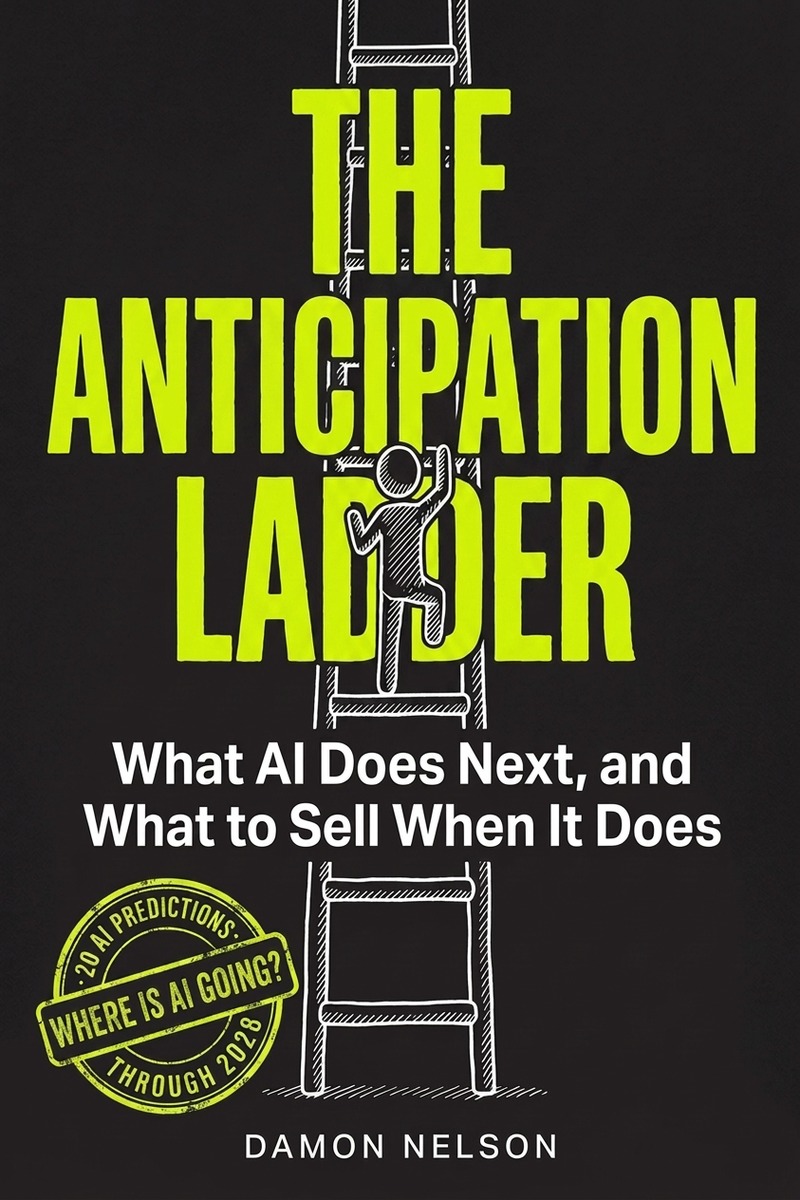
Here's what the book actually is. It's an evening, maybe two. The introduction gives you the framework. Part Three gives you priced, sequenced offers sized for a business of one — audits, agent installs, content retrofits — each matched to a specific prediction with a checkpoint date attached.
The predictions have dates. March 2027. March 2028. Damon grades them live on a public scorecard. 'Forecasters who won't be graded are just entertainers.' You'll know exactly when the map is right and exactly when it missed.
If you've been waiting to get ahead of something instead of catching up to it again, this is a reasonable place to start. Head over to Amazon and see it for yourself.
See It on AmazonQuestions people actually ask
By the time I read this, won't the predictions already be outdated?
This is the objection the book was built to answer. Every prediction carries a specific checkpoint date — March 2027 and March 2028 — and a public scorecard Damon grades live. A dated map you can plan against is the opposite of the vague 'AI will change everything someday' content that goes stale the moment the newsletter sends. The dates are the whole point.
I've bought AI books before. They're all hype with no real playbook. Why is this different?
Fair. Part Three is nothing but priced, sequenced offers sized for a one-person shop — audits, agent installs, content retrofits — each matched to a specific prediction. The test the book sets for itself: can you open Part Three and build an offer before the first checkpoint date? If not, the public scorecard will tell you exactly where the map failed. That accountability doesn't exist in most business books.
I'm not technical. Can I actually sell the services this book describes?
The book's core argument is that the technical edge is already gone. Every shop runs the same engine for about eight dollars. The scarce skill is knowing which client, which bottleneck, which specific fumble to point it at. That is a marketing skill, and it's what the playbook chapters teach. No engineering background required.
My clients aren't asking for AI yet. Is there really a market here for someone my size?
Honest answer: if your market is genuinely pre-awareness, some offers in Part Three won't land yet — and the book says so. The framework helps you identify which rung your clients are actually on so you lead with the outcome they already want: a phone answered, a support ticket closed, a morning that ran itself. The AI is invisible. That's what the book calls winning.
I don't have time for another business book right now.
The introduction is explicit: this costs an evening or two. The predictions are built to be dog-eared and stand alone. You can go straight to Part Three, skip to the offer frameworks, and have something priced before you've read the whole thing. The ask is one evening, not a semester.
Aren't the big players just going to make all of this obsolete anyway?
The book has a direct answer: tools built on a capability gap die when the gap closes. Build instead on what was always scarce — your voice, your relationships, your read on one specific market — and every model upgrade becomes a rising tide under your boat rather than over your head. The big players closing gaps doesn't hurt that position. It helps it.