The gap between where software sits and where expectations are heading is a price list
He walked into Best Buy to look at TVs. Found the one he liked. Pulled out his phone, opened the Amazon app, and scanned the barcode to check the price. He knows the salespeople hate it. He did it anyway.
The whole time, he was doing the machine's job by hand. All the noticing, all the comparing, all the asking. The intelligence was there. The labor of pulling it out was entirely his.
That moment sat with him. Because it described exactly what he'd been watching small operators do with AI for the past three years — staying current, working hard, doing all the heavy lifting themselves — and still feeling like they were one announcement away from being behind again.
He wrote about it in a book called The Anticipation Ladder. Not as a tech book and not as a forecast with footnotes. As a map with dates on it, built specifically for operators who can't afford to be wrong.
The argument is simple: AI isn't a race anymore. The engine is a utility bill now. What the book does is show you exactly where the ladder is going over the next eighteen months, and how to turn the gap between where most businesses sit today and where their clients' expectations are heading into a set of scoped, priced offers you can be running before the first checkpoint date arrives.
The predictions have public grades. Damon holds himself to them. As he puts it: "Forecasters who won't be graded are just entertainers. Hold me to the difference."

The arms race ended in a tie, and everyone won the same weapons
Chapter one of the book names what most AI newsletters won't: the engine stopped being the edge a while back. The eight-dollar model handles most of what most people need. Every shop has the same horsepower. The differentiator moved. As the book puts it: "The differentiator is not the engine. It's knowing where to install it." That is a positioning shift with a direct consequence. If you're still competing on which tool you use, you're competing on the wrong thing.
The differentiator is not the engine. It's knowing where to install it.

Four rungs. Every AI product on earth sits on one of them
The Anticipation Ladder sorts it fast: Reactive answers when asked. Suggestive proposes next moves. Anticipatory prepares before you ask. Delegated asks if it can just handle it. The rung a business sits on right now is a number you can charge money to change. Most businesses are sitting on rung one, doing exactly what he was doing in Best Buy: scanning barcodes by hand when the machine could have been doing it already. That gap is not a problem. "That gap, between where the world's software sits and where the world's expectations are about to be, is not a tragedy. It's a price list."
That gap, between where the world's software sits and where the world's expectations are about to be, is not a tragedy. It's a price list.
The winning assistant isn't the smartest one. It's the one that knows you
For forty years, software treated every user identically. Every copy of Excel ran the same. AI-powered software now remembers your voice, habits, and history. It behaves differently for every person who uses it. One-to-many is ending. The scarce inputs are the ones that were always scarce. The book puts it plainly: "When intelligence is a commodity, the only scarce inputs left are the ones that were always scarce: your voice, your opinions, your relationships." Those assets finally compound instead of expiring.
Two reputation boards are running right now, and you can only see one of them
There's the market where AI quotes you to humans — citations, search answers, recommended reads. And there's a second market, running quietly beneath it, where AI recommends you to other AIs. Agent-to-agent reviews. The book points out that the top Google rank and the top AI citation overlap less than twenty percent of the time. Being visible on one board does not buy you a seat on the other. Both reward the most specific, most useful, most structured source — which is a skill set, not a budget.
There are now two reputation markets: one where AI quotes you to humans, and one where AI recommends you to other AIs. You can only see the first one.

Build for where AI will be when you ship, not where it is when you start
A tool built on a model gap dies when the gap closes. A build takes six to eighteen months; models improve every month. The book's test for every offer idea is one question: what will this capability cost for free by my ship date? Build instead on the scarce inputs — your data, your client relationships, your judgment, your distribution. That way every model improvement lifts your offer rather than making it irrelevant before the invoice clears.
LAW OF AI Tools built on a model gap die when the gap closes.
What readers are saying
"I like that Damon actually put real dates on the predictions and promised to grade them in public. Most people just throw out vague forecasts and hope you forget. This one feels different."
— James T."Bought the book Friday night and ran the audit from Chapter 10 on three of my clients over the weekend. Two of them had no idea what the AI was saying about their business. Instant ice water moment. Already paid for itself."
— Chris P."The section on tools built on model gaps dying saved me from a bad idea I was about to build. Pride is not a market. That line stuck with me."
— Hannah G.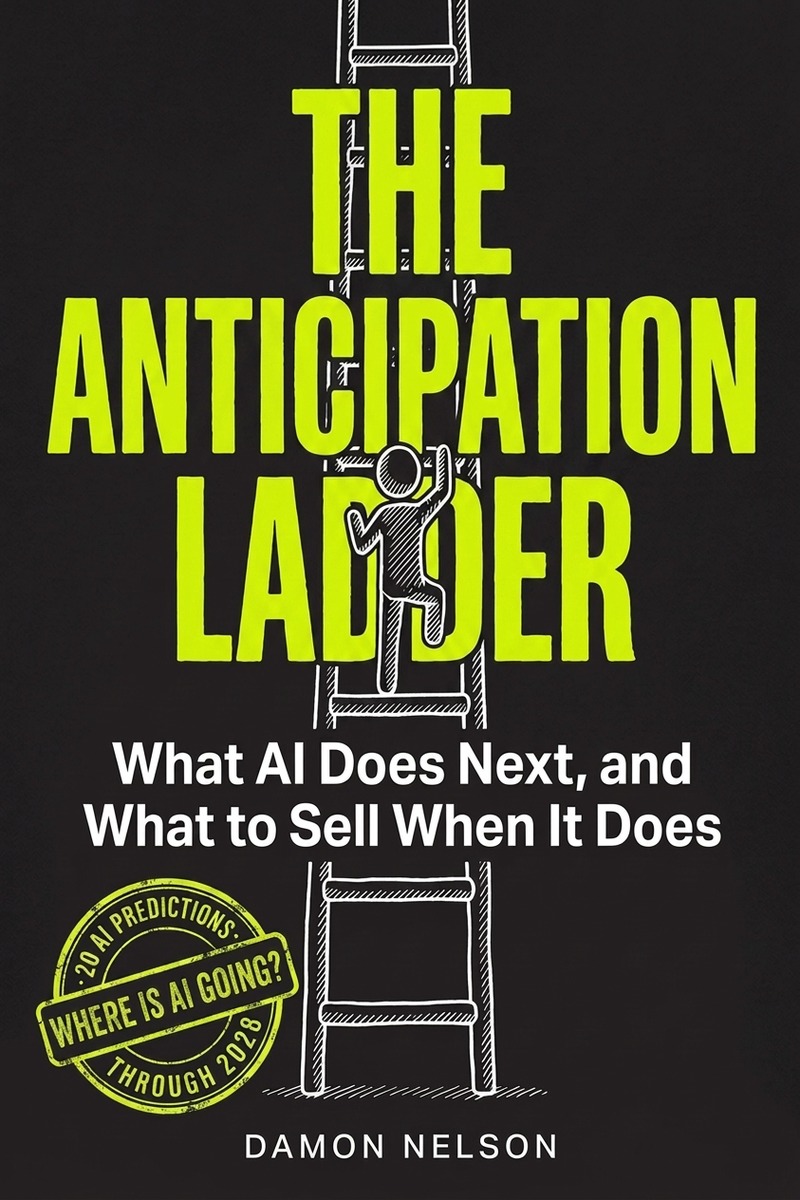
The Anticipation Ladder gives you a dated map of the next eighteen months, the four-rung framework that sorts every AI headline in one second, and a set of priced, sequenced offers you can be selling before the first checkpoint date lands in March 2027.
Part Three is nothing but the playbook: audits, agent installs, content retrofits, scoped and sized for a business of one. You can go straight there and have an offer framework before you've read the whole thing. The ask is one evening, not a semester.
The predictions are public and graded. If the map is wrong, you'll know exactly when and exactly where. That is the deal. If you've been wanting to get ahead of this instead of catching up again, the link below is where to start.
See It on AmazonQuestions people actually ask
By the time I read this, won't the predictions already be outdated?
Every prediction in the book carries a specific checkpoint date — March 2027 and March 2028 — and a public scorecard Damon grades live. A dated map you can plan against is the opposite of vague 'AI will change everything someday' content. The dates are the point. Stale overnight is what happens when there are no dates at all.
I've bought AI books before and they're all hype with no real playbook. Why is this different?
The test is a simple one: can you open Part Three and build a priced offer before the first checkpoint date? If you can't, the public scorecard means you'll know exactly when the map failed. The playbook chapters cover audits, agent installs, and content retrofits — scoped for a business of one, not a corporate team with a six-figure budget.
I'm not technical. Can someone like me actually sell AI services?
The book's core argument is that the technical edge is gone. Every operator has the same engine for the price of lunch. The scarce skill is knowing which client, which bottleneck, which Tuesday-morning fumble to point it at. That is a marketing skill. The playbook chapters teach exactly that, not engineering.
My clients aren't asking for AI yet. Is there even a market for this?
This is the one objection the book concedes in part. If your specific market is genuinely pre-awareness, some offers in Part Three won't land yet. The honest answer is that the framework helps you identify which rung your clients are already on, so you lead with the outcome they already want — a phone answered, a support ticket closed — and let the AI stay invisible, the way every winning product already works.
I don't have time to read another business book right now.
The introduction says it plainly: this costs an evening or two. The predictions are built to be dog-eared and stand on their own. You can go straight to Part Three and have a priced offer framework before you've finished the whole thing. One evening, not a semester.
Will this still be relevant a year from now?
The four-rung framework classifies products, not specific tools, so it doesn't expire when a model updates. The predictions have checkpoint dates, so you'll know exactly which calls aged well and which ones didn't. The people who lose over the next eighteen months, the book argues, won't lose to AI. They'll lose to somebody who read the map earlier.