The only AI book where the author signs his name to dates and grades himself in public
You're standing in a Best Buy. A TV on the wall looks right. Price seems fair. You pick up your phone, scan the barcode, and check Amazon before the salesperson finishes walking over. You already know who wins.
Here's the part nobody says out loud: you did all the work. Every bit of intelligence that comparison required, you supplied. The phone answered when you asked. That's it. That's the whole deal.
I've been that guy in the aisle more times than I care to admit. And the first time I thought carefully about why that felt slightly embarrassing, I had the seed of everything in this book.
That Best Buy moment is rung one on what I ended up calling the Anticipation Ladder. Your phone had everything it needed to help you before you walked through the door. The price comparison, your purchase history, the three sets in your eye-line. But it sat quiet until you asked. All the noticing was still your job.
That gap between 'it answered' and 'it already knew' is where the next eighteen months of AI development is happening. And if you sell marketing, content, or any kind of digital service to small businesses, the rung your clients sit on right now is a number you can charge money to move.
The book is called The Anticipation Ladder. It maps the climb from reactive to anticipatory to fully delegated, attaches twenty predictions to real checkpoint dates, and hands you a three-part playbook of priced offers you can be selling before the first date arrives. I also built a public scorecard so you can watch me be right or wrong in real time, which is either brave or foolish — I'll know by March 2027.

The arms race already ended — and everybody got the weapons
Here's something the AI newsletter cycle doesn't want to admit: the gap between the expensive model and the cheap one is nearly gone. The eight-dollar tier handles most of what most people need. Open-weight models keep pushing the floor toward zero. 'Intelligence became a utility bill. Nobody sends a press release when something becomes a utility bill. It just quietly stops being the interesting part.' What that means for you is that chasing the next model is a treadmill, not a strategy. The differentiator moved. It moved to knowing exactly which client, which bottleneck, which fumble to point the engine at. That's a marketing skill. It's also, according to this book, the most sellable skill in the room.
The differentiator is not the engine. It's knowing where to install it.

There are now two reputation markets, and you can only see one of them
You already know about Google rankings, backlinks, review counts. The visibility game you've been playing for years. Here's what most people haven't clocked yet: a second, parallel market has opened up where AI systems recommend businesses to other AI systems, and being number one on Google does not guarantee you a place in those answers. The two lists overlap less than 20% of the time. The book spends a full chapter on how to structure your content and presence so you show up in both. 'The machines can take your traffic. They cannot take your list.' That line is doing real work, and it gets a lot of practical backing in the chapters that follow.
There are now two reputation markets: one where AI quotes you to humans, and one where AI recommends you to other AIs. You can only see the first one.
The 'Do It For Me' button is rung four, and almost everyone presses it
Think about the last time a software tool offered you a tutorial. Did you want the tutorial, or did you want the thing the tutorial was supposed to get you to? That question cuts right to the biggest business story in the book. When a trustworthy agent offers to just handle it, the answer is almost always yes. The chapter on delegated AI isn't a technical forecast — it's a practical walkthrough of what support agents, phone agents, and task agents look like when they're productized and sold to Main Street businesses. This is what I call the computer-guy moment, and the window to be first in your market is open right now.
Nobody ever wanted the training. They wanted the thing that the training produces.

Fresh human experience is the one raw material the machines cannot manufacture
The internet is filling with machine-made content. Copies of copies, each a little blurrier. The scarce thing, the thing every AI company actually needs and cannot generate, is dated, verified, first-person human experience. 'When intelligence is a commodity, the only scarce inputs left are the ones that were always scarce: your voice, your opinions, your relationships.' That's not a consolation prize for people who feel left behind. That's the strategic position the last chapter of this book is built on. The twenty-year arrangement where your data made platforms rich for free is starting to renegotiate, and it pays to know where you stand before the new terms are set.
What readers are saying
"The whole 'intelligence became a utility bill' idea reframes everything. Once the engines are equal, the only things left that matter are your voice, your judgment, and your relationships. That feels true."
— Claire E."The two reputation markets law is the one I can't stop thinking about. One where AI quotes you to humans, and one where AI recommends you to other AIs. Most businesses only know the first one exists."
— Ethan R."Prediction 3 saying good-enough intelligence gets cheaper than coffee by March 2028 already feels close. The eight-dollar tiers are handling most of what I need today. Access is no longer the product."
— Ashley R.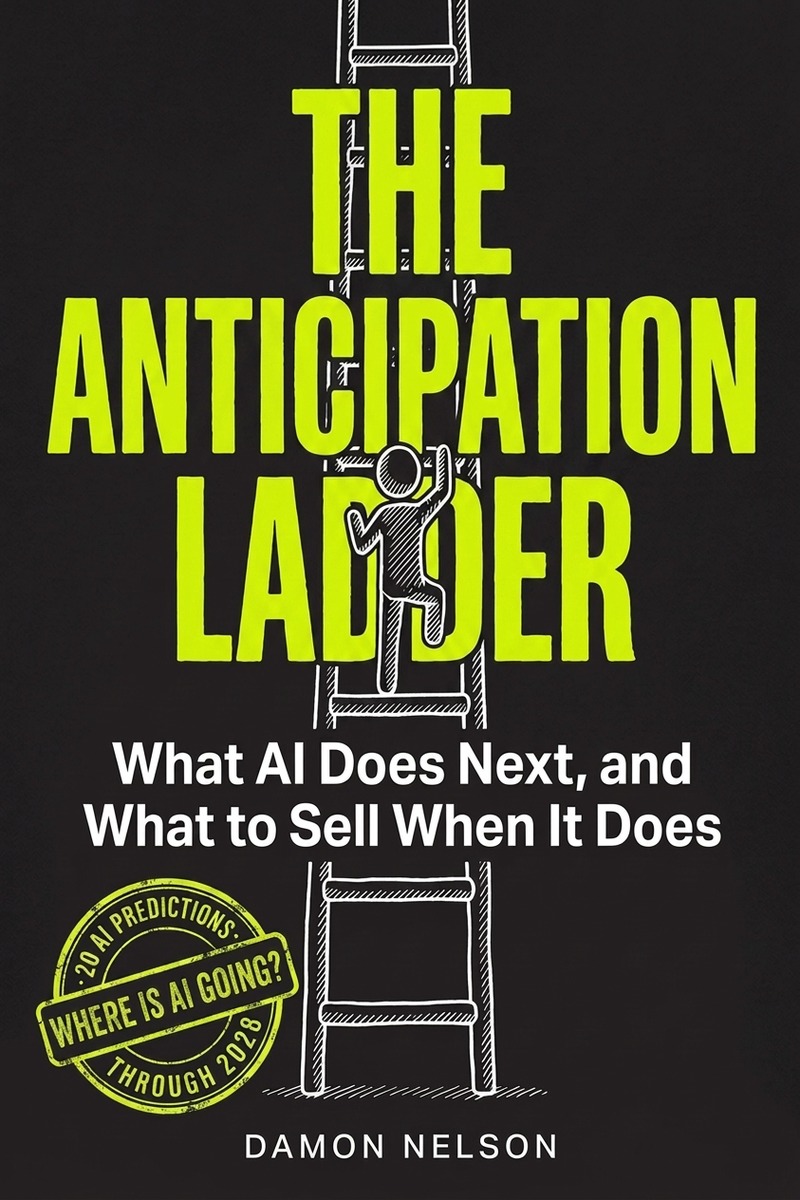
Here's what you're actually getting. One clear framework that lets you place any AI headline on a four-rung scale in about one second. Twenty predictions with real checkpoint dates you can plan against. A three-part playbook of priced, sequenced offers sized for a shop of one or two people. And a public scorecard where I grade my own calls, on the record, when the dates arrive.
The introduction is explicit about the time ask: an evening, maybe two. Part Three stands alone. You can go straight to the offer frameworks before you've read the whole thing and have a scoped service ready before the first checkpoint date.
'The people who lose over the next eighteen months won't lose to AI. They'll lose to somebody who read the map earlier.' I wrote that in the introduction because I believe it, and I put my name on dates because I think forecasters who won't be graded are just entertainers. Check what it costs on Amazon and decide for yourself.
See It on AmazonQuestions people actually ask
By the time I read this, won't the predictions already be outdated?
Every prediction carries a specific checkpoint date — March 2027 and March 2028 — and a public scorecard the author grades live. That's the structural difference from a vague 'AI will change everything' take. A dated map you can plan against doesn't go stale overnight. If a prediction misses, the scorecard says so.
I've bought AI books before and they're full of hype and no real playbook. Why is this different?
Part Three is nothing but priced, sequenced offers for a business of one. Audits, agent installs, content retrofits, each matched to a specific prediction and rung. The honest test: can you open Part Three and build a scoped offer before the first checkpoint date? If you can't, the scorecard is right there to tell you the map failed.
I'm not technical. Can I actually sell the services this book describes?
The book's core argument is that the technical edge is already gone. Every shop has the same engine for roughly the same monthly cost. The scarce skill is knowing which client, which bottleneck, which specific fumble to point it at. That is a marketing skill, not an engineering one, and that's what the playbook chapters are built around.
My clients aren't asking for AI yet. Is there even a market for this?
This is the one objection the book concedes in part. If your specific market is genuinely pre-awareness, some offers in Part Three won't land yet. The honest answer is that the ladder helps you lead with the outcome your clients already want — a phone answered, a ticket closed, a morning brief ready — and let the AI be invisible. The book calls that the sound of winning.
I don't have time for another business book right now.
The introduction puts it plainly: one evening, maybe two. The predictions are designed to be dog-eared and used as a standalone reference. You can go straight to Part Three and have a priced offer framework before you've finished the whole thing. The ask is one evening, not a semester.