The $97 Tool Died Quietly. Here's What He Built From the Grief.
It didn't send a farewell email. There was no announcement, no changelog entry, no moment you could point at. One ordinary week, the specialized tool he'd been paying $97 a month for — built by one of the best direct-response copywriters alive, the guy who invented the Video Sales Letter — just stopped being worth the line item. The eight-dollar model on his phone matched it for everything he actually needed.
He felt grief. That sounds dramatic, but it's the honest word. There was real craft inside that tool. And then he felt something else: gratitude. Because the thing he'd been renting was now in the utility bill. The arms race had ended, and everyone got the weapons for eight dollars.
That moment is what this book is about. Not the tool. What comes after the leveling.
The Anticipation Ladder, by Damon Nelson, started as a personal framework — a way to stop reacting to every AI headline and start placing each one on a single, simple scale. It grew into a dated map: twenty public predictions, each with a checkpoint date of March 2027 or March 2028, graded live on a public scorecard with the author's name on it.
The book's core argument isn't that AI is changing everything. You already know that. The argument is that the change is following a specific four-rung sequence, and the rung a business sits on right now is a number someone can charge money to move.
Nelson doesn't hide behind vague 'someday' language. The map has dates. The scorecard has grades. As he puts it: "Forecasters who won't be graded are just entertainers." This is the other kind.

The leveling already happened. The edge moved.
Chapter 1 makes a case most AI content is too optimistic to make: the capability race is over, and it ended in a tie. Open-weight models keep pushing the floor toward zero. The eight-dollar subscription handles most of what most people need. So if your strategy is 'keep up with the tools,' you are running a race that finished without a winner. Nelson's call: The differentiator is not the engine. It's knowing where to install it. That skill is a marketing skill. It's what the playbook chapters teach, and it's the one thing the base model cannot supply.
The differentiator is not the engine. It's knowing where to install it.

The four rungs tell you exactly where the money is moving.
The Anticipation Ladder sorts every AI product on earth into four positions: Reactive (you ask, it answers), Suggestive (it answers and proposes what's next), Anticipatory (it prepares before you ask), Delegated (it asks whether it should just handle it). Most small businesses are stuck on rung one. The book's argument is simple and concrete: the rung a business sits on is a number you can charge money to change. That framing alone turns 'AI consulting' from a vague pitch into a scoped, billable audit.
The rung a business sits on is a number you can charge money to change.
Two reputation markets exist. You can only see one of them.
There's the search ranking everyone's been optimizing for twenty years. Then there's the one that's invisible: the market where AI systems recommend you to other AI systems, with no human in the loop. These two lists overlap less than 20% of the time. Nelson's line cuts clean: "Being number one on Google does not guarantee you a place in the AI answers." Part Two of the book shows what structured, useful content looks like to a machine reader, and why the most useful, most structured source wins in both markets at once.
Being number one on Google does not guarantee you a place in the AI answers.
The 'do it for me' button is the biggest business story in the book.
Chapter 7 makes a point that's obvious in hindsight. Nobody ever wanted the training manual for the software. They wanted the outcome the software was supposed to produce. When a trustworthy agent can deliver the outcome directly, almost everyone presses that button. The chapter maps which support, content, and operations jobs are first in line and sizes them as priced services a one-person shop can deliver today. Not someday. Before the first checkpoint date.

You are the one ingredient the machines cannot manufacture.
The book's most optimistic chapter is also its most practical. The machines trained on human-made content. Now the internet fills with machine-made content, copies of copies each a little blurrier. Fresh, dated, verified human experience is the scarcest raw material in the system. Nelson's framing: "When intelligence is a commodity, the only scarce inputs left are the ones that were always scarce: your voice, your opinions, your relationships." That's not a pep talk. It's a positioning strategy with a price tag attached.
When intelligence is a commodity, the only scarce inputs left are the ones that were always scarce: your voice, your opinions, your relationships.
What readers are saying
"Proper useful book. Clear thinking, no fluff, and the playbook sections are ready to use the same day. The ladder alone is worth the price of admission."
— Sophie R."Showed a client the screen of what the AI said about his business versus his competitor. The look on his face was priceless. The audit sells itself. This book is already making me money."
— Brian C."Memory becoming the moat (Prediction 15) is the quiet one that will matter most. By the eighteen-month mark, switching assistants is going to feel like leaving a relationship, not just changing software. That's sticky in a way most people aren't pricing yet."
— Brandon W.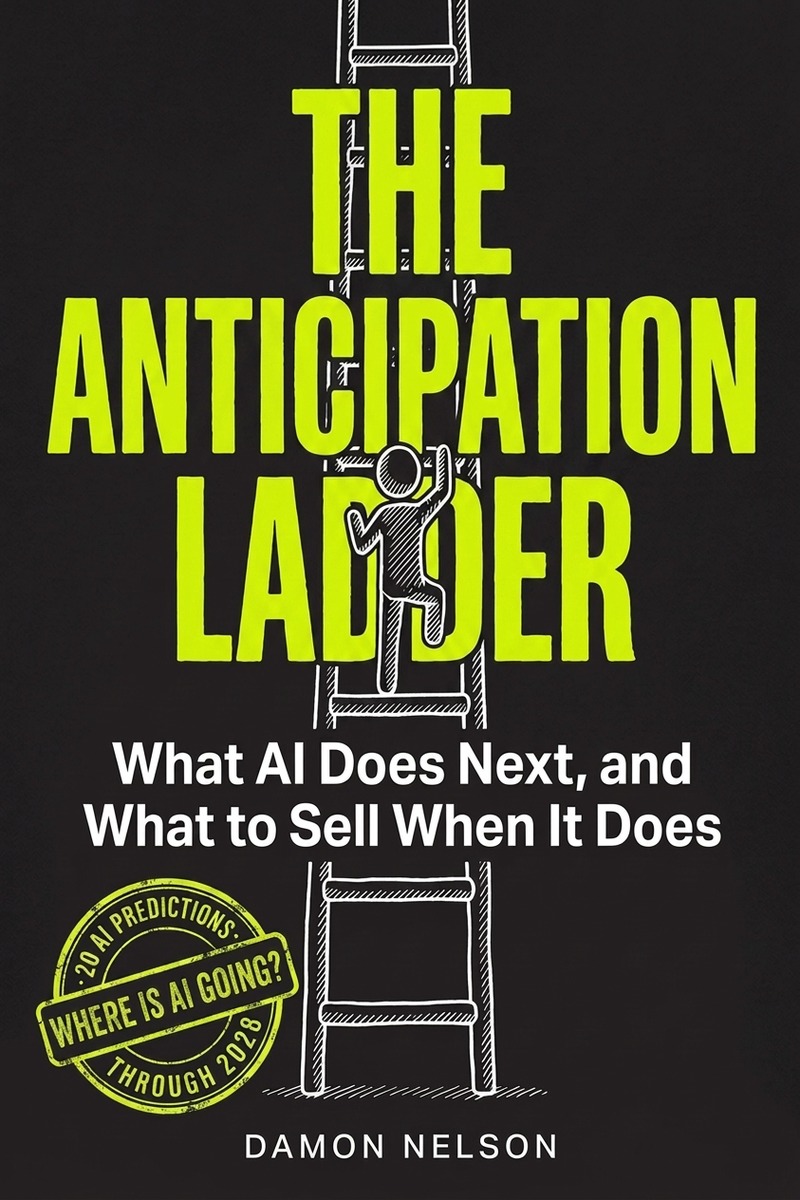
Here's what you get. A dated map of the next eighteen months of AI development, organized by the four rungs of the Anticipation Ladder. Twenty public predictions with specific checkpoint dates the author grades live. A three-part playbook in Part Three with priced, sequenced offers — audits, agent installs, content retrofits — sized for a business of one.
The introduction is honest about the ask: this costs an evening, maybe two. The predictions are built to be dog-eared. You can go straight to Part Three and have a priced offer framework before you've read the whole thing.
"The people who lose over the next eighteen months won't lose to AI. They'll lose to somebody who read the map earlier." If that line lands, the next move is obvious.
See It on AmazonQuestions people actually ask
By the time I read this, won't the predictions already be outdated?
Every prediction in the book carries a specific checkpoint date — March 2027 or March 2028 — and a public scorecard the author grades live. The dates are the point. A map with checkpoints you can plan against is the opposite of the vague 'AI will change everything someday' content that goes stale the morning after you read it.
I've bought AI books before. They're all hype with no real playbook.
Part Three is nothing but priced, sequenced offers sized for a business of one: audits, agent installs, content retrofits, matched to specific predictions. The test is simple — can you open it and build a billable offer before the first checkpoint date? If you can't, the public scorecard tells you exactly when the map failed. That accountability is either the book's best feature or a very public way for the author to be wrong.
I'm not technical. Can I actually sell AI services?
The book's core argument is that the technical edge is gone. Every shop has the same engine for eight dollars. The scarce skill is knowing which client, which bottleneck, which specific Tuesday-morning fumble to point it at. That's a marketing skill. The playbook chapters are built around that skill, not around coding or model configuration.
My clients aren't asking for AI yet. Is there even a market for this?
Honest answer: if your specific market is genuinely pre-awareness, some offers in Part Three won't land yet. The book helps you identify which rung your clients are actually on, so you lead with the outcome they already want — a phone answered, a support ticket closed, a morning brief ready — and let the AI stay invisible. That's how the highest-rung products already work.
I don't have time to read another business book right now.
The introduction is explicit: this costs an evening or two. The predictions are built to stand alone and be dog-eared. Part Three works before you've finished the whole book. The ask is one evening, not a semester. If you can't make that work, the book probably isn't the problem.
How is this different from every AI newsletter I already subscribe to?
Newsletters give you weekly takes with no skin in the game. This book has a public scorecard with the author's name on the predictions and a grade date on every call. There's a word for forecasters who won't be graded: entertainers. This is the other kind.