The arms race ended in a tie. Here's who wins the next eighteen months.
I was paying $97 a month for a specialized AI copywriting tool. Good one, too. Built by the guy who invented the Video Sales Letter. It earned its keep because it wrote sales copy noticeably better than the general-purpose models. I liked it. I renewed it without thinking.
Then one ordinary week, no announcement, nothing to point at, I noticed the eight-dollar model already on my phone matched it for everything I actually needed. Not close. Matched.
I felt grief, then gratitude, then something I couldn't name for a few days. The thing I'd been renting was now included in the utility bill. And if that was true for a $97 specialist tool, it was probably true for a lot of the edges people were still paying to rent.
That moment is what made me write The Anticipation Ladder: What AI Does Next, and What to Sell When It Does.
The book starts from one honest observation: the arms race is over, and it ended in a tie. The eight-dollar model handles most of what most people need. Capability is no longer the edge. Knowing where to install it is.
What the book gives you is a dated map of the next eighteen months of AI development, a four-rung framework that sorts every AI headline in about one second, and a set of priced, sequenced offers you can be selling before the first checkpoint date arrives. There is also a public scorecard where I grade myself. Out loud. In real time. Because, as I wrote in the conclusion, forecasters who won't be graded are just entertainers.

The engine is a commodity. The address is everything.
For years, the winning move was finding the smartest model. That race is done. Intelligence became a utility bill. The differentiator now is knowing which business, which bottleneck, which Tuesday-morning fumble to point it at. The book calls this the Great Leveling, and it is genuinely good news for small operators: the Fortune 500's engine is now on your phone for the price of lunch. The scarce inputs are the ones that were always scarce: your voice, your opinions, your relationships.
The differentiator is not the engine. It's knowing where to install it.

Four rungs. Every AI product on earth fits on one of them.
The Anticipation Ladder sorts every AI product into one of four positions: Reactive (answers when asked), Suggestive (proposes next moves), Anticipatory (prepares before you ask), Delegated (asks if it can just handle it). The rung a business occupies is a number you can charge money to change. The gap between where most software sits today and where consumer expectations are heading is, in the book's words, not a tragedy. It is a price list.
That gap, between where the world's software sits and where the world's expectations are about to be, is not a tragedy. It's a price list.
The tool that vanishes is the tool that won.
CES 2026 was the biggest AI show ever staged. The winning companies barely said the word. A technology hasn't fully won until it disappears from the label, and AI is mid-disappearance right now. What that creates is a quiet, recurring need: every invisible AI layer runs on visible, structured inputs that someone has to supply. That loading-dock work is skilled, recurring, and paid. The book maps exactly what that work looks like and what it invoices for.
Two reputation boards are running. You can only see one.
There is a market where AI quotes you to humans, and a market where AI recommends you to other AIs. The top Google rank and the top AI citation overlap less than 20% of the time. The book gives you a concrete framework for showing up on both boards, because being number one on Google does not guarantee you a place in the AI answers. Word of mouth didn't die. It just stopped needing mouths.
Being number one on Google does not guarantee you a place in the AI answers.

The installer is a real trade with a real pricing ladder.
The same moment that created 'the computer guy' in 1998 is repeating right now. Phone agents, support agents, workflow documentation, content retrofits: these bundle into a recognized local profession. The same skills sell up-market to funded hardware companies at ten times the invoice, because thousands of them built brilliant products with no human story and no path for machine buyers. Trust is the expensive part. Small operators already own some.
What readers are saying
"Eighteen months out, the AI installer trade in Prediction 19 is going to look obvious in hindsight. Right now it still feels early. That's usually the best time to start."
— Megan T."I keep coming back to the law about the differentiator not being the engine. It's knowing where to install it. That's the whole game now. Most people are still arguing about models."
— Derek L."The do-it-for-me button in Prediction 10 is going to reshape software faster than most people realize. By March 2028 a product without that option is going to feel broken. Almost everyone will press it."
— Tyler J.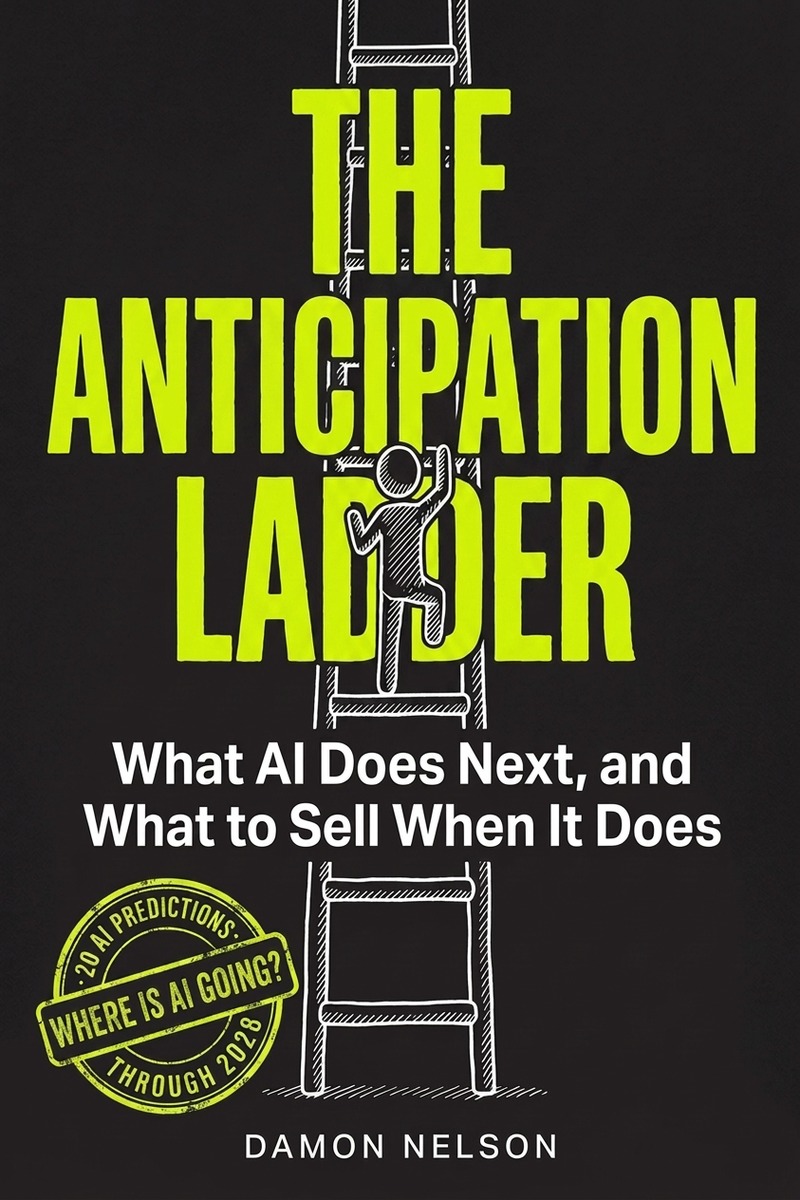
The Anticipation Ladder is built to cost you an evening, not a semester. The introduction lays out the framework. The predictions stand alone and are built to be dog-eared. Part Three is nothing but priced, sequenced offers sized for a business of one: audits, agent installs, content retrofits, matched to specific checkpoint dates.
Every prediction carries a date. March 2027. March 2028. And a public scorecard I grade myself, live, when each one arrives. No other book in this category has the author signing their name to dates and checking the work out loud. That is not a marketing line. That accountability is the point.
If you've been waiting to get ahead of this instead of catching up again, the link below is where to go.
See It on AmazonQuestions people actually ask
By the time I read this, won't the predictions already be outdated?
Every prediction in the book carries a specific checkpoint date: March 2027 and March 2028. A dated map you can plan against is the opposite of the vague 'AI will change everything someday' content that goes stale overnight. The dates are the point. The public scorecard means you'll know exactly when the map is right and when it missed.
I've bought AI books before and they were all hype with no real playbook.
Fair. Part Three is the test. It is nothing but priced, sequenced offers sized for a business of one: audits, agent installs, content retrofits. Open it and try to build a scoped offer before the first checkpoint date. If you can't, the scorecard promise means the map failed, and you'll know it on a specific date rather than some vague someday.
I'm not technical enough to actually sell AI services.
The book's whole argument is that the technical edge is gone. Every shop has the same engine for eight dollars. The scarce skill is knowing which client, which bottleneck, which Tuesday-morning fumble to point the engine at. That is a marketing skill, not an engineering one, and it is what the playbook chapters teach.
My clients aren't asking for AI yet, so there's no market for this.
This is the one objection the book partly concedes. If your market is genuinely pre-awareness, some offers in Part Three won't land yet. The honest answer is that the book helps you identify which rung your clients are on, so you lead with the outcome they already want: a phone answered, a support ticket closed, a brief ready. The AI stays invisible, the way winning products already work.
I don't have time to read another business book right now.
The introduction is explicit about this: it costs an evening or two, not a semester. The predictions are built to be read standalone and dog-eared. You can go straight to Part Three and have a priced offer framework before you've read the whole thing. One evening is the ask.