He Spent Ten Years Training Software That a Free Tool Replaced in a Day. He Wrote the Map So You Don't Have To.
For about ten years, I started every morning the same way. Sit down, open Dragon NaturallySpeaking, read a few sentences out loud to warm it up, and pray my voice sounded exactly like it did the last time I trained the thing. Catch a cold and it would quit understanding me. Drift two inches from the mic and same problem.
And the output was verbatim — every um, every half-sentence I abandoned, every tangent that wandered off and never came back. I'd spend as much time cleaning the transcript as I would have spent just typing. I got good at it. I got good at a thing that, it turns out, was already on its way out.
I switched to Wispr Flow. No training session. No reading paragraphs to it. Out of the box, it hit 98 to 99% accuracy. The ums never showed up in the output. They just disappeared, like it knew I didn't mean them.
A year later it started rewriting me — grammar fixed, the whole thing tightened, making my rambling sound the way I meant it to sound. This story you just read? I dictated it straight into that tool.
That morning I sat there and did the math. Ten years of careful training. Gone. Replaced overnight by something that needed none of it. And I realized: I had been running as fast as I could on a treadmill that was about to be unplugged. That's when I started writing The Anticipation Ladder.

The Arms Race Already Ended. Almost Nobody Noticed.
Chapter one of the book makes a case that feels a little uncomfortable the first time you read it: the model war is basically over. The eight-dollar subscription handles most of what most people need, and open-weight models keep pushing the floor toward zero. The book calls it plainly — "Intelligence became a utility bill. Nobody sends a press release when something becomes a utility bill. It just quietly stops being the interesting part." If you've been chasing new models hoping one of them finally gives you a durable edge, that chapter is a permission slip to stop.
Intelligence became a utility bill. Nobody sends a press release when something becomes a utility bill. It just quietly stops being the interesting part.

The Ladder Tells You What Anything Is Worth in About One Second.
The core framework in the book is four rungs: Reactive (you ask, it answers), Suggestive (it answers and then tells you what to ask next), Anticipatory (it prepares before you ask), Delegated (it asks if it should just handle the whole thing). Every AI headline, every new product, every client request fits on one of those rungs. Once you have the framework, you stop needing to read every breathless announcement. You just place it on the ladder and decide in the same breath whether it's worth your time. The book puts it straight: "The rung a business sits on is a number you can charge money to change."
The rung a business sits on is a number you can charge money to change.
Winning Products Stop Saying 'AI' Entirely.
There's a chapter in the book built around one observation: a technology hasn't fully won until it disappears from the label. Nobody shops for a motorized thermostat. The highest-rung AI products already work this way — they just deliver a morning that worked. But every invisible layer still runs on structured, accurate inputs. Feeding those inputs is skilled, recurring, paid work. The businesses that figure this out early stop selling AI and start selling outcomes. That's a completely different sale, and a much easier one.
A technology hasn't fully won until it vanishes from the label.
There Are Two Reputation Markets Now. You Can Only See One.
The book spends a chapter on something most people in marketing haven't felt yet: there are now two separate lists that matter for visibility. One is where AI quotes you to humans. The other is where AI recommends you to other AIs. Those two lists overlap less than 20% of the time. Being number one on Google is no longer a guarantee of anything in the second market. The book is direct: "Being number one on Google does not guarantee you a place in the AI answers." Understanding both markets, and how to show up in each, is a concrete service you can scope and invoice.
There are now two reputation markets: one where AI quotes you to humans, and one where AI recommends you to other AIs. You can only see the first one.

The Differentiator Is Not the Engine.
This is the one that changes how you think about your own positioning. The Fortune 500 and the one-person shop are running the same model. Their extra ten thousand employees don't make their AI one point smarter. The edge now belongs to whoever knows which specific business, which specific bottleneck, which annoying Tuesday-morning fumble to point it at. The book calls that skill marketing, not engineering. "The differentiator is not the engine. It's knowing where to install it." That's a skill you already have. The book gives you the framework for packaging and selling it.
The differentiator is not the engine. It's knowing where to install it.
What readers are saying
"The two reputation markets law is the one I can't stop thinking about. One where AI quotes you to humans, and one where AI recommends you to other AIs. Most businesses only know the first one exists."
— Ethan R."Showed a client the screen of what the AI said about his business versus his competitor. The look on his face was priceless. The audit sells itself. This book is already making me money."
— Brian C."The section on tools built on model gaps dying saved me from a bad idea I was about to build. Pride is not a market. That line stuck with me."
— Hannah G.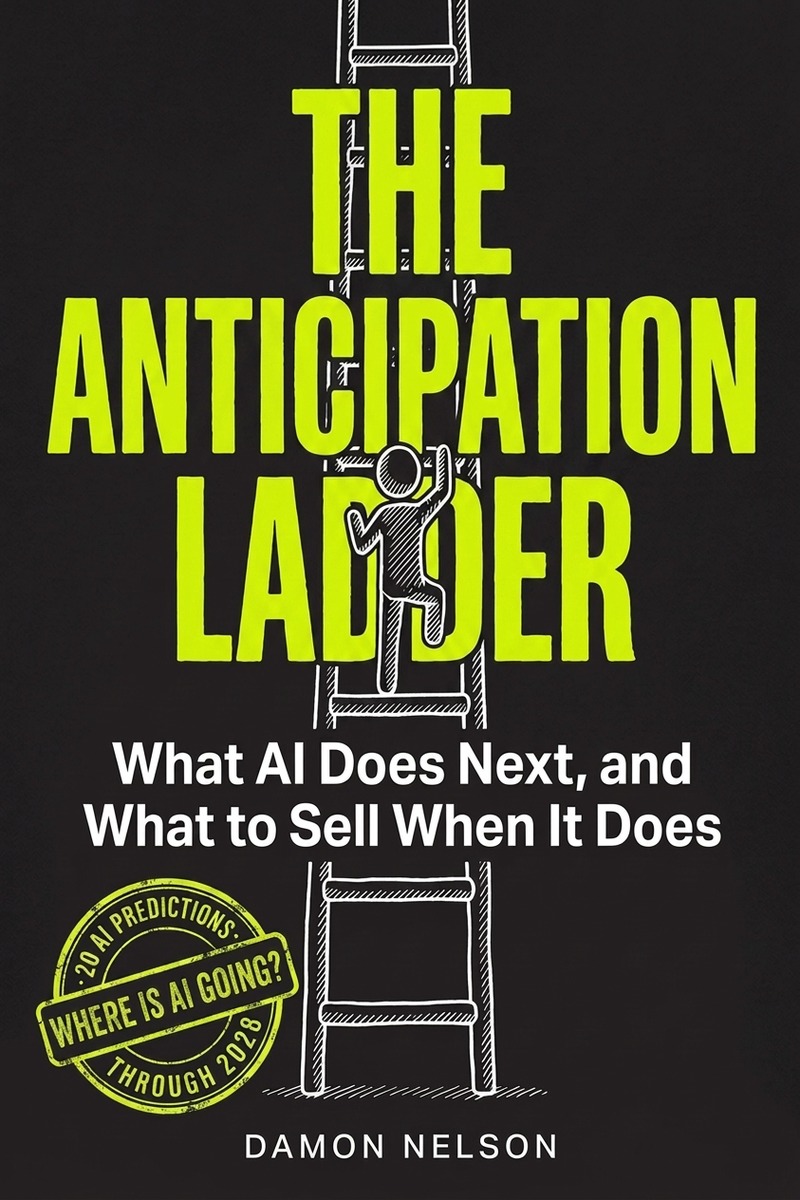
The Anticipation Ladder is one evening. Maybe two if you want to mark it up. The framework is in the first half; the playbook is in Part Three — priced, sequenced offers sized for a business of one. Audits, agent installs, content retrofits, each one matched to a specific rung and a specific checkpoint date.
There are twenty public predictions in the book, each with a date — March 2027 or March 2028 — and a live scorecard the author grades himself against. No other book in this category has the author signing their name to specific dates and reporting back in public. "Forecasters who won't be graded are just entertainers." This one is graded.
If you've been following the newsletter or caught a session somewhere, you already know the voice. This is the thing the sessions were pointing toward. Go find it on Amazon, see what it costs, and decide if one evening is worth a map you can actually plan against.
See It on AmazonQuestions people actually ask
By the time I read this, won't the predictions already be outdated?
Every prediction has a specific checkpoint date — March 2027 or March 2028 — and a public scorecard the author grades live. A dated map you can plan against is the opposite of 'AI will change everything someday' content. Vague predictions go stale. Dated ones give you something to act before and something to measure after.
I've bought AI books before and they're all big ideas with no actual playbook.
Part Three is nothing but priced, sequenced offers built for a business of one. The test the book sets for itself is simple: can you open it and have a scoped, priced offer before the first checkpoint date arrives? If you can't, the scorecard is public and you'll know exactly when the map failed. That's a different promise than most.
I'm not technical. Can I actually sell any of this?
The book's core argument is that the technical edge is gone. Every shop has the same engine for roughly the price of a streaming subscription. The scarce skill is knowing which client, which bottleneck, which specific problem to aim it at. That is a marketing skill. The playbook chapters are built around that assumption, not an engineering one.
My clients aren't asking for AI yet. Is there even a market for this?
Honest answer: if your market is genuinely pre-awareness, some offers in Part Three won't land yet. The book helps you identify which rung your clients are actually on, so you lead with the outcome they already want — a phone answered, a ticket closed, a brief ready in the morning — and let the AI stay invisible. That sale is easier than pitching AI directly.
I don't have time to read another business book right now.
The introduction says it plainly: this costs an evening or two. The predictions are built to be dog-eared and stand on their own. You can go straight to Part Three and have a priced offer framework before you've finished the whole thing. The ask is one evening, not a semester.
Is this really different from the newsletter and the sessions, or is it just the same material in a longer format?
The newsletter and sessions are the thinking out loud. The book is the framework made permanent, with the full four-rung ladder, all twenty dated predictions, and the complete Part Three playbook in one place. If the sessions made you want more structure, this is where the structure lives.