The tool got so good it turned invisible. Here is why that matters more than any AI announcement you read this week.
For about ten years I talked to software and then fixed what it got wrong. That was the deal with Dragon NaturallySpeaking. You read to it for hours so it could learn your voice. You stayed close to the mic. You spoke carefully, like you were giving a deposition. Catch a cold and you were back to the keyboard because it simply stopped recognizing you as you.
The other thing it did was take you verbatim. Every um, every half-sentence, every tangent that should have died in your throat went straight onto the page. The draft was technically yours. It just read like a transcript of someone thinking out loud in a parking lot.
I switched to Wispr Flow and it hit 98 to 99 percent accuracy out of the box. No training. No reading to it. A year after that it started quietly rewriting me, dropping the filler, tightening the grammar, making my rambling sound the way I meant it to. The chapter where I tell that story was itself dictated into that tool. I did not feel triumphant. I felt vertigo.
That vertigo is what the book is about. Not the tool. The vertigo. Because what happened to dictation software has already happened to writing tools, image tools, and search. And it is about to happen to the software your clients use every single day, whether they know it is AI or not.
The book is called The Anticipation Ladder. I wrote it because I kept watching smart operators, people who had stayed curious and kept up through every previous wave, get stuck in the same loop: new tool, new course, obsolete by May, repeat. The problem was never the tools. The problem was having no map of where the tools were going.
The Anticipation Ladder gives you that map. It has dates, a four-rung framework that sorts every AI headline in about one second, and a set of priced offers you can build before the first checkpoint date arrives. It also has a public scorecard where I grade my own predictions live, because forecasters who won't be graded are just entertainers.

Intelligence stopped being the edge the second everyone could afford it
The eight-dollar model handles most of what most people need. The arms race ended in a tie and everybody got the weapons for the price of lunch. That is the opening move of the book and it reframes everything after it. If the engine is no longer the advantage, the advantage moved somewhere else. The book's argument is that it moved to knowing which specific business, which specific bottleneck, which Tuesday-morning fumble to point the engine at. That is a marketing skill. Most readers already have it.
The differentiator is not the engine. It's knowing where to install it.

Your voice is the one input the machines cannot manufacture
For forty years software treated every user identically. A spreadsheet looks the same whether you are a florist or a freight broker. AI-powered software now remembers your habits, your history, your preferences, and it behaves differently for every person who uses it. One-to-many is ending. One-to-one is replacing it. The only inputs that cannot be copied into that system are the ones that were always scarce: your specific experience, your opinions, and the relationships people already trust. Those assets finally compound instead of expire.
AI writes the skeleton. You supply the heartbeat.
A technology hasn't fully won until it vanishes from the label
I did not notice when dictation became invisible. I just noticed one day that I had stopped thinking about it. The book tracks that same disappearance happening across every AI layer right now. CES 2026 was the biggest AI show ever staged, and the winning products barely said the word. Every invisible AI layer runs on structured inputs that someone must supply. That supply work is skilled, recurring, and paid. The book calls it loading-dock work. It does not require an engineering degree. It requires knowing what the machine needs and being the person who shows up with it.
The gap between where software sits and where expectations are heading is a price list
Every AI product on earth sits on one of four rungs: Reactive, which answers when asked. Suggestive, which proposes next moves. Anticipatory, which prepares before you ask. Delegated, which asks if it can just handle it. Most of your clients' businesses are stuck on rung one. Consumer expectations are already moving toward rung three. That gap is not a tragedy, it is a number you can charge money to close. Part Three of the book turns each rung into a scoped, priced service offer sized for a business of one.
That gap, between where the world's software sits and where the world's expectations are about to be, is not a tragedy. It's a price list.

The people who lose won't lose to AI
They will lose to somebody who read the map earlier. That line is in the introduction and it is the honest version of every breathless AI headline you have been skimming for two years. The Anticipation Ladder is not a warning. It is a set of coordinates. Twenty dated predictions, two checkpoint dates, and a public scorecard the author grades himself. If the map is wrong, you will know exactly when and exactly where it failed. That accountability is the thing no other book in this category offers, because most of them are not willing to be wrong in public.
Forecasters who won't be graded are just entertainers. Hold me to the difference.
What readers are saying
"You become the asset. That's Prediction 20, and it's the longest-range idea in the book. Fresh human experience is the one ingredient the machines still can't manufacture. The people filing their knowledge banks and journals now are going to be the ones holding inventory when the royalties start."
— Rachel V."The do-it-for-me button in Prediction 10 is going to reshape software faster than most people realize. By March 2028 a product without that option is going to feel broken. Almost everyone will press it."
— Tyler J."Best part is you can feel the lived experience on every page. He wrote it the same way he teaches — skeleton and heartbeat. Doesn't sound like a book that was manufactured. Highly recommend if you're actually trying to make money with this stuff."
— Megan O.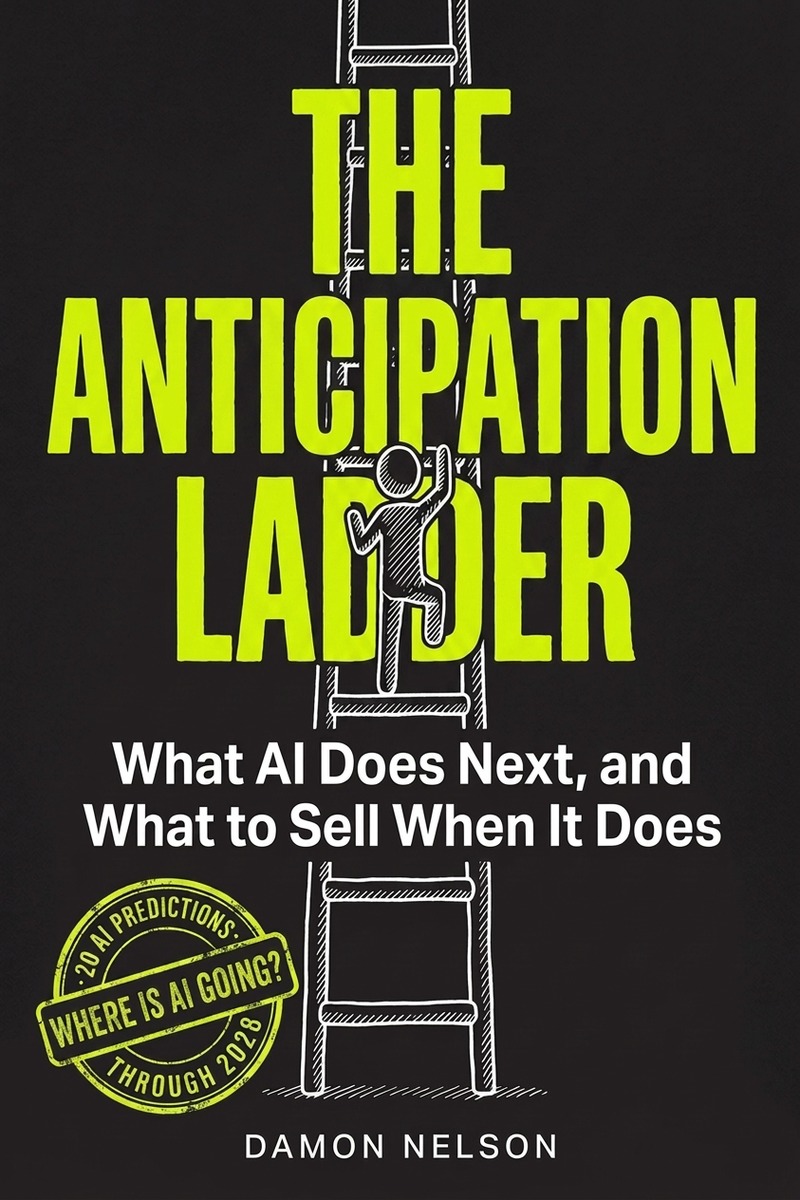
The Anticipation Ladder costs an evening or two. The introduction is explicit about that. The predictions are built to be dog-eared. You can go straight to Part Three and have a priced offer framework before you have read the whole thing.
What you walk away with: a dated map of the next eighteen months of AI development, a grading lens that sorts every AI headline in one second, a set of priced offers sized for a solo operator or small agency, and a public scorecard that holds the author accountable to the dates he set.
If the map is useful, you will feel it in your calendar before the first checkpoint arrives. If it is not, the scorecard will tell you exactly where it failed. That is the deal. Hit the link below to get your copy.
See It on AmazonQuestions people actually ask
By the time I read this, won't the predictions already be outdated?
Every prediction in the book carries a specific checkpoint date, March 2027 and March 2028, and a public scorecard the author grades live. That is the opposite of the vague 'AI will change everything someday' content that goes stale overnight. A dated map you can plan against is useful precisely because it commits to being wrong or right on a specific day.
I've bought AI books before and they're all framework with no real playbook. Why is this different?
Part Three is nothing but priced, sequenced offers sized for a business of one: audits, agent installs, content retrofits, matched to specific predictions. The honest test is whether you can open it and build an offer before the first checkpoint date. The scorecard means you will know exactly when the map fails if it does.
I'm not technical. Can I actually sell AI services from this?
The book's core argument is that the technical edge is gone. Every shop has the same engine for the price of lunch. The scarce skill is knowing which client, which bottleneck, which specific Tuesday-morning problem to point it at. That is a marketing and positioning skill. It is what the playbook chapters teach. No engineering required.
My clients aren't asking for AI yet. Is there even a market for this?
This is the one objection the book concedes in part. If your specific market is genuinely pre-awareness, some offers in Part Three will not land yet. The honest answer is that the book helps you identify which rung your clients are already on, so you lead with the outcome they want: a phone answered, a support ticket closed, a morning brief ready. The AI stays invisible, the way winning products already work.
I don't have time for another business book right now.
The introduction states it plainly: this costs an evening or two. The predictions stand alone and are built to be skimmed and dog-eared. You can go straight to Part Three and have a priced offer framework before you have finished the whole thing. The ask is one evening, not a semester.