You're not behind because you stopped learning. You're behind because learning the tools was never the strategy.
He'd fed it hours of webinar transcripts. His Friday-call stories. His Texas drawl in paragraph form. And when he asked the AI to define his writing style, what came back was — him. Short sentences. Story first. The habit of walking a reader through a drive-thru instead of handing them a chart. He corrected it, fed it more, corrected it again. Like breaking in a talented new hire who happened to learn twice as fast as any human he'd ever hired.
Then he tested it on a real paragraph. Asked it to turn a thought into an email. The result stopped him cold. His voice. His rhythm. Anecdotes from calls he'd taken that week. He sat there having, as he later put it, 'a small identity crisis over a paragraph.'
Not because the machine had done something threatening. Because it had done something useful — and he suddenly understood that the people who figure out what to do with that first are going to have a very different eighteen months than everyone still refreshing the AI news feed.
That moment is the spine of The Anticipation Ladder — Damon Nelson's new book, and the first AI strategy book I've seen that comes with a public scorecard the author grades live. The premise is simple and a little uncomfortable: the tools are already tied. The eight-dollar model handles most of what most people need. The arms race ended, and everybody got the weapons for roughly the cost of a streaming subscription.
What isn't tied is the map. Most small operators are staring at the plateau — prose quality, image generation, the stuff that wowed everyone in 2023 — and missing the rocket standing right next to it. Agentic capability. The ability to plan, use tools, and carry a twelve-step job all the way through. That part is climbing fast, and the people who've already sketched out where each rung lands are building offers today that most of the market won't understand until next year.
The book gives you a framework called the Anticipation Ladder that sorts any AI headline in about one second. Four rungs: Reactive, Suggestive, Anticipatory, Delegated. You learn where any product or business sits on that scale — and, more importantly, you learn that the rung it sits on is a number you can charge money to change.

The tools are tied. The edge went somewhere else.
Chapter 1 makes a claim that'll annoy people who spent two years building on proprietary model gaps: those gaps are closing. The eight-dollar model does most of what most people need, and open-weight models keep pushing the floor toward zero. The book calls it plainly — Tools built on a model gap die when the gap closes. The edge that's left isn't technical. It's positional. Knowing which client, which bottleneck, which specific Tuesday-morning fumble to point the engine at. The book calls that skill marketing. It pays accordingly.
The differentiator is not the engine. It's knowing where to install it.

Your voice is the one ingredient the machine can't manufacture.
The identity crisis Damon had over that paragraph wasn't a warning. It was a business insight. The machines trained on human content. Now the internet is filling up with machine content — copies of copies, each a little blurrier. Fresh, dated, verified human experience is getting scarcer, not more common. The book's argument: When intelligence is a commodity, the only scarce inputs left are the ones that were always scarce: your voice, your opinions, your relationships. That's not motivational-poster material. It's a supply-and-demand observation about what the AI companies actually need and cannot make themselves.
AI writes the skeleton. You supply the heartbeat.
There are two reputation markets now. You can only see one of them.
Here's the thing that genuinely surprised me in Chapter 6. There's the search-engine market, where Google ranks you, and then there's the agent-recommendation market, where AI systems recommend you to other AIs running on behalf of buyers. Being number one on Google does not guarantee you a place in the AI answers. The two lists overlap less than 20% of the time. The book lays out exactly what it takes to show up in both — and it's not what most content-marketing advice covers. The skills that get you into AI citations are learnable, productizable, and currently underpriced in the market.
The 'do it for me' button is the biggest business story in the book.
Chapter 7 is the one I keep coming back to. Support agents that stop teaching and start doing. Handed a trustworthy do-it-for-me button, almost everyone presses it. The book's line on why cuts through: Nobody ever wanted the training. They wanted the thing that the training produces. That shift from explaining to executing is rung four of the Anticipation Ladder — Delegated — and the businesses that get there first, or that help their clients get there first, are going to look very smart in about twelve months. Part Three of the book tells you exactly how to sell that transition as a priced service.
Nobody ever wanted the training. They wanted the thing that the training produces.

A dated map beats a vague forecast every single time.
Most AI books have a shelf life of about four months before the predictions age out. The Anticipation Ladder does something different: every prediction carries a specific checkpoint date — March 2027 and March 2028 — and Damon grades himself live on a public scorecard. The book even addresses this directly: Forecasters who won't be graded are just entertainers. You can agree or disagree with any individual call, but you can't call it vague. A map you can plan against — even an imperfect one — beats waiting for certainty that never shows up.
The people who lose over the next eighteen months won't lose to AI. They'll lose to somebody who read the map earlier.
What readers are saying
"I like how cleanly he separates the plateau from the rocket. Words leveled. Doing is still climbing hard. That two-axis picture is the most honest take I've seen on where we actually are."
— Kayla D."The quiet prediction that will matter most is memory becoming the moat. Switching assistants is going to feel like moving house once they know everything about you. I'm taking the portability advice seriously."
— Natalie F."Just finished The Anticipation Ladder. The four rungs finally made the whole AI mess click for me. I graded every tool I use this morning and most of them are still stuck on rung one. That alone was worth the read."
— Mike R.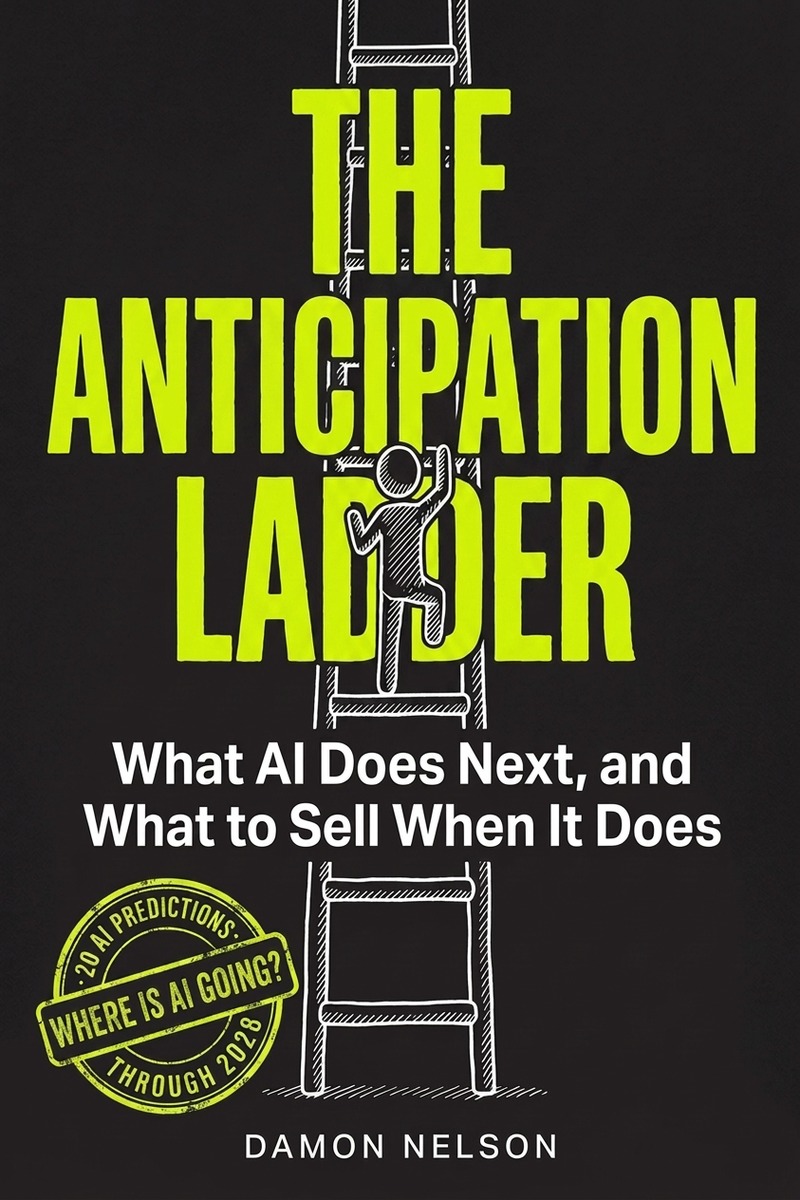
Here's what you get. A dated, four-rung framework that places any AI product or business on a single scale. Twenty public predictions with specific checkpoint dates — March 2027 and March 2028 — graded live. And Part Three: a concrete playbook of priced, sequenced offers a business of one can build and sell before the first checkpoint date arrives. Audits. Agent installs. Content retrofits matched to specific predictions.
The introduction is honest about the time ask: an evening or two. The predictions stand alone and are built to be dog-eared. You can go straight to Part Three and have a priced offer framework before you've finished the whole thing.
The AI headlines will still arrive tomorrow morning. The question is whether you'll place each one on the ladder in one second and decide — or spend another hour in the feed, feeling behind. One of those mornings costs an evening to change.
See It on AmazonQuestions people actually ask
By the time I read this, won't the predictions already be stale?
Every prediction carries a specific checkpoint date — March 2027 and March 2028 — and a live public scorecard the author grades himself on. A dated map you can plan against is the opposite of the 'AI will change everything someday' content that goes stale overnight. The dates are the whole point.
I've bought AI books before. They're all hype with no real playbook.
Fair. Part Three is nothing but priced, sequenced offers sized for a business of one — audits, agent installs, content retrofits — each matched to a specific prediction. The test is simple: can you open it and build an offer before the first checkpoint date? If you can't, the live scorecard tells you exactly when the map failed.
I'm not technical. Can I actually sell AI services?
The book's core argument is that the technical edge is already gone — every shop runs the same engine for eight dollars. The scarce skill is knowing which client, which bottleneck, which specific problem to point it at. That's a marketing skill. The playbook chapters teach marketing, not engineering.
My clients aren't asking for AI yet. Is there even a market for this?
This is the one objection the book concedes in part. If your specific market is genuinely pre-awareness, some offers in Part Three won't land yet. The honest answer: the book helps you identify which rung your clients are already on so you lead with the outcome they want — a phone answered, a support ticket closed — and let the AI stay invisible, the way winning products already work.
I don't have time to read another business book right now.
The introduction says this costs an evening or two, and that's accurate. The predictions stand alone and are built to be dog-eared. You can go straight to Part Three and have a priced offer framework before you've read the whole thing. The ask is one evening, not a semester.
Won't AI just make the advice in this book obsolete too?
Anything built on a specific model's capabilities will age. This book is built on a structural framework — four rungs that describe how intelligence gets embedded into products and businesses — not on which model won last quarter. The ladder doesn't change when a new model drops. That's the design choice, and it's why the checkpoint dates matter more than the model names.