The tools are tied. The edge now belongs to whoever reads the map first.
It was a Tuesday. He had a paragraph of rough notes, a Claude window open, and about twenty minutes before a client call. He pasted his notes in, asked for an email, and what came back stopped him mid-sip. It sounded exactly like him. Not close. Exactly him — the short sentences, the sideways joke, even an anecdote from a Friday call he'd mentioned once in a transcript he'd fed the thing weeks earlier.
He sat there for a minute, not quite sure how to feel about it. Not proud. Not scared. Just unsettled, the way you feel when something you thought was uniquely yours turns out to be learnable. He'd spent years building a voice people recognized. And here was a machine, reading it back to him from a text box.
He had a choice to make in that moment, and he's been thinking about it ever since. Because that choice — leverage or terror — turns out to be the only one that actually matters right now.
That moment is the opening of something much bigger in The Anticipation Ladder: What AI Does Next, and What to Sell When It Does. Damon Nelson wrote it as the book he wished existed eighteen months ago, when he was doing the same thing most small operators are doing: subscribing to every AI newsletter, finishing courses that felt stale before the last module, and quietly wondering if keeping up with the tools was ever going to translate into keeping up with the market.
It doesn't pitch a new tool. It pitches a framework. Specifically: a four-rung ladder that classifies every AI product on earth, predicts where it's going next, and converts the gap between where software sits today and where client expectations are heading into a priced service you can be selling before the next announcement drops.
The book has twenty dated predictions — checkpoint dates in March 2027 and March 2028 — and a public scorecard Damon grades live. 'Forecasters who won't be graded are just entertainers. Hold me to the difference.' That line is in the conclusion. It's also the reason this isn't another AI hype piece.

The arms race ended in a tie, and everybody got the weapons for the price of lunch
Chapter one lands this hard: AI capability has leveled across price tiers. The eight-dollar model handles most of what most people need. 'Intelligence became a utility bill. Nobody sends a press release when something becomes a utility bill. It just quietly stops being the interesting part.' The differentiator is no longer the engine. It's knowing where to install it. That's not a consolation prize for small operators. That's the whole ballgame flipping.
The differentiator is not the engine. It's knowing where to install it.

Your voice, your opinions, your relationships are the only inputs that cannot be copied
For forty years, every software product treated every user identically. AI-powered software now remembers your voice, habits, and history, behaving differently for every person who uses it. The one-to-many era is ending. The one-to-one era doesn't have a use for the smartest engine. It has a use for the most specific human in the room. 'When intelligence is a commodity, the only scarce inputs left are the ones that were always scarce: your voice, your opinions, your relationships.'
AI writes the skeleton. You supply the heartbeat.
Every AI headline sorts itself in about one second once you have the ladder
The Anticipation Ladder puts every AI product on one of four rungs: Reactive (answers when asked), Suggestive (proposes next moves), Anticipatory (prepares before you ask), Delegated (asks if it can just handle it). The rung a business occupies is a number you can charge money to change. And the gap between where software sits today and where expectations are heading? 'That gap is not a tragedy. It's a price list.'
The rung a business sits on is a number you can charge money to change.
The map has checkpoint dates, and a scorecard the author grades in public
Twenty predictions. Each one carries a specific checkpoint date. Each one gets graded live on a public scorecard. That structure exists because a dated map you can plan against is the opposite of 'AI will change everything someday.' You can dog-ear the predictions that matter to your market, build offers against them, and know exactly when the map was right or wrong. That accountability is the whole point.

The people who lose won't lose to AI
This is the line that tends to stick: 'The people who lose over the next eighteen months won't lose to AI. They'll lose to somebody who read the map earlier.' Not somebody with a bigger team or a bigger budget. Somebody who had a framework for sorting the noise and built offers before the predictions landed. That window is open right now. The book is the argument that it won't stay open.
The people who lose over the next eighteen months won't lose to AI. They'll lose to somebody who read the map earlier.
What readers are saying
"Just finished The Anticipation Ladder. The four rungs finally made the whole AI mess click for me. I graded every tool I use this morning and most of them are still stuck on rung one. That alone was worth the read."
— Mike R."Chapter 11's $97 machine is the most practical offer I've seen in ages. Simple, sticky, and the fact that every new post makes the agent smarter is a smart retention play. Building my first one this week."
— Amy L."I like how cleanly he separates the plateau from the rocket. Words leveled. Doing is still climbing hard. That two-axis picture is the most honest take I've seen on where we actually are."
— Kayla D.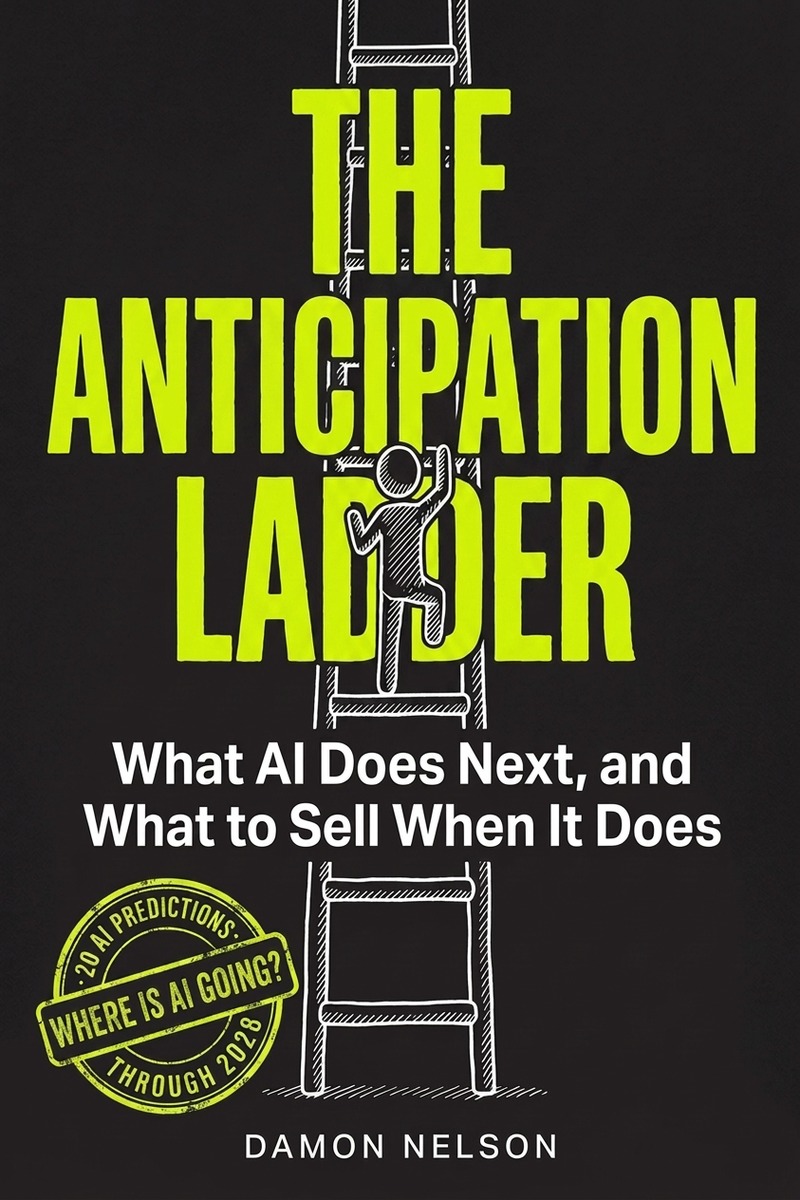
The Anticipation Ladder costs an evening. Maybe two if you go slow. The introduction alone reframes the last eighteen months of AI noise in a way that is hard to undo. Part Three is nothing but priced, sequenced offers sized for a business of one: audits, agent installs, content retrofits, matched to specific predictions with checkpoint dates attached.
You can go straight to Part Three before you've finished the first half and have an offer framework before the week is out. The ask is one evening, not a semester.
If you've been waiting to get ahead of this instead of catching up to it again, the link below is the place to start.
See It on AmazonQuestions people actually ask
By the time I read this, won't the predictions already be outdated?
Each of the twenty predictions carries a specific checkpoint date — March 2027 and March 2028 — and a public scorecard Damon grades live. The dates are the point. A dated map you can plan against is the opposite of the vague 'AI will change everything someday' content that goes stale overnight. The scorecard tells you exactly when the map is right or wrong.
I've bought AI books before and they're all hype with no real playbook.
Fair. Part Three is the test. It's nothing but priced, sequenced offers for a business of one: audits, agent installs, content retrofits, each matched to a specific prediction. Open it before you've finished the intro and see if you can sketch an offer. If you can't, the public scorecard means you'll know exactly when the map failed.
I'm not technical enough to actually sell AI services.
The book's core argument is that the technical edge is gone. Every shop has the same engine for the price of lunch. The scarce skill is knowing which client, which bottleneck, which Tuesday-morning fumble to point it at. That is a marketing skill, not an engineering one. The playbook chapters teach that skill specifically.
My clients aren't asking for AI yet, so there's no market for this right now.
This is the one objection the book concedes in part. If your specific market is genuinely pre-awareness, some offers in Part Three won't land yet. What the book helps you do is identify which rung your clients are on, so you lead with the outcome they already want — a phone answered, a support ticket closed, a morning brief ready — and let the AI stay invisible. Which, the book argues, is exactly how winning products already work.
I don't have time to read another business book right now.
The introduction is explicit: this costs an evening or two. The predictions are built to be dog-eared and stand alone. You can go straight to Part Three and have a priced offer framework before you've read the whole thing. One evening, not a semester.
Won't the AI just keep improving until everything I build on it breaks?
That's the right question, and the book answers it directly: tools built on a model gap die when the gap closes. The build that lasts is built on the inputs that don't improve away — your data, your relationships, your distribution, your judgment. Every model improvement should lift your work, not gut it. The framework shows you how to check that before you build.