The AI Race Already Ended. The People Who Know Where to Aim Next Are Writing Invoices.
It was a Saturday morning. Dog on the leash, earbuds in, coffee still too hot to drink. And the thing playing in my ears was a two-host AI podcast reviewing the training I had run the day before. My own material. Summarized back to me by two voices that did not exist.
I hadn't asked for that. NotebookLM had just done it. Grabbed the recording from Friday, turned it into a conversation, dropped it in the feed. And somewhere around the third block, one of those voices started asking questions about the next thing the training implied. Not the thing I taught. The thing I hadn't taught yet.
That's when I started writing what became this book. Not because the technology was impressive. Because I realized the technology was already one rung above where I had it installed, and nobody had sent me a memo.
I've been in this business long enough to remember when 'the computer guy' was a real job title. I watched SEO go from dark art to commodity. I watched social media go from edge to noise. Every time, the people who caught the wave early weren't the smartest ones. They were just the ones who saw the shape of it before it broke.
The Anticipation Ladder is the book I wrote because I needed it myself. It maps out exactly where AI is going over the next eighteen months, rung by rung, with twenty specific predictions that carry checkpoint dates. Not 'AI will transform everything someday.' March 2027. March 2028. Real dates, public scorecard, graded live.
The point isn't to be right about every prediction. The point is that a dated map you can plan against is a completely different object than the breathless weekly newsletter you're already ignoring. One produces anxiety. The other produces a client invoice.

The arms race already ended in a tie. Now what?
Chapter one makes a point that took me longer to say out loud than it should have. Intelligence became a utility bill. The eight-dollar model handles most of what most people need, and the Fortune 500 is running on the same engine as you. The differentiator is not the engine anymore. It's knowing which specific Tuesday-morning fumble at which specific client to point it at. That is a marketing skill. You already have it.
The differentiator is not the engine. It's knowing where to install it.

Every AI product on earth fits on four rungs. One second to sort it.
Reactive answers when you ask. Suggestive proposes what's next. Anticipatory prepares before you ask. Delegated just handles it. Every AI headline, every new product launch, every 'this changes everything' post in your feed fits on one of those four rungs. Once you see the ladder, you can't unsee it. And the gap between where a client's software sits today and where their expectations are already heading is, as the book puts it, a price list.
That gap, between where the world's software sits and where the world's expectations are about to be, is not a tragedy. It's a price list.
The tool that knows you is the one you can't leave.
The book's argument about memory is the one that stayed with me longest. The winning assistant is not the smartest one. It's the one that has been living inside your calendar, email, and files long enough to feel like it knows you. By 2028, leaving that assistant will feel like moving house. The book names this clearly as both the deepest retention strategy in the game and the biggest ethical question the industry hasn't answered yet. Both things are true at once.
Your voice is the one input the machine cannot manufacture.
AI trained on AI output produces a photocopy of a photocopy. The machines need fresh, dated, verified human experience to run on, and they cannot make it themselves. Your opinions, your scar tissue, your customer proximity, your relationships: those are the scarce raw materials the next wave runs on. The one-to-many software era is ending. The book's argument is that the one-to-one era rewards exactly the inputs that small operators already own.
AI writes the skeleton. You supply the heartbeat.

The installer is a real trade. It has a pricing ladder.
The same moment that created 'the computer guy' in 1998 is repeating right now. Phone agents, support agents, workflow documentation, content retrofits for the new AI search. These bundle into a recognizable local service that a solo operator can price and scope before the first checkpoint date arrives. Part Three of the book is nothing but that: priced, sequenced offers sized for a business of one. Not theory. The kind of thing you can open on a Tuesday night and have a proposal drafted by Thursday.
The people who lose over the next eighteen months won't lose to AI. They'll lose to somebody who read the map earlier.
What readers are saying
"Just finished The Anticipation Ladder. The four rungs finally made the whole AI mess click for me. I graded every tool I use this morning and most of them are still stuck on rung one. That alone was worth the read."
— Mike R."Prediction 3 saying good-enough intelligence gets cheaper than coffee by March 2028 already feels close. The eight-dollar tiers are handling most of what I need today. Access is no longer the product."
— Ashley R."The 'technology hasn't fully won until it vanishes from the label' law is already happening. The best AI experiences I'm using right now never once say the letters A and I. That silence is the signal."
— Lauren C.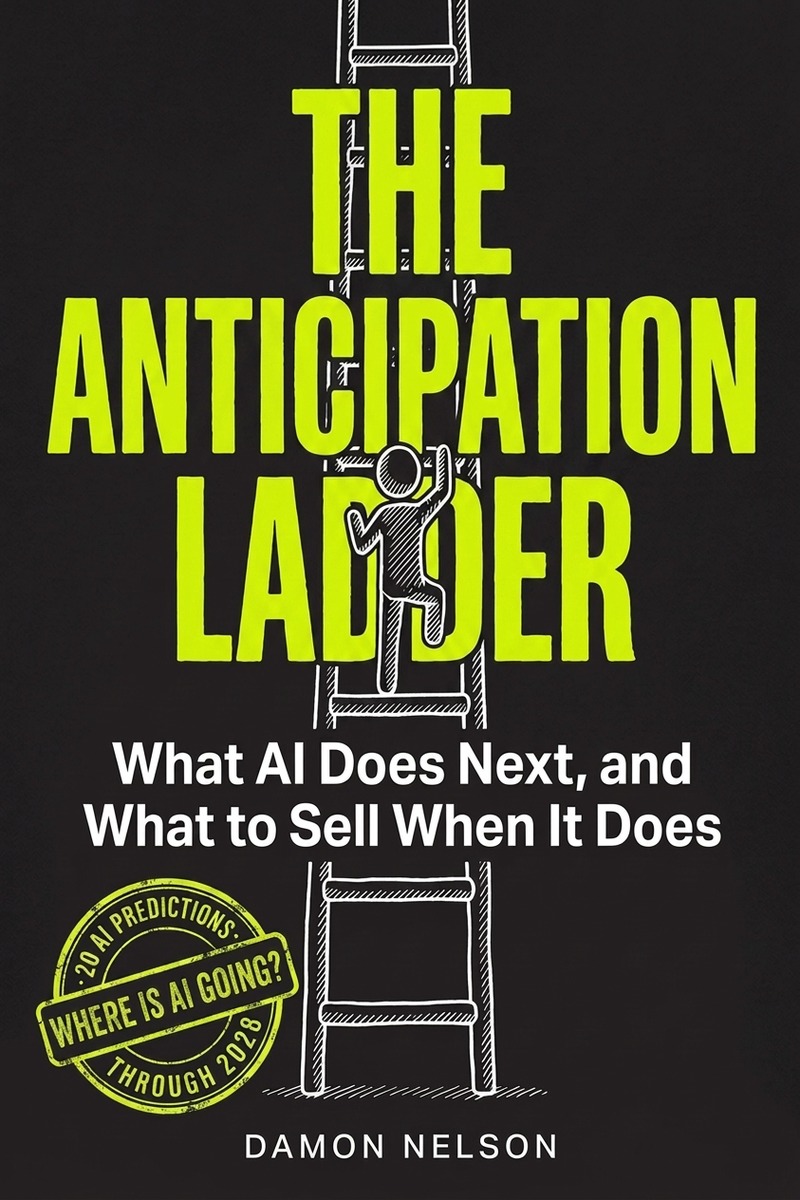
Here's what you get when you follow the link below. You get the full Anticipation Ladder framework, the four-rung lens that sorts every AI announcement in one second. You get twenty dated predictions with specific checkpoint dates and a public scorecard the author grades live. And you get Part Three: a set of priced, sequenced offers you can be selling before the first checkpoint arrives.
This is an evening, maybe two. The predictions stand alone and are built to be dog-eared. You can go straight to Part Three without reading front to back and still have something worth invoicing by the end of the week.
The map has dates, and a public scorecard. Forecasters who won't be graded are just entertainers. This one will be graded. That's the whole difference.
See It on AmazonQuestions people actually ask
By the time I read this, won't the predictions already be out of date?
Every prediction in the book carries a specific checkpoint date: March 2027 or March 2028. That's the design. A dated map you can plan against is a different object than vague 'AI will change everything' content. The public scorecard means you'll know exactly which calls landed and which ones missed. Outdated is what happens to evergreen. This has an expiration date on purpose.
I've bought AI books before. They're all hype with nothing actionable.
Fair. Part Three exists specifically because that complaint is true of most of them. It's priced, sequenced offers sized for a solo operator or small agency: audits, agent installs, content retrofits matched to specific predictions. The test the book sets for itself is simple: can you open it and build a proposal before the first checkpoint date? If you can't, the scorecard will show that.
I'm not technical. Can I actually sell AI services?
This is the book's core argument. The technical edge is gone. Every shop has the same engine for roughly the price of lunch. The scarce skill now is knowing which client, which bottleneck, which specific operational fumble to point the engine at. That is a marketing and positioning skill. It's what the playbook chapters teach. No engineering required.
My clients aren't asking for AI yet. Is there even a market for this?
This is the one objection the book concedes, at least in part. If your specific market is genuinely pre-awareness, some offers in Part Three won't land yet. The honest use of the ladder in that case is to lead with the outcome your clients already want: a phone answered, a support ticket closed, a morning brief ready. Let the AI be invisible. The book's argument is that the winning products already work that way.
I don't have time for another business book right now.
The introduction is direct about this: the ask is one evening, maybe two. The predictions are built to be read standalone. Part Three is structured so you can go straight to it. The book is not asking for a semester. It's asking for the kind of focused evening that ends with a document you can send to a client.