The map exists. March 2027 doesn't move. Here's what you build before it gets here.
Every morning for years, same routine. Log into the group, scan for spam, bounce the obvious bots, referee whatever argument had started overnight, and mop up whatever the notification algorithm had stirred up while he slept. Thirty minutes of janitorial work. On a floor he didn't own.
The bell wasn't broken. That was the part that stung. Facebook's notification bell was doing exactly what Facebook built it to do — pulling his people toward the next shiny thing, away from the thing he'd spent real time building. He was maintaining someone else's casino, and calling it community.
He knew AI was changing the game. He just couldn't figure out which changes actually mattered for someone his size, running everything alone, with no research department and a calendar that was already full.
The move off Facebook wasn't dramatic. Same people, different landlord, and the janitorial work mostly disappeared. But the bigger shift happened when he stopped trying to track every AI headline and started asking a different question entirely: not what is AI doing next, but which rung is it on — and what do you sell when it gets there.
That question became The Anticipation Ladder. It's a framework in four rungs — Reactive, Suggestive, Anticipatory, Delegated — that lets you place any AI product, any headline, any potential offer on a single scale in about one second. And once you know the rung, you know the pitch.
The book isn't a survey of tools. It's a dated map with twenty public predictions, a scorecard the author grades live, and a three-part playbook sized for a business of one. The promise is specific: you should be able to build and price an offer before the first checkpoint date arrives.

The arms race ended. Everybody got the weapons for eight dollars.
AI capability has leveled across price tiers. The eight-dollar model handles most of what most people need, and open-weight models keep pushing the floor toward zero. That means the Fortune 500's ten thousand extra employees don't make their model one point smarter than yours. The edge now belongs to whoever knows which specific business problem, which annoying Tuesday-morning fumble, to point the engine at. The book's call: 'The differentiator is not the engine. It's knowing where to install it.' That skill has a name — marketing — and it was always yours.
The differentiator is not the engine. It's knowing where to install it.

Two reputation markets exist right now. You can probably only see one of them.
There's the market where AI quotes you to humans, and the market where AI recommends you to other AIs. Being number one on Google does not guarantee a place in the AI answers — the two lists overlap less than 20% of the time. Both markets reward the most useful, most structured source. The book puts it plainly: 'There are now two reputation markets: one where AI quotes you to humans, and one where AI recommends you to other AIs. You can only see the first one.' Knowing the second one exists is the entire first move.
There are now two reputation markets: one where AI quotes you to humans, and one where AI recommends you to other AIs. You can only see the first one.
Nobody ever wanted the training. They wanted the thing the training produces.
Rung four on the ladder is Delegated — the point where a customer stops asking how to do something and just hands the job over. Support agents stop teaching and start doing. The book's argument is that handed a trustworthy do-it-for-me button, almost everyone presses it. Not because people are lazy, but because the training was never the goal. The outcome was. Installing that button for a small business — phone answered, ticket closed, morning brief ready — is a scoped, priced service. The technical lift is not yours. The knowing-where-to-point-it part is.
Nobody ever wanted the training. They wanted the thing that the training produces.

Fresh human experience is the one ingredient machines cannot manufacture.
The machines learned from human-made content. Now the internet fills with machine-made content — copies of copies, each a little blurrier. Fresh, dated, verified human experience is the scarce raw material AI companies need and cannot make. The book frames it this way: 'When intelligence is a commodity, the only scarce inputs left are the ones that were always scarce: your voice, your opinions, your relationships.' The thirty years you've spent watching one specific market? That's not a nice-to-have. It's the asset the next cycle is built on.
When intelligence is a commodity, the only scarce inputs left are the ones that were always scarce: your voice, your opinions, your relationships.
What readers are saying
"Being number one on Google does not guarantee you a place in the AI answers. That under-20% overlap number should scare every SEO still living in 2019. Prediction 6 is already true for a lot of my clients."
— Samantha K."Memory becoming the moat (Prediction 15) is the quiet one that will matter most. By the eighteen-month mark, switching assistants is going to feel like leaving a relationship, not just changing software. That's sticky in a way most people aren't pricing yet."
— Brandon W."Showed a client the screen of what the AI said about his business versus his competitor. The look on his face was priceless. The audit sells itself. This book is already making me money."
— Brian C.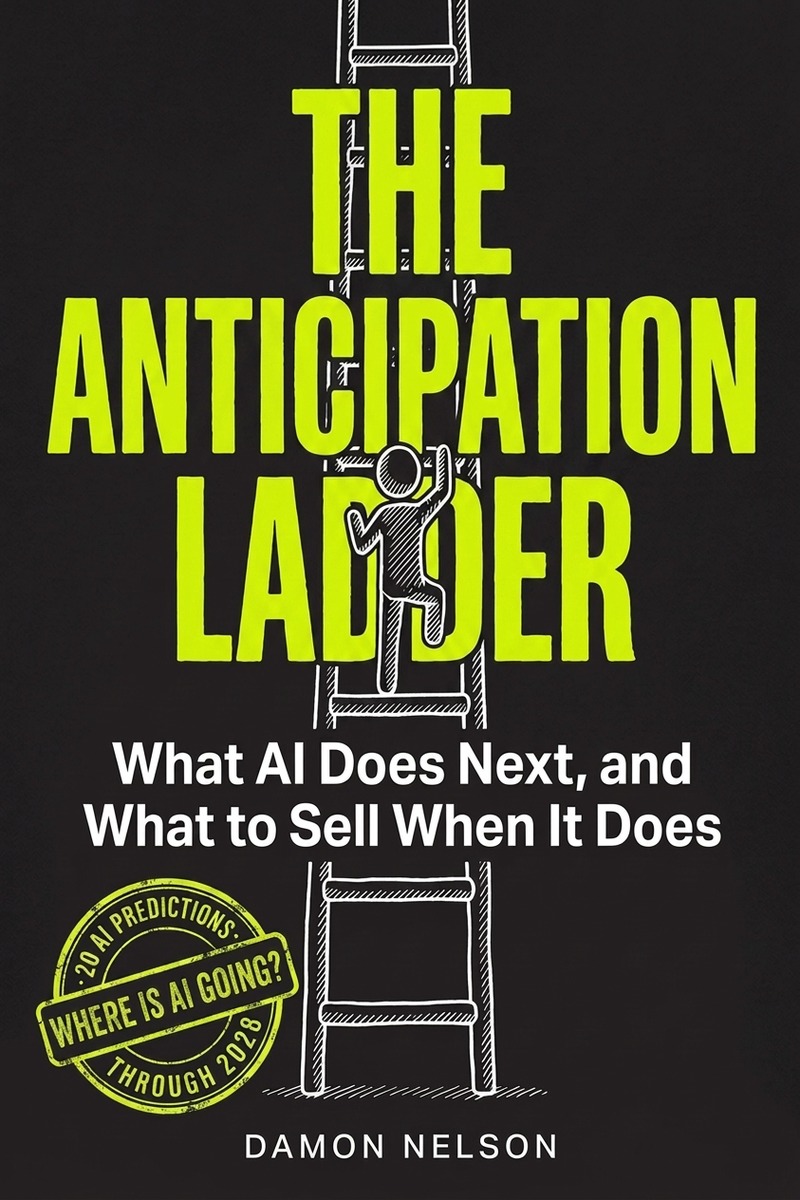
Here's what the book actually is. An evening, maybe two. Twenty dated predictions with checkpoint dates in March 2027 and March 2028 — not vague 'someday' forecasts, but specific calls the author grades live on a public scorecard. A four-rung framework you can apply to any headline in one second. And Part Three: priced, sequenced offers sized for a business of one — audits, agent installs, content retrofits — matched to specific rungs on the ladder.
The gap between now and the first checkpoint is a fixed, shrinking window. Someone who reads this week builds an offer this week. Someone who reads it in October starts from a shorter runway. The book's own line lands here: 'The people who lose over the next eighteen months won't lose to AI. They'll lose to somebody who read the map earlier.'
Go to Amazon, see it for yourself, and decide.
See It on AmazonQuestions people actually ask
By the time I read this, won't the predictions already be outdated?
Every prediction carries a specific checkpoint date — March 2027 and March 2028 — and a public scorecard the author grades live. A dated map you can plan against is the opposite of the 'AI will change everything someday' content that goes stale overnight. The dates are the whole point.
I've bought AI books before. They're all hype with no real playbook.
Part Three is nothing but priced, sequenced offers sized for a business of one — audits, agent installs, content retrofits — matched to specific predictions. The test is simple: can you open it and build a priced offer before the first checkpoint date? If you can't, the live scorecard tells you exactly when the map failed. That's the author putting his forecast on the line, not just your money.
I'm not technical. Can I actually sell AI services?
The book's core argument is that the technical edge is gone. Every shop has the same engine for eight dollars. The scarce skill — the one the playbook teaches — is knowing which client, which bottleneck, which specific fumble to point the engine at. That's a marketing skill. It was always yours.
My clients aren't asking for AI yet. Is there even a market for this?
Honest answer: if your market is genuinely pre-awareness, some offers in Part Three won't land yet. That's the one the book concedes. But the ladder helps you lead with the outcome your clients already want — a phone answered, a ticket closed, a brief ready — and let the AI stay invisible. The way the book describes winning products, that's exactly how they work.
I don't have time for another business book right now.
The introduction is explicit: this costs an evening or two. The predictions are built to be dog-eared and stand on their own. You can go straight to Part Three and have a priced offer framework before you've finished the whole thing. The ask is one evening, not a semester.