Record Once on Monday. Close a Client by Friday.
Monday you record a training call. Tuesday you need a newsletter. Wednesday a client wants a summary. Thursday you owe someone a short clip for their feed. Friday you're staring at a blank doc and the week ate itself.
Nobody sat down and decided to run a content factory. It just happened. You stayed curious, kept creating, and somewhere between the tools and the tabs and the 'post every day or die' advice, the creating stopped feeding the business. It started feeding the calendar.
That's not a discipline problem. It's a system problem. One recording going in and nothing reusable coming out is just a broken pipe.
I want to tell you what my actual Monday looks like, because it's embarrassing how simple it got.
I record once a week. A training, a working session, a talk — timestamps on. That recording goes into a notebook tool. What comes out the other side is the podcast cut, the written summary, the short clips, the quiz, the post drafts. The whole week's content in one pass.
That's Chapter 10 of The Anticipation Ladder. Damon calls it the Weekly Pipeline. But here's the part that changes the business, not just the calendar: the same pipeline feeds the knowledge bank. The knowledge bank feeds the agent. And the client watches the agent get smarter every month. That's the retention mechanic in one sentence.
The book is called The Anticipation Ladder: What AI Does Next, and What to Sell When It Does. It maps the next eighteen months of AI development across four rungs, pairs each rung with a concrete, priced offer, and backs every prediction with a public scorecard and real checkpoint dates. The content pipeline is one chapter. The rest of the book is the map you build the offers on.

The treadmill isn't the content. It's the re-creation.
Every week starts from zero because nothing from last week was built to be reused. The pipeline flips that. One recorded session becomes the source file for every format the week needs. You stop manufacturing content and start distributing a single truth across channels. The work happens once. The outputs multiply.
The work happens once. The outputs multiply.

The knowledge bank is why clients don't leave.
Each week's recording doesn't just feed the content calendar. It feeds a structured knowledge bank the agent draws from. The client sees their AI get more useful month over month, shaped by their own voice and history. That compounding is what turns a one-time project into a retainer. The Anticipation Ladder calls this the retention mechanic, and it's the most underpriced thing a one-person shop can install.
The rung a business sits on is a number you can charge money to change.
Two reputation markets now exist, and the pipeline feeds both.
There's the market where AI quotes you to humans, and there's the market where AI recommends you to other AIs. As Damon writes: There are now two reputation markets: one where AI quotes you to humans, and one where AI recommends you to other AIs. You can only see the first one. Structured, dated, attributed content from a real weekly pipeline is exactly what earns rank in both. Repurposed-fast thin posts earn rank in neither.
Fresh human experience is the only input AI cannot make.
The machines learned from human-made content. Now the internet fills with machine-made content, and each generation of AI trains on copies of copies. Fresh, dated, specific human experience is the scarce raw material. When intelligence is a commodity, the only scarce inputs left are the ones that were always scarce: your voice, your opinions, your relationships. The pipeline is how you capture those inputs before the week disappears.
AI writes the skeleton. You supply the heartbeat.

The checkpoint dates are what make the map usable.
Every prediction in the book carries a specific date: March 2027, then March 2028. The author grades himself publicly on both. Forecasters who won't be graded are just entertainers. The dates turn a prediction into a planning window. The content pipeline in Chapter 10 is designed to have you building a client offer before the first checkpoint arrives, not catching up after it does.
What readers are saying
"Short and sweet: the book makes sense of the chaos. Worth reading if you're actually trying to sell into this shift instead of just watching it."
— Olivia F."Prediction 3 saying good-enough intelligence gets cheaper than coffee by March 2028 already feels close. The eight-dollar tiers are handling most of what I need today. Access is no longer the product."
— Ashley R."Best part is you can feel the lived experience on every page. He wrote it the same way he teaches — skeleton and heartbeat. Doesn't sound like a book that was manufactured. Highly recommend if you're actually trying to make money with this stuff."
— Megan O.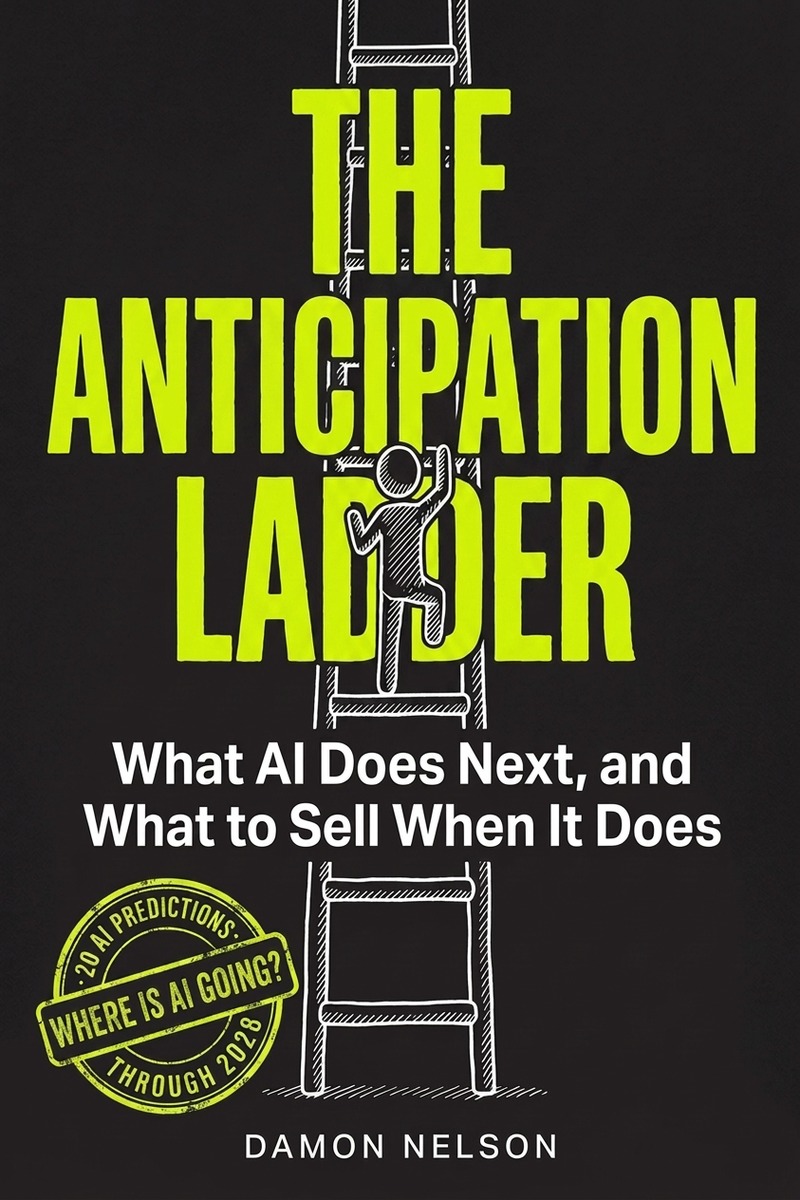
Here's what you get. A dated map of the next eighteen months of AI development. A four-rung framework that sorts any AI headline in one second. A three-part playbook of concrete, priced offers — audits, agent installs, content retrofits — sized for a business of one. And a public scorecard the author grades live so you know exactly when the map holds and when it doesn't.
The introduction is honest about the ask: one evening, maybe two. Part Three stands alone. You can go straight to the pipeline chapter and have a priced offer framework before you've read the whole thing.
The first checkpoint date is March 2027. That window is open right now. Someone who read the map a week earlier is already building the offer. The people who lose over the next eighteen months won't lose to AI. They'll lose to somebody who read the map earlier.
See it on Amazon and decide for yourself.
See It on AmazonQuestions people actually ask
By the time I read this, won't the predictions already be outdated?
Every prediction carries a specific checkpoint date — March 2027 and March 2028 — and the author grades himself publicly on both. A dated map you can plan against is the opposite of vague 'AI will change everything someday' content that goes stale overnight. The dates are the point.
I've bought AI books before. They're all hype with no real playbook.
Part Three is nothing but priced, sequenced offers sized for a business of one: audits, agent installs, content retrofits, matched to specific predictions. The test the book sets for itself is whether you can open it and build an offer before the first checkpoint date. If you can't, the public scorecard tells you exactly when the map failed.
I'm not technical. Can I actually sell AI services?
The book's core argument is that the technical edge is already gone. Every shop has the same engine. The scarce skill is knowing which client, which bottleneck, which specific Tuesday-morning fumble to point it at. That's a marketing skill, not an engineering one. It's what the playbook chapters teach.
My clients aren't asking for AI yet. Is there even a market for this?
Honest answer: if your market is genuinely pre-awareness, some offers in Part Three won't land yet. The book helps you identify which rung your clients are on so you lead with the outcome they already want — a phone answered, a support ticket closed, a morning brief ready — and let the AI stay invisible. That's actually how the highest-rung products already work.
I don't have time to read another business book right now.
The introduction names the ask directly: one evening, maybe two. The predictions are built to be dog-eared and stand alone. You can go straight to Part Three and have a priced offer framework before you've finished the whole thing. It's not a semester. It's a Tuesday night.