Thirty minutes a day mopping someone else's floor — and the AI arms race is doing the same thing to your business
He kept showing up. Every morning, same thirty minutes. Delete the spam. Boot the bots. Referee whatever argument had broken out overnight between strangers. Then try to get something useful done before the next notification pulled everyone sideways.
The people in the group were great. The platform was a landlord who kept rearranging the furniture to sell more ads. And the longer he stayed, the clearer it became: the work wasn't building anything. It was just maintenance on rented land.
Sound familiar? Not the Facebook group, necessarily. The feeling. You stay current, you put in the hours, and somehow you end up more behind than you were before you started.
That Facebook story sits inside a chapter about where content actually lives now — and who gets found, and by what. Damon eventually moved his community off Facebook onto a platform built for learning, not distraction. The janitorial work mostly stopped. The learning went up. Same people, different landlord.
He wrote that chapter as part of a broader argument laid out in The Anticipation Ladder. The book's core idea is simple: AI is climbing a four-rung ladder in a predictable sequence, and the gap between where most businesses sit on that ladder and where consumer expectations are heading is not a problem to panic about. It is, as the book puts it, a price list.
The Facebook-to-focused-platform move is a small version of the bigger shift the book maps out. Stop doing janitorial work on platforms and tools that don't compound. Start installing things that do. Know where the ladder is going before you build the next thing. The book gives you the grading lens to sort every AI headline in about one second, and a set of priced offers you can start running before the first checkpoint date hits.

The arms race already ended — and nobody won
Chapter 1 makes a point that takes a second to land. The eight-dollar model handles most of what most people need. The advantage used to live with whoever had the biggest engine. It doesn't anymore. As the book puts it: "Intelligence became a utility bill. Nobody sends a press release when something becomes a utility bill. It just quietly stops being the interesting part." The interesting part, the part you can actually charge money for, is knowing where to install it.
The differentiator is not the engine. It's knowing where to install it.

Every AI product on earth sits on one of four rungs
Reactive. Suggestive. Anticipatory. Delegated. That is the full ladder, and every AI headline you will read this week fits one of those four slots. The rung tells you where a product is now and where expectations are about to overtake it. That gap is the commercial opportunity the book builds its whole playbook on. "The rung a business sits on is a number you can charge money to change." That is the sentence. One rung up is a scoped, priced service.
That gap, between where the world's software sits and where the world's expectations are about to be, is not a tragedy. It's a price list.
Your voice and your relationships are the only inputs the engine cannot copy
For forty years, software treated every user identically. One-to-many is ending. The AI-powered tools now remember your voice, your habits, and your history. They behave differently for every person who uses them. That means the one thing the machine genuinely cannot manufacture is fresh, specific, human experience. Your proximity to clients, your opinions, your scar tissue. The book calls this plainly: "AI writes the skeleton. You supply the heartbeat." Those inputs finally compound instead of expiring.
There are two reputation markets now, and you can only see one of them
The citation replaced the click as the front page of the internet. There is the market where AI quotes you to humans, and a second market where AI recommends you to other AIs making purchasing decisions. The top Google rank and the top AI citation overlap less than twenty percent of the time. Both boards reward the most useful, most specific, most structured source. The Facebook chapter lives here: the right landlord, the right structure, the right kind of content that machines can actually read and recommend.
Being number one on Google does not guarantee you a place in the AI answers.

Build for where the ladder will be when you ship, not where it is today
A build takes six to eighteen months. Models improve every month. Every product idea needs one honest question run through it: what will be free by the time this ships? Tools built on a model gap die when the gap closes. Build instead on the inputs that get scarcer as the models get smarter: your data, your relationships, your distribution, your judgment. Every model improvement then lifts your product instead of gutting it. The book has a dated map so you can run that test against a real timeline.
The people who lose over the next eighteen months won't lose to AI. They'll lose to somebody who read the map earlier.
What readers are saying
"Chapter 11's $97 machine is the most practical offer I've seen in ages. Simple, sticky, and the fact that every new post makes the agent smarter is a smart retention play. Building my first one this week."
— Amy L."Started documenting my own workflows the way Prediction 4 says. Agents can't run what isn't written down. Simple advice that most people will ignore until it's too late."
— Mark D."Memory becoming the moat (Prediction 15) is the quiet one that will matter most. By the eighteen-month mark, switching assistants is going to feel like leaving a relationship, not just changing software. That's sticky in a way most people aren't pricing yet."
— Brandon W.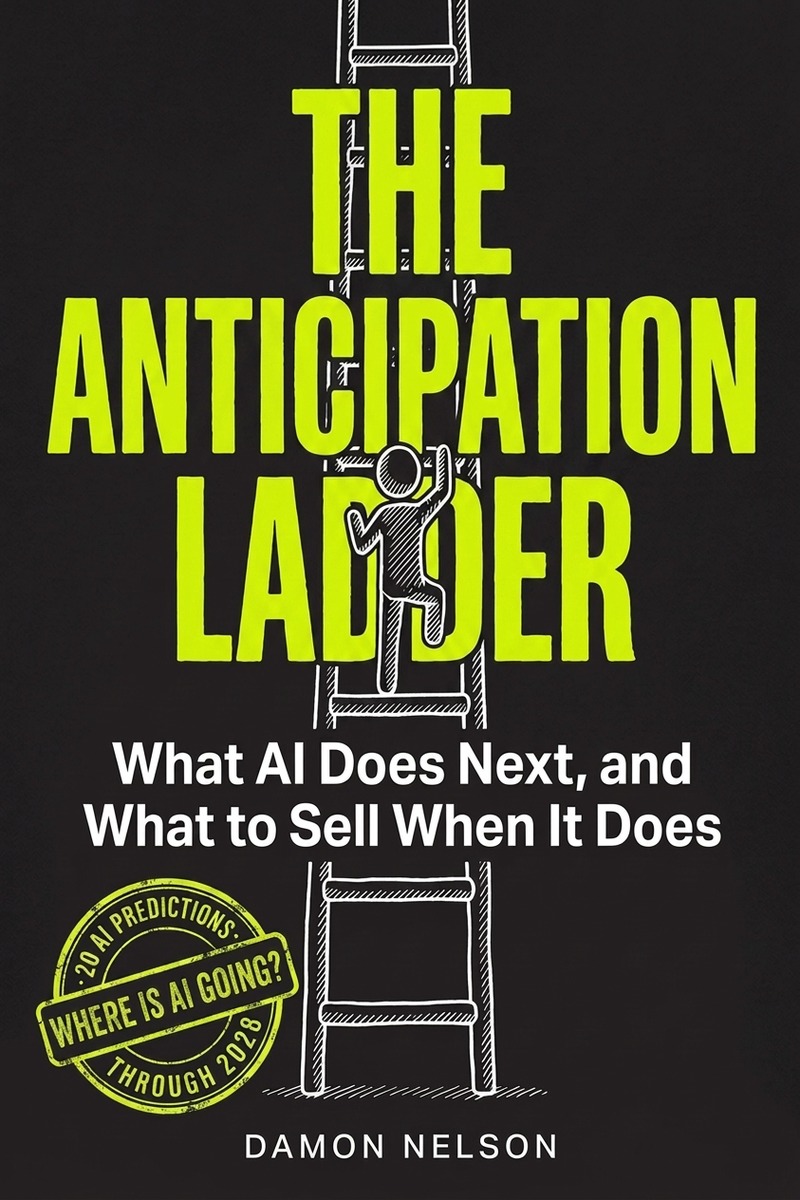
The Anticipation Ladder is a one-or-two-evening read with twenty dated predictions, a four-rung grading lens you will use every week, and a Part Three that is nothing but priced, sequenced offers sized for a solo operator or small shop.
The first checkpoint date is March 2027. The window between now and that date is the window to build an offer, run it with a few clients, and invoice it before the map gets graded. Damon grades his own scorecard publicly. "Forecasters who won't be graded are just entertainers. Hold me to the difference."
If you want the map, it is at the link below. Go straight to Part Three if you are short on time. Have an offer framework before you finish the introduction.
See It on AmazonQuestions people actually ask
By the time I read this, won't the predictions already be outdated?
Every prediction in the book carries a specific checkpoint date — March 2027 or March 2028 — and Damon grades them on a public scorecard. A dated map you can plan against is the opposite of the vague 'AI will change everything someday' content that goes stale overnight. The dates are the point.
I've bought AI books before and they're all hype with no real playbook. What's different here?
Part Three is nothing but priced, sequenced offers — audits, agent installs, content retrofits — matched to specific predictions and sized for a business of one. The test is simple: can you open it and build a client offer before the first checkpoint date? If you can't, the public scorecard will tell you exactly when the map failed.
I'm not a developer. Is this book actually for me?
The book's core argument is that the technical edge is already gone. Every shop has the same engine for roughly the price of lunch. The scarce skill is knowing which client, which bottleneck, which Tuesday-morning fumble to point it at. That is a marketing and positioning skill, and it's what the playbook chapters teach.
My clients aren't asking about AI yet. Is there even a market for this?
This is the one objection the book concedes in part. If your market is genuinely pre-awareness, some offers in Part Three won't land yet. The honest answer: the book helps you identify which rung your clients are on so you lead with the outcome they already want — a phone answered, a morning brief ready — and let the AI stay invisible, the way the book says winning products already work.
I don't have time for another business book right now.
The introduction is explicit: this is an evening or two. The predictions are built to be dog-eared and stand alone. You can go straight to Part Three and have a priced offer framework before you've read the whole thing. The ask is one evening, not a semester.
What if the ladder framework just doesn't apply to my specific niche?
The four rungs describe how any AI product behaves, not just tech-sector ones. Reactive, Suggestive, Anticipatory, Delegated. Every business that uses a tool — booking software, support chat, email automation — sits on one of those rungs. The gap to the next rung is where the service opportunity lives, regardless of the industry.