He Wrote 20 Dated AI Predictions and Built a Scorecard to Grade Himself in Public
The newsletter came in on a Thursday. Another AI announcement. Something had changed, something was going to change everything, here were the five tools you needed to know about. You scanned it. You opened two tabs. You closed them both an hour later with nothing written, nothing invoiced, nothing different about your Thursday except you now felt slightly more behind than you did before breakfast.
That feeling has a name. It's not ignorance. It's not laziness. It's what happens when staying current becomes the job, and the job never produces anything you can actually invoice. You learned the workflow in March. By May it was a punchline. You're not behind because you stopped paying attention. You're behind because paying attention was never the right strategy to begin with.
I've been in that exact seat. And the thing that finally moved me wasn't a better newsletter or a faster tool. It was a framework that told me, in about one second, whether a given AI headline was worth acting on or worth ignoring.
The framework is in a book I wrote called The Anticipation Ladder: What AI Does Next, and What to Sell When It Does. I want to be straight with you about what it is and what it isn't.
It is not a tool guide. The tools will change by next quarter and we both know it. It's a map of where AI capability is heading over the next eighteen months, a grading lens that classifies every AI product on a four-rung ladder, and a set of priced, sequenced offers you can be selling before the first checkpoint date arrives.
The map has dates, and a public scorecard. I grade myself in public on every prediction. That's not a marketing move. It's the only thing that separates a map from a fortune cookie. As I put it in the book: 'Forecasters who won't be graded are just entertainers. Hold me to the difference.'

The Arms Race Already Ended. You Just Weren't Told.
The book opens with a claim that felt wrong to me when I first wrote it, and then felt obvious: intelligence is now a utility bill. The eight-dollar model handles most of what most people need. The gap between what a Fortune 500 lab has and what a solo operator has closed to almost nothing. As I wrote in Chapter 1: 'The differentiator is not the engine. It's knowing where to install it.' That shift guts the anxiety about keeping up with tools. It also opens a door. If the engine is a commodity, the scarce input is the person who knows which client, which bottleneck, which Tuesday-morning fumble to point it at. That is a marketing skill. You already have it.
The differentiator is not the engine. It's knowing where to install it.

Every AI Product on Earth Sits on One of Four Rungs.
Reactive: it answers when you ask. Suggestive: it proposes next moves. Anticipatory: it prepares before you ask. Delegated: it asks if it can just handle it. That's the whole ladder. Every product, every headline, every client's current setup fits on one of those rungs. The reason this matters practically is what the book says plainly: 'The rung a business sits on is a number you can charge money to change.' The gap between where a business sits today and where consumer expectations are heading in twelve months is not a crisis. The book calls it what it actually is: a price list.
That gap, between where the world's software sits and where the world's expectations are about to be, is not a tragedy. It's a price list.
What the HVAC Guy From Church Taught Me About Scoping.
Chapter 11 walks through a hypothetical client the book calls Dale, an HVAC contractor, to make the ladder concrete. The scenario runs month by month: a $500 audit in month one reveals the AI thinks his shop closes at five, can't find his service area, and recommends a competitor. A phone agent goes in after a setup fee in month two. A few weeks later, the agent books a sizable install from a late-Tuesday call that would have gone to voicemail. By month twelve, Dale has referred two contractor buddies. I wrote it as a worked example, not a case study. The point is that the scoping and the pricing sequence are learnable before you ever have a Dale of your own.
Your Voice Is the One Input the Machine Cannot Copy.
For forty years, software treated every user identically. AI-powered software now remembers your voice, your habits, your history. One-to-many is ending. One-to-one is replacing it. The implication for a small operator is significant: the assets that never scaled before, your opinions, your client relationships, your specific way of seeing a problem, are now the only inputs that compound. 'AI writes the skeleton. You supply the heartbeat.' That line is from Chapter 2, and it is the most important reframe in the book for anyone who has been treating the tool as the point.
AI writes the skeleton. You supply the heartbeat.

Two Reputation Markets Exist. You Can Only See One.
Here is the prediction that will cost people the most money if they miss it. There is a market where AI quotes you to humans. There is a second market where AI recommends you to other AIs. The top Google rank and the top AI citation overlap less than 20% of the time. Both boards reward the most useful, most specific, most structured source. The book maps exactly what that means for content, for positioning, and for the retainer work that comes with fixing it. 'Being number one on Google does not guarantee you a place in the AI answers.' That checkpoint is already arriving.
Being number one on Google does not guarantee you a place in the AI answers.
What readers are saying
"The Anticipation Ladder itself is the best mental model I've got for AI right now. Once you see reactive → suggestive → anticipatory → delegated, you start looking at every piece of software differently."
— Emily W."The part that stuck with me longest is how the winners go quiet. The higher something climbs the Anticipation Ladder, the less you hear the word AI at all. That invisibility is the real endgame."
— Justin M."Prediction 10 hit me the hardest. That 'want me to just do it for you' button is coming and most people will press it without thinking twice. I've already started writing those sentences under every tutorial I create."
— Rachel M.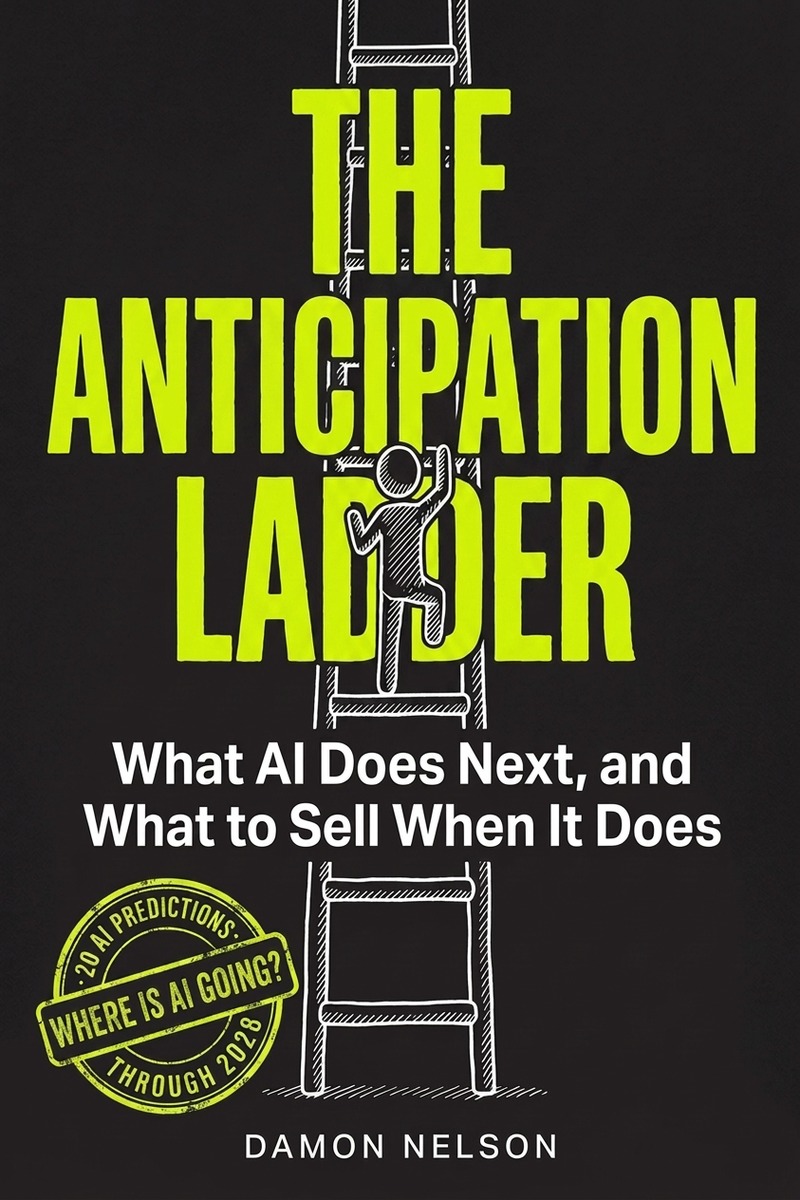
The Anticipation Ladder is built to cost you one evening, maybe two. The introduction and the prediction chapters stand alone. Part Three is nothing but priced, sequenced offer frameworks sized for a business of one: audits, agent installs, content retrofits, matched to specific checkpoint dates.
You can go straight to Part Three and have a working offer framework before you've read the whole book. The predictions come with a public scorecard. Every checkpoint has a date. If the map fails, you'll know exactly when and why, because I'll be the one posting the grade.
'The people who lose over the next eighteen months won't lose to AI. They'll lose to somebody who read the map earlier.' That's not a slogan. It's the thesis. The link below is where the book lives.
See It on AmazonQuestions people actually ask
By the time I read this, won't the predictions already be out of date?
Every prediction in the book carries a specific checkpoint date, March 2027 or March 2028, and a public scorecard that gets graded live. A dated map you can plan against is the opposite of the vague 'AI will change everything someday' content that goes stale overnight. The dates are not a risk. They're the whole point.
I've bought AI books before and they're all ideas with no real playbook. Is this the same?
Part Three is offer frameworks: audits, agent installs, content retrofits, scoped and priced for a business of one. The test the book sets for itself is whether you can build a priced offer before the first checkpoint date. If you can't, the public scorecard will show you exactly where the map fell short.
I'm not technical. Can I actually sell AI services from this?
The book's central argument is that the technical edge is gone. Every shop has the same engine for roughly the price of lunch. The scarce skill is knowing which client problem to point it at. That is a marketing and positioning skill. The playbook chapters are built around that, not around building software.
My clients aren't asking for AI yet. Is there even a market here for me?
This is the one objection the book concedes in part. If your market is genuinely pre-awareness, some offers won't land yet. The honest answer is that the ladder helps you lead with the outcome the client already wants — a phone answered, a support ticket closed, a morning brief ready — and let the AI stay invisible. The book says that's how the winning products already work.
Do I need to read the whole thing, or can I skip to the useful parts?
The introduction is explicit about this: it costs an evening or two. The predictions are built to be dog-eared. You can go straight to Part Three and have a priced offer framework before you've finished the rest. The ask is one evening, not a semester.
Will this still matter in six months, or is it going to feel dated fast?
The framework chapters — the ladder itself, the leveling argument, the one-to-one shift — are structural observations, not feature announcements. The predictions have checkpoint dates precisely so you can tell the difference between the ideas that age and the ones that don't. That separation is deliberate.