The Map He Built When He Got Tired of Guessing Which AI Headlines Actually Mattered
About two years ago, Damon opened a new AI tool for the first time. It said: 'Hey Damon, what can we start with today?'
Software had treated him like a stranger for forty years. This one knew his name, remembered where they'd left off, and asked if he wanted to give it a sample of his writing style. He sat there for a second. Not amazed, exactly. More like: quietly recalibrating. Because if the handshake changed, everything downstream from it probably changed too.
The question wasn't whether AI was different now. It obviously was. The question was: different how, and different in which order, and what does a one-person shop actually do about it before the wave breaks?
That question is what drove Damon to write The Anticipation Ladder: What AI Does Next, and What to Sell When It Does.
Not another tool roundup. Not a hype cycle with a twelve-dollar word count. A dated map — twenty specific predictions, each carrying a checkpoint date of March 2027 or March 2028 — plus a public scorecard where Damon grades himself. His words on that scorecard: 'Forecasters who won't be graded are just entertainers.'
The book is built around a single framework called the Anticipation Ladder. Four rungs: Reactive, Suggestive, Anticipatory, Delegated. Every AI product on earth sits on one of them. Every client business sits on one of them. And 'the rung a business sits on is a number you can charge money to change.' That's the whole business model, right there in a sentence.

The Arms Race Already Ended. You Just Didn't Get the Memo.
Chapter 1 makes a point that should genuinely relax you: the engine is a tie. The eight-dollar model handles most of what most people need. Open-weight models keep pushing the floor toward zero. 'Intelligence became a utility bill. Nobody sends a press release when something becomes a utility bill. It just quietly stops being the interesting part.' The edge now belongs to whoever knows which specific bottleneck, which annoying Tuesday-morning fumble, to point the tools at. That is a marketing skill. It's probably the skill you already have.
The differentiator is not the engine. It's knowing where to install it.

Two Reputation Markets Exist Right Now. You Can Only See One of Them.
There's the reputation market where AI quotes you to humans, and there's the one where AI recommends you to other AIs. 'Being number one on Google does not guarantee you a place in the AI answers.' The two lists overlap less than 20% of the time. Chapter 6 maps both markets and explains what structured, useful content looks like to a machine buyer — and why the operators who build it now are locking in positions that will compound for years.
There are now two reputation markets: one where AI quotes you to humans, and one where AI recommends you to other AIs. You can only see the first one.
Nobody Ever Wanted the Training. They Wanted the Thing It Produces.
Rung four on the Anticipation Ladder is Delegated: the AI doesn't teach you, it just handles it. Chapter 7 argues that a trustworthy do-it-for-me button gets pressed by almost everyone, almost every time, because the training was never the goal. The thing the training produces was the goal. Support agents, phone agents, morning briefs that arrived before you asked — these are priced services, not future speculation. Part Three of the book gives you the scope and the number to charge.
Nobody ever wanted the training. They wanted the thing that the training produces.
The Hardware Gold Rush Needs Translators, Not Engineers.
Chapter 9 describes thousands of funded physical-product companies that built for the anticipated world and have spec-sheet websites with no human story and no machine path. Engineering brilliance plus marketing starvation equals a buyer who doesn't negotiate hard. The marketer who can write the story and build the second front door for machine buyers is the translator this market is paying for. 'The people who lose over the next eighteen months won't lose to AI. They'll lose to somebody who read the map earlier.'

Your Voice Is the One Ingredient They Cannot Manufacture.
The machines learned from human content. Now the internet fills with machine content — copies of copies, each one a little blurrier. Fresh, dated, first-person experience is the scarce raw material AI companies need and cannot make. 'When intelligence is a commodity, the only scarce inputs left are the ones that were always scarce: your voice, your opinions, your relationships.' AI writes the skeleton. You supply the heartbeat. That sentence is from Chapter 2, and it's the whole content strategy.
AI writes the skeleton. You supply the heartbeat.
What readers are saying
"The whole 'intelligence became a utility bill' idea reframes everything. Once the engines are equal, the only things left that matter are your voice, your judgment, and your relationships. That feels true."
— Claire E."Best part is you can feel the lived experience on every page. He wrote it the same way he teaches — skeleton and heartbeat. Doesn't sound like a book that was manufactured. Highly recommend if you're actually trying to make money with this stuff."
— Megan O."Being number one on Google does not guarantee you a place in the AI answers. That under-20% overlap number should scare every SEO still living in 2019. Prediction 6 is already true for a lot of my clients."
— Samantha K.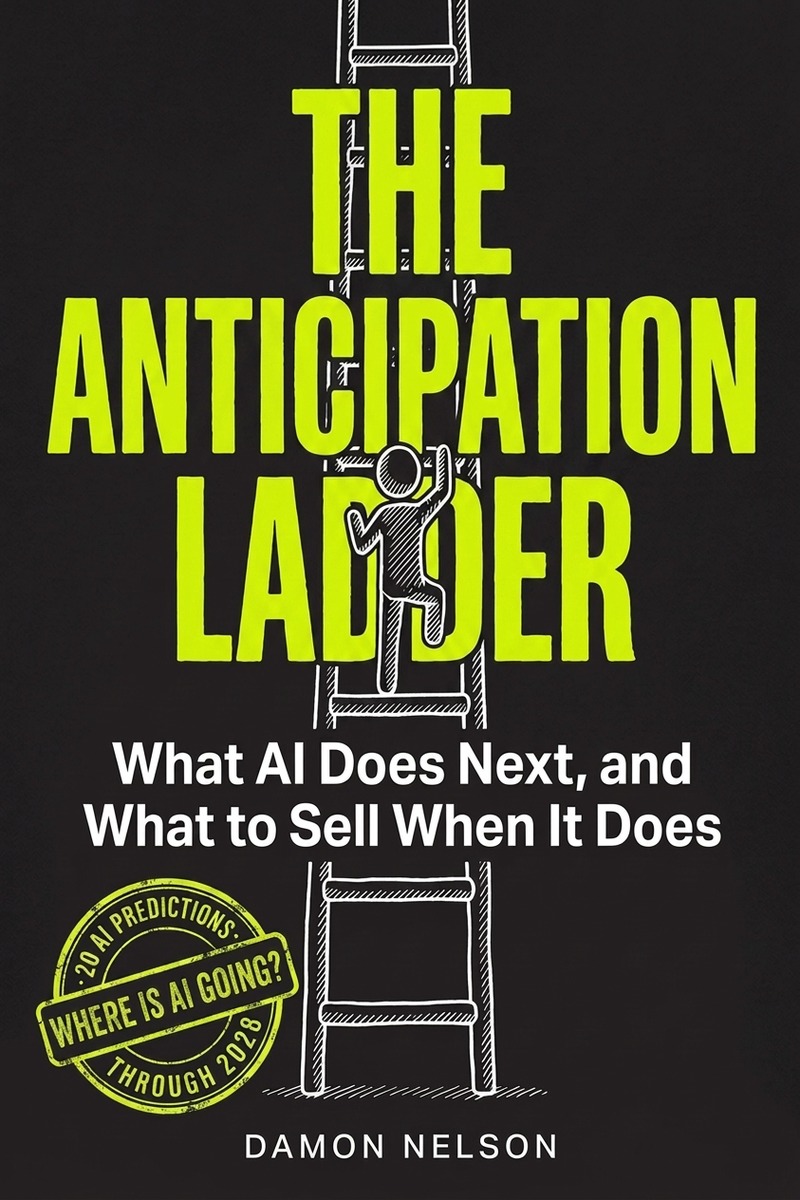
The Anticipation Ladder is built for an evening, not a semester. The introduction is explicit about that. The predictions stand alone and are made to be dog-eared. You can go straight to Part Three and have a priced offer framework — audits, agent installs, content retrofits, machine-path builds — before you've read the whole thing.
What you walk away with: a four-rung framework that sorts any AI headline in about one second, a dated map of the next eighteen months with specific checkpoint dates you can plan against, and a sequenced set of offers you can be selling before the first checkpoint arrives. Plus a live scorecard where Damon grades every prediction in public.
If you've been following the work and waiting for the one that's worth your time, this is it. Check it out on Amazon.
See It on AmazonQuestions people actually ask
By the time I read this, won't the predictions already be outdated?
Every prediction in the book carries a specific checkpoint date — March 2027 or March 2028 — and a public scorecard Damon grades himself against. That's the point. A dated map you can plan against is the opposite of the vague 'AI will change everything someday' content that goes stale the morning after you read it. The dates are the accountability mechanism, not decoration.
I've bought AI books before. They're usually hype with no real playbook.
That's a fair burn. Part Three is nothing but priced, sequenced offers sized for a business of one — audits, agent installs, content retrofits, machine-path builds — matched to specific predictions. The test is simple: can you open it and build an offer before the first checkpoint date? If you can't, the public scorecard means you'll know exactly when the map failed.
I'm not technical. Can I actually sell any of this?
The book's core argument is that the technical edge is already gone. Every shop has the same engine for about eight dollars a month. The scarce skill is knowing which client, which bottleneck, which specific Tuesday-morning fumble to point it at. That's a marketing skill. It's what the playbook chapters teach, and it's probably closer to what you already do than you think.
My clients aren't asking for AI yet. Is there even a market here for me?
Honest answer: if your specific market is genuinely pre-awareness, some offers in Part Three won't land yet. The book helps you identify which rung your clients are actually on, so you can lead with the outcome they already want — a phone answered, a support ticket closed, a morning brief ready — and let the AI stay invisible. Which, the book argues, is exactly how the winning products already work.
I don't have time for another business book right now.
The introduction is explicit: one evening or two, not a semester. The predictions are built to be read out of order. Part Three stands alone. The ask is one focused evening to get a priced offer framework in your hands before the first checkpoint date. That's a reasonable trade.
Will this be obsolete in six months like every other AI resource I've bought?
Tools built on a specific model's capability gap can go stale fast — the book says that directly. This one is built on a framework for reading the direction of travel, not a tutorial on any one tool. The Anticipation Ladder works on the AI that exists today and the AI that exists in eighteen months, because the four rungs describe a direction, not a product.