Software talked at him for forty years. Then one morning it called him by name.
He opened the tab like he had a hundred times before. A new AI tool, a free trial, the usual blank cursor. Except this time a line came back before he typed anything. Hey Damon, what can we start with today?
He sat with that for a second. Not because it was magic. Because he realised, in the same breath, that software had been treating him like a stranger his entire adult life. Every app. Every platform. Every tool upgrade. All of them behaved exactly the same way for him as for anyone else who happened to click the same button.
That morning something changed. Not in the tool. In how clearly he could see what was actually coming next, and what a person who understood the pattern could do about it before anyone else caught up.
That moment ended up being the seed for The Anticipation Ladder: What AI Does Next, and What to Sell When It Does. It is a short, dense read built around one framework and twenty dated predictions, each one graded publicly on a live scorecard the author updates himself.
The framework is a four-rung ladder: Reactive, Suggestive, Anticipatory, Delegated. Every AI product on earth sits on one of those rungs right now. The book shows exactly where each rung is heading and how the gap between where a business sits today and where consumer expectations are landing becomes, in plain terms, a list of services you can price and start selling.
This is not a tool tutorial. There is no chapter about which AI writing app won this quarter. The whole argument is that the tool race ended in a tie and the edge moved somewhere most people are not looking yet.

The arms race ended. Most people missed the announcement.
Chapter one makes a blunt case: AI capability has leveled across every price tier. The eight-dollar model handles most of what most businesses need. Intelligence became a utility bill. When something becomes a utility bill, the press releases stop and the differentiator moves. The book's argument is that it moved to knowing which specific business, which specific bottleneck, to point the engine at. That is a marketing skill, not an engineering one.
The differentiator is not the engine. It's knowing where to install it.

Software stopped treating everyone the same. That changes what you can sell.
For forty years, every software product was a photocopy. It behaved identically for every person who opened it. The book's second chapter traces how that era is ending: AI-powered software now remembers your voice, your habits, your history. It behaves differently for every person who uses it. The inputs it cannot copy are the ones that were always scarce: your voice, your opinions, your relationships. Those assets finally compound, instead of getting obsoleted every March.
AI writes the skeleton. You supply the heartbeat.
A technology hasn't won until it vanishes from the label.
One of the book's sharpest observations is about invisibility. The biggest AI trade show in history ran in early 2026, and the companies that cleaned up barely said the word AI. The winning products had absorbed the capability so completely it disappeared into the outcome. Every invisible layer still runs on structured inputs someone must supply. The book calls that work the loading dock, and it names the pricing for the people who show up there.
Two reputation markets exist now. Most small operators only know about one.
There is the market where AI quotes you to humans — citations, summaries, answers. And there is a second, less visible market where AI recommends you to other AIs, agent to agent, before a human ever enters the conversation. The book argues these two boards overlap less than twenty percent of the time. Knowing both exist is step one. Building for both is a specific, recurring, payable service the book walks through.
There are now two reputation markets: one where AI quotes you to humans, and one where AI recommends you to other AIs. You can only see the first one.

The same moment that created 'the computer guy' is happening again.
In 1998 a new trade appeared. Nobody called it a profession yet, but someone had to show up, install the thing, explain it, and come back next month. The book maps how that moment is repeating: phone agents, support agents, workflow documentation, and a set of retrofit services that bundle into a recognized local profession. The same skills sell up-market to funded hardware companies at ten times the invoice. Trust is the expensive part. The installer already owns some.
That gap, between where the world's software sits and where the world's expectations are about to be, is not a tragedy. It's a price list.
What readers are saying
"Prediction 18 is the opportunity almost nobody is talking about. All these smart hardware companies with brilliant products and terrible marketing. The ones who can fix both the story and the machine path are going to print money."
— Paul W."Finished it last night. What I respect most is that he signed his name to the dates and said the grades will go up live. That kind of accountability is rare."
— Lisa B."Just finished it over the weekend. Straight talk, useful frameworks, and he actually puts dates on the predictions. Recommend."
— David L.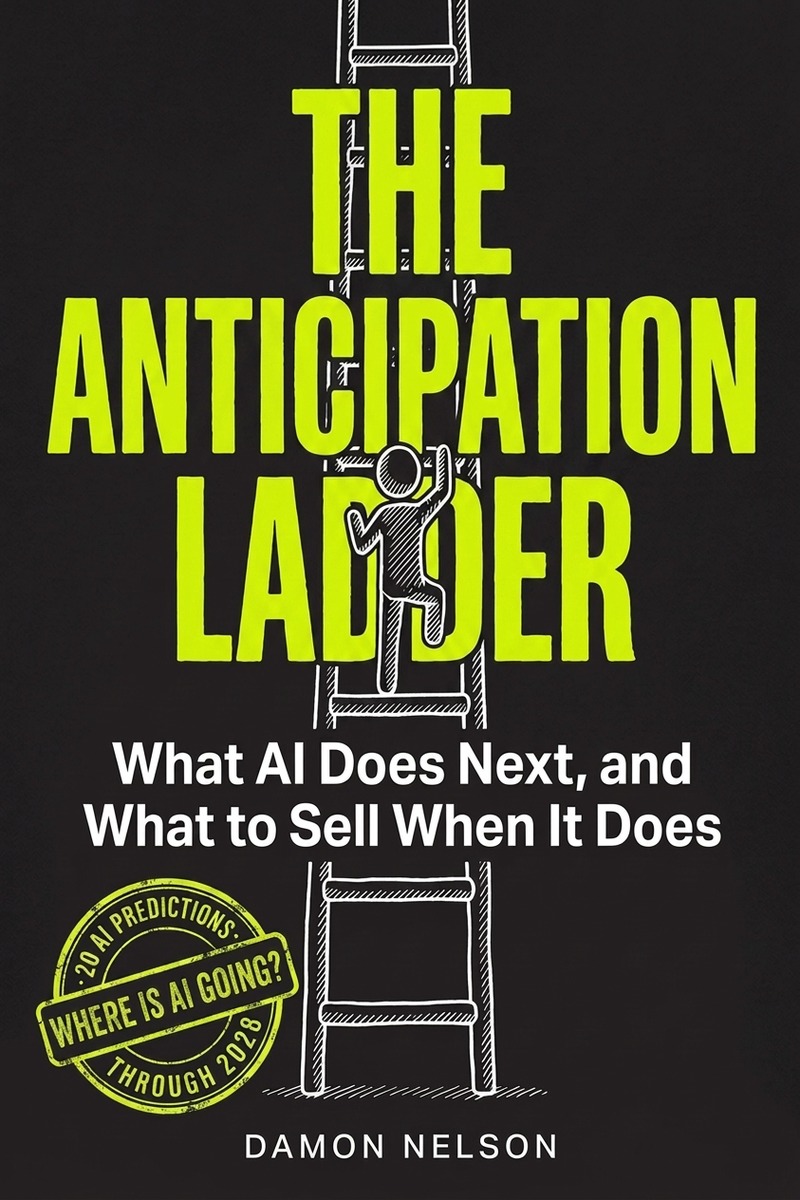
The Anticipation Ladder is built to cost you one evening. The introduction and the framework chapters stand alone. Part Three is nothing but priced, sequenced offers sized for a business of one: audits, agent installs, content retrofits, matched to specific predictions with specific checkpoint dates.
Twenty predictions. Two checkpoint dates. A public scorecard the author grades live. If the map is wrong, you will know exactly when it failed and why. That accountability is the one thing most AI content will never offer you.
If you wanted to get ahead of this instead of catching up again, the page below is where to start.
See It on AmazonQuestions people actually ask
By the time I read this, won't the predictions already be outdated?
Every prediction in the book carries a specific checkpoint date, March 2027 or March 2028, and the author grades each one publicly on a live scorecard. A dated map you can plan against is the opposite of the vague 'AI will change everything someday' content that goes stale the morning after you read it. The dates are the entire point.
I've bought AI books before and they're all hype. Is this just another one?
Part Three is the honest test. It contains nothing but priced, sequenced offers sized for a solo operator or small agency: audits, agent installs, content retrofits, each matched to a specific prediction. If you can open it and build an offer before the first checkpoint date arrives, it earned its read. If you can't, the scorecard tells you exactly when the map failed.
I'm not technical. Can I actually sell AI services without being a developer?
The book's core argument is that the technical edge is gone. Every shop has the same engine for eight dollars. The scarce skill is knowing which client, which bottleneck, which Tuesday-morning fumble to point it at. That is a marketing skill. The playbook chapters teach that skill, not engineering.
My clients aren't asking for AI yet. Is there even a market for this?
This is the one objection the book concedes in part. If your market is genuinely pre-awareness, some offers in Part Three won't land yet. The honest answer is that the framework helps you identify which rung your clients are already on, so you lead with the outcome they want — a phone answered, a ticket closed, a brief ready — and let the AI stay invisible. That is exactly how the book says winning products already work.
Do I have to read the whole thing, or can I go straight to the practical parts?
The introduction is explicit: this costs an evening or two. The predictions are built to be dog-eared and stand alone. You can go straight to Part Three and have a priced offer framework before you have finished the rest. The ask is one evening, not a semester.
The author is making predictions. What happens when he's wrong?
He publishes a public scorecard and grades every prediction himself on the checkpoint dates. His words on this: 'Forecasters who won't be graded are just entertainers. Hold me to the difference.' A wrong prediction, graded honestly, is still more useful than a vague trend piece that can never be proven wrong.